



Warehouse stock management is a fundamental aspect of the traditional production cycle. While a shortage of stock causes production freezes and delays in order fulfillment, damaging reputation and customer trust, an excessive inventory of materials or finished products leads to unnecessary costs and the risk of obsolescence.
More efficient and conscious stock management not only improves business performance but also contributes to promoting more sustainable consumption and production models in line with goals 12 and 13 of the UN 2030 Agenda. Adopting efficient stock management means finding the right balance and being able to minimize the costs of holding stock in the warehouse while guaranteeing optimal inventory to satisfy production needs or, for a distribution center, to fulfill customer orders in a timely manner. Stock management is therefore a decisive element for the success and sustainability of companies in a competitive and changing market.
But how do you optimize warehouse and stock management? We have described in this article some methods and models that could help you find the right solution. But first, let us start with the first fundamental steps: what stocks are and how they are classified.
What is Warehouse Stock?
Before analyzing some of the stock management methods, it is necessary to pause briefly on the definition of the concept of “stock” itself. Warehouse stocks are a quantity of items accumulated within the company to be made available to users according to specific needs and timelines. In other words, stocks are all the materials present in the warehouse, including raw materials, semi finished products, components, or finished products, waiting to be processed, assembled, used, or distributed respectively.
These storages are essential to ensure the availability of materials, reduce the time between order and delivery, and minimize the risk of stockouts by adapting to changes in demand. For these very reasons, warehouse stock management is an integral part of controlling the flow of materials within the logistical and production process. Its goal, as anticipated, is to minimize storage costs while maintaining an adequate supply of production and sales flows.

Warehouse Stock: classify it well to manage it perfectly
To optimize warehouse stock management, you cannot go by eye, nor can you improvise. A deep and refined knowledge of how storage works is required and, as a natural consequence, how these warehouse stocks are classified. We can identify different types of stock based on various factors such as: availability, life cycle, value or rotation, usage, seasonality, and the stock level itself. Let us look at all these classifications in more detail.
1. Stocks by availability in the warehouse
- allocated stocks: items already assigned to specific orders and still present in the warehouse;
- available stocks: items ready for production or shipping, not yet assigned;
- stocks in transit: items ordered and in the transport phase towards the warehouse;
- incoming stocks: products ordered but not yet delivered;
- stocks to be ordered: products whose availability is about to fall below the minimum level and must be reordered;
- under-stock items: quantity lower than the minimum expected, but not yet ordered;
- out-of-stock items: zero availability;
- regular stocks: stable availability in line with ordinary demand.
2. Stocks by life cycle
- perishable stocks: subject to rapid deterioration, they must be used within a certain date (e.g., fresh food, cosmetics, pharmaceuticals);
- non perishable stocks: not subject to deterioration, they can be stored for a long time (e.g., metal components, furniture, spare parts);
- stocks with expiration: even if not strictly perishable, they have a date beyond which they are no longer marketable (e.g., biscuits or preserves packaged with a Best Before Date);
- obsolete stocks: products surpassed by new models or technologies (e.g., old versions of electronic components no longer requested);
- inactive stocks: not moved for a long time, not because they are technically outdated, but simply because they have no sales prospects (e.g., out of season Christmas decorations).
3. Stocks by value / rotation
- fast moving stocks (low value): goods with a high frequency of sales (e.g., stationery, small accessories for daily use);
- slow moving stocks (high value): expensive items that stay longer in the warehouse (e.g., machinery, technical niche instrumentation).
4. Stocks by usage
- functional stocks: fundamental to ensuring continuity in the production cycle and avoiding downtime (e.g., raw material necessary for a continuous production line);
- safety stocks: extra stock to face unforeseen events, variations in demand, or supply delays (e.g., additional stock of screws in a factory to cover supplier delays);
- cycle stocks: planned surplus to cover demand during the time necessary for reordering (e.g., ordering a larger lot to reduce unit costs or avoid shortages during the lead time);
- speculative stocks: purchased in anticipation of price increases or increased demand (e.g., stocking up on paper before a predicted increase in the price of cellulose);
- alert stocks: threshold that signals the need to proceed with a new order without exhausting the stock (e.g., WMS software can set an automatic alert when the minimum level is approached).
5. Stocks by Seasonality
- regular stocks: constant demand throughout the year (e.g., water bottles or office paper);
- seasonal stocks: demand concentrated in specific periods (e.g., Panettoni at Christmas, sunscreens in summer).
6. Stocks by Stock Level
- total stocks: sum of all items present in the warehouse;
- net stocks: total stocks minus those already committed for orders not yet fulfilled;
- available stocks: net stocks plus those in transit from suppliers;
- minimum stocks: minimum level to avoid operational interruptions;
- maximum stocks: maximum level that can be held without generating excessive costs;
- optimal stocks: ideal level between minimum and maximum, calculated based on demand, delivery times, and company strategies.
Understanding all types of stock based on the most relevant factors for your specific industry (e.g., perishability for a food company; seasonality for a cosmetics company) is the fundamental first step to clearly defining the warehouse stock management model.

Models and methods of Warehouse Stock Management
Considering the importance of warehouse stock management, it is not surprising that inventory management has given rise to various management models that companies can use according to their needs. Among these models we mention:
-
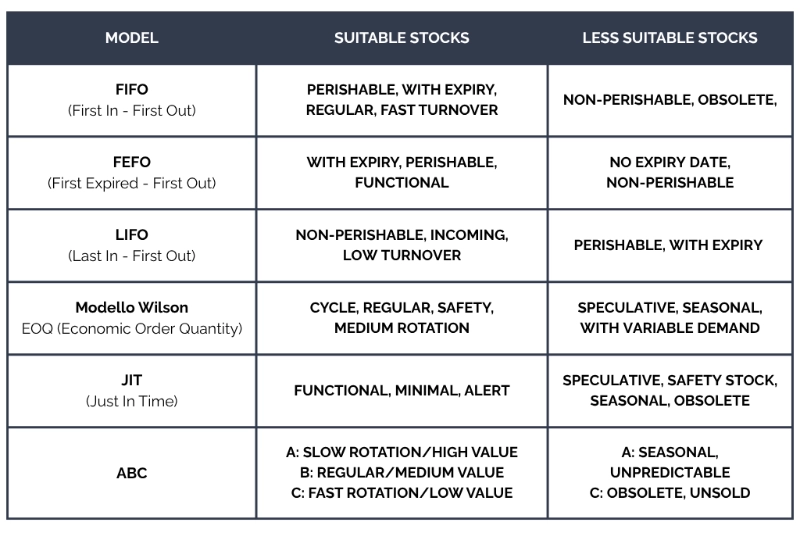
FIFO Method, First In-First Out: products are sold following the chronological order of entry into the warehouse. This model is ideal for managing perishable or expiring items, such as medicines and food products, to avoid deterioration or obsolescence. Thanks to FIFO, it becomes simple to evaluate warehouse inventory since the value of the stock corresponds to the price of the last batch purchased multiplied by the total stock.
-
FEFO Method, First Expired-First Out: unlike the FIFO method, which is based on the date of entry into the warehouse, FEFO manages stock based on the actual expiration date of the products. Products with the nearest expiration are used or sold first, regardless of when they were received. It is the ideal method for managing packaged food, drugs, cosmetics, or any item subject to a Best Before Date (BBD) or Expiration Date (ED). FEFO reduces the risk of having to dispose of expired products and ensures compliance with hygiene and health regulations.
-
LIFO Method, Last In-First Out: products that entered the warehouse most recently are the first to be sold. The advantage of this method lies in the possibility of being able to place newly arrived goods in an easily accessible position, thus avoiding having to move pre existing goods. LIFO is ideal for managing bulk storage of goods for long periods but is obviously not suitable for the storage of perishable products. It is a method rarely used in Europe (for accounting reasons) and more common in fiscal contexts such as the USA.
-
Wilson Model: also known as “economic lot” or “EOQ method” (from Economic Order Quantity), it identifies the optimal quantity of stock to order to minimize order and storage costs (EOQ = √[(2 × Annual Demand × Order Cost) / Carrying Cost]). Suitable when demand is stable, this method allows calculating the number of units to request with each order, but it has significant limitations when demand varies because it is dictated, for example, by seasonal logic. Chosen by many SMEs with regulated orders, the Wilson model requires a constant quantity of orders purchased and regular intervals between orders to maintain stock in the warehouse. Therefore, it manages well: cycle stocks, regular stocks, and partly safety stocks. It should be specified, however, for completeness, that dynamic variants of this model also exist (probabilistic EOQ) to manage fluctuations.
-
Just in Time Model: born in Japanese Toyota plants, it aims to reduce waste and renew items based on demand, producing only what the customer requests. By eliminating unnecessary stock, this method allows for reduced storage costs and the risk of product obsolescence, optimizing the production process. To be truly effective and offer all its advantages, it requires perfect synchronization between production and distribution along the supply chain. In summary: it is ideal for minimizing total stocks, eliminating speculative stocks, and optimizing functional stocks. It requires precise control of minimum stocks. Another small note: JIT is effective but risky in contexts with fragile supply chains (e.g., pandemics, geopolitical crises). Specific additional buffers are needed for uncertainty scenarios.
-
ABC Method: this model classifies stocks into three categories (specifically A, B, and C) based on their economic value and frequency of use. Class A includes the most expensive or critical items, which represent a small percentage of the total but strongly affect the overall value of the warehouse and require more monitoring (such as high end perfumes, life saving drugs, engines or transmissions). Class B includes products of intermediate value with regular rotation that require periodic reordering (such as packaging boxes, mid range cosmetics, mechanical parts). Class C, finally, is associated with low value products with high availability, which can be managed with more flexibility (such as stationery, bolts, sugar packets, latex gloves).
If you want to delve deeper into the topic, discover “How to choose between FIFO, FEFO, and LIFO.” Beyond the classic warehouse stock management methods, others exist that are less widespread but still effective in certain contexts, which can manage specific demand and Supply Chain situations. Among these we mention: the VMI method (Vendor Managed Inventory), in which the supplier directly manages stock at the customer’s site (ideal for functional and safety stocks in highly integrated B2B contexts, e.g., a beverage supplier directly managing stocks in a supermarket); the Kanban method, which regulates reordering based on actual consumption (perfect for cycle and functional stocks in lean environments); and finally, the DRP method (Distribution Requirements Planning), used to plan stock in distributed warehouses (suitable for regular, seasonal, and safety stocks). The choice of the right model depends on the combination of stock type, company strategy, and demand characteristics.
Warehouse Stocks: less is more
Among the models discussed above, the Just In Time model is based on a simple concept adapted from the core principles of lean manufacturing: the absence of waste and, specifically, of accumulation. It is natural that to minimize storage costs, only the stocks actually needed for scheduled production should be in the warehouse. The principle is therefore simple to understand but much more complicated to put into practice because, as is known, it involves optimizing not only internal processes but the entire supply chain.
Logistics and Stock Management, a difficult balance
As we have seen, warehouse stock management is nothing more than the search, unfortunately not simple, for a perfect balance. To counterbalance the availability of raw materials to avoid stopping production or order fulfillment, there is the concrete risk of overstocking, thus producing inefficiencies related mainly to the immobilization of capital.
For this reason, warehouse stock management cannot be the result of the sensitivity and experience of the people working in the warehouse, but must be entrusted to software capable of processing an infinite number of data in real time. In other words, at the center of warehouse stock management, there must be a WMS software, supported by automatic identification technologies, capable of governing the warehouse in all its multiple aspects.
The WMS, or Warehouse Management System, is responsible for solving a formula that is both simple and complex:
Availability = Stocks – Demands + Coverage.
Availability is equal to inventory, minus demands, plus coverage.
The role of the WMS in Warehouse Stock Management
What exactly is the role of the Warehouse Management System (WMS) and, above all, why is it so important in inventory management processes?
The first aspect to emphasize is that stock management is only one of the activities for which the WMS takes responsibility. This system, in fact, covers the management of all warehouse logistics operations, from goods receipt to shipment. Rather than relying on more specific solutions, which perhaps only cover a small part of these activities, it is always better to turn to a comprehensive solution that avoids having to intervene later with ad hoc integration activities.
Every warehouse stock management method requires visibility, preferably in real time, on the quantity, type, and state of goods present in stock. Especially a method like Just in Time, whose distinctive trait is precisely the presence in the warehouse of only the indispensable quantity according to production and orders, requires great precision on the state of inventory. Without knowing the state of stocks with obsessive precision, it would not be possible to achieve the goal of minimizing company costs.
Furthermore, by knowing in real time the quantity of products or materials present in the warehouse, you can prevent stockouts, risks of obsolescence, quickly transfer products from one warehouse to another to meet different production needs and, provided the WMS is integrated with other workflows (such as purchasing, accounting), also optimize all operations related to the supply chain.
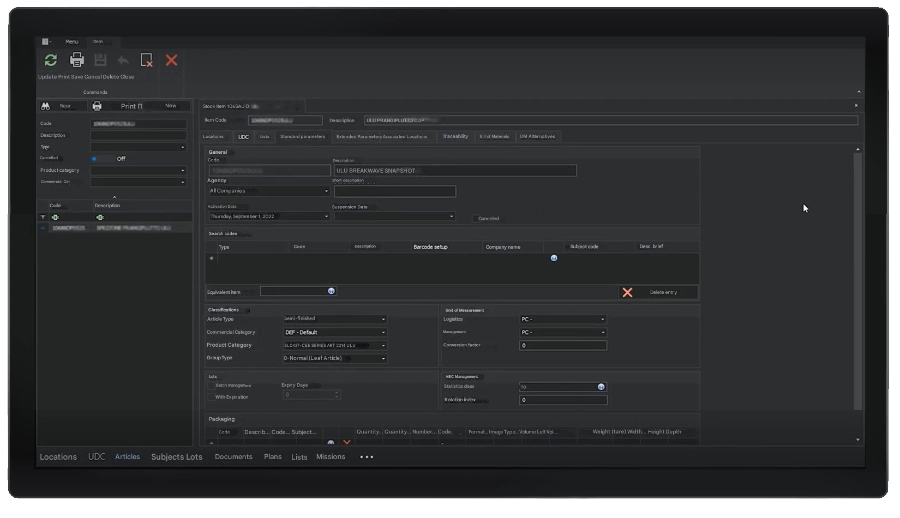
In the context of stock management, the WMS allows you to view the detailed position of goods within the warehouse, calculate rotation indices, upon which the location of goods depends, and manage the state of the stock, including reserve products, those to be replaced, and any defective batches.
The new frontiers of Warehouse Stock Management: digital, predictive, sustainable
Stock management is no longer a static activity confined to the warehouse walls. With the digital transformation of our era, it has become a complex orchestra where advanced technology, artificial intelligence, and sustainability play in unison to ensure efficiency, precision, and resilience. Let us see how innovations are redefining this crucial role.
1. Digital Supply chain and Artificial Intelligence (AI) for predictive logistics
The digital Supply Chain is the beating heart of a modern company, and Artificial Intelligence (AI) amplifies its potential as never imagined until a few years ago. The integration of Machine Learning algorithms in logistics allows for refining demand forecasting and optimizing stock rotation with unprecedented precision. Applications are concrete and immediate: systems capable of providing automatic reordering suggestions based on consumption patterns and market trends, or performing simulations of material shortage scenarios to prepare the company for every eventuality. AI is not just a “plus”, but a “must” for a warehouse that thinks about the future.
In this context, modern APS software (Advanced Planning and Scheduling) also comes into play, advanced planning and scheduling tools capable of coordinating demand, stocks, and production capacity in real time while taking into account logistical and production constraints. Thanks to “what if” simulation functions, the APS allows for predicting the impact of unforeseen events or strategic decisions (such as supplier delays, demand peaks, or lead time variations), helping the company make faster and more informed decisions. These technologies fuel so called predictive logistics, which transforms historical and real time data into actionable forecasts. The benefits are many:
- anticipating stockouts before they become emergencies;
- optimizing replenishment with minimal but always sufficient stocks;
- calculating dynamic buffers, continuously adapting safety stocks.
The result? A proactive rather than reactive Supply Chain, capable of adapting to changes before they have an operational impact.
2. IoT and real time traceability
The Internet of Things (IoT) brings an unprecedented level of visibility inside the warehouse. RFID tags, Bluetooth beacons, temperature/humidity sensors, smart scales, each of these tools contributes to building a connected and responsive ecosystem in which every element of the warehouse communicates in real time with the WMS and other company information systems. This is also how warehouse stock management stops being a problem and becomes a lever for competitiveness. Thanks to IoT devices, it is possible to:
- monitor the status and position of stocks in real time: knowing exactly where every single item is at every stage, from receipt to shipment;
- automatically update inventory in the WMS: eliminating human errors and ensuring data precision;
- activate automatic alerts: for expiring goods, products that require critical storage conditions, or any anomaly that requires immediate intervention.
This level of traceability not only improves operational efficiency but is fundamental for service quality and regulatory compliance.
3. Stock Management and ESG: efficiency that benefits the environment
Integrating ESG (Environmental, Social, Governance) principles into stock management is not just an ethical choice aimed at reducing environmental impact, but also a strategic and concrete lever to improve operational efficiency. Sustainable stock management contributes to:
- reducing obsolescence and waste: with more accurate forecasts and dynamic reordering policies, excesses that would otherwise end up unsold or need disposal are minimized;
- reducing the ecological footprint of storage: less excess stock means less space occupied, less energy consumption for climate control, handling, and lighting;
- optimizing transport related to stock logistics: strategies such as intelligent multi depot location or sustainable replenishment reduce the need for urgent or partial shipments, directly cutting emissions.
The most attentive companies are already adopting tools that allow them to:
- monitor the carbon footprint associated with inventory and product life cycles;
- valorize stock at risk (unsold or slow movers) through alternative channels (e.g., donation, recycling, secondary markets);
- set ESG KPIs related to stock, such as the percentage of recovered products vs disposed of, sustainable rotation index, or CO₂ impact per SKU.
In this context, the evolution of management software, WMS, ERP, APS, plays a key role: they increasingly integrate environmental dashboards and modules dedicated to ESG analysis, giving visibility to the impact of warehouse decisions also from a green perspective. Managing stocks according to ESG means, in short, making smart choices for the company and the planet, actively contributing to the achievement of the Sustainable Development Goals (SDGs) of the UN 2030 Agenda.
4. Data driven optimization: the role of business intelligence and KPIs for Warehouse Stock Management
Finally, it is necessary to translate all these innovations into tangible results. For this reason, one cannot ignore the data driven approach and the power of Business Intelligence (BI). The WMS, in particular, is an exceptional source of data: it knows every detail about incoming goods, their location, rotation, and much more. A robust Business Intelligence system can transform this mass of information into a comprehensive picture. It provides company managers not only with invaluable insights to evaluate the efficiency of internal logistics but also a complete vision (thanks to integration with other platforms) to identify strengths and weaknesses.
To monitor the effectiveness of your stock strategies, it is essential to rely on updated and significant KPIs (Key Performance Indicators). To do this, a modern BI system allows you to:
- identify slow moving or near obsolete SKUs (Stock Keeping Units);
- compare stock levels with lead times and demand trends;
- support reordering, reallocation, or promotion decisions on a quantitative basis;
- simulate scenarios of excess or shortage of stock over different time horizons.
The true strength of this approach lies in its ability to translate data into actionable decisions, improving Supply Chain agility and warehouse profitability. But what are the main KPIs to monitor stock management efficiency? Among the most important metrics we mention:
- rotation index: measures the frequency of stock renewal, useful for identifying oversized or unused inventory;
- Fill Rate: measures the percentage of orders fulfilled completely and therefore indicates the warehouse’s readiness to satisfy immediate demand;
- OTIF (On Time In Full): also includes punctuality, reflecting effectiveness in ensuring complete and timely deliveries;
- obsolete stock percentage: detects inefficiency in the stock life cycle;
- inventory accuracy: fundamental for maintaining alignment between management data and physical reality, avoiding chain errors in orders and replenishment.
Monitoring these indicators continuously allows not only for evaluating performance but also for activating continuous improvement processes on stock management, preventing inefficiencies and reducing hidden costs.

In summary: steps to optimize stocks
Let us summarize all the fundamental steps to understand if you are truly managing your warehouse stocks in the best way and which levers to activate to improve efficiency:
- Do you have updated control of stocks? Frequently check the quantity, status, and position of items in the warehouse.
- Do you know which products sell the most and which remain still? Analyze what rotates well and what risks remaining unused.
- Do you avoid waste and excess goods? Order only what is truly needed to avoid taking up space and reduce costs.
- Can you satisfy orders at the right time? Check if you can fulfill requests without serious delays.
- Do you have automated systems to keep everything under control? Consider using software (such as a WMS) to simplify and speed up operations and keep an eye on key performance indicators such as: static stocks, sales, replenishment, and delivery punctuality.
- Do you think about sustainability? Avoid useless accumulation, reduce waste, and optimize transport and consumption.
If you already do most of these things, then you probably already have a good warehouse stock management system. If, on the other hand, you still have doubts or do not know where to start, book a first free consultation with our experts: we will help you understand your needs, analyze your processes, and choose the most suitable solutions to unlock the potential of your warehouse.
FAQ
What is stock management?
Stock management is the set of activities to control and optimize the quantity of goods (raw materials, finished products, semi finished products, etc.) present in the warehouse. The goals are: finding a balance between the availability of products (to satisfy demand) and the costs of maintaining the warehouse; avoiding stockouts; avoiding excess inventory.
How to manage warehouse inventory?
Warehouse inventory (or excess stock) can be managed in various ways: optimization of demand forecasting processes, implementation of models such as Just in Time, negotiation with suppliers, promotional sales or on alternative channels (outlets), recycling or donation for products at risk of obsolescence or disposal, and an accurate analysis of data via WMS and Business Intelligence.
What is warehouse stock called?
Warehouse stock can also be called “inventory”, “inventory”, or “stock.” Among the stocks we find: goods (items that do not undergo transformations, purchased and resold by the company); raw materials (materials to be used for production); semi finished products (goods that still need to undergo processing before becoming a finished product); finished products (complete items ready for distribution and sale).
What are the risks of poor stock management?
Inefficient stock management can involve some risks worth mentioning: stockouts (loss of sales and customers); excess inventory (high maintenance costs, obsolescence, immobilization of capital); operational inefficiencies (errors, delays, waste of space and resources); reduction of competitiveness and company profitability in the medium to long term.
What is the carrying cost of warehouse stock?
The carrying cost of stock (or cost of possession) includes all expenses associated with holding goods in the warehouse. It includes: storage costs (rent, utilities, insurance, equipment depreciation, warehouse staff), obsolescence and deterioration costs, administrative costs of inventory management, costs of immobilized capital (the opportunity cost of money tied up in stock). One of the goals of the various stock management strategies seen in this article is precisely to identify all the optimization potential of these costs to increase, in the final instance, company marginality.
What is the difference between WMS and ERP in stock management?
The WMS (Warehouse Management System) is software specialized in optimizing physical and informative operations within the warehouse (receiving goods, storage, picking, inventory, shipping). The WMS works and optimizes on the field. The ERP (Enterprise Resource Planning) is an integrated management system that coordinates business processes at a broader level: finance, human resources, production, and sales. In the context of warehouse stocks, the ERP is limited to managing accounting and administrative data of inventory (such as recorded quantities, economic value, planned orders). In summary: the ERP “records”, the WMS “acts and optimizes.” For truly effective warehouse stock management, an ERP module is not sufficient, a dedicated WMS is needed, capable of guaranteeing visibility, control, and operational traceability in real time.
What is the inventory turnover ratio and why is it important?
The inventory turnover ratio measures how many times the company sells or uses its average stock in a given period. It is important because it indicates the efficiency with which a company manages its inventory: a high index suggests good liquidity and low obsolescence; a low index can indicate excess stock, a slowdown in sales, or obsolete products.
How to calculate the optimal stock level?
To calculate the optimal stock level, you must consider: average demand, lead time (delivery time), and their variability. A fundamental element is safety stock, which serves to protect against unforeseen events. A common formula for calculating it is: Safety Stock = (Maximum Demand × Maximum Lead Time) – (Average Demand × Average Lead Time). However, the overall optimal level also considers carrying costs, ordering costs, and reorder frequency, often determined with models like the EOQ (Wilson Model) or advanced versions that use predictive analysis.
Which sectors benefit most from the FEFO method (and other stock management models)?
Every sector has different needs in terms of stock management related to perishability, value, rotation, and seasonality of products. It is important to choose the most suitable model based on the physical characteristics of the goods and demand patterns. Here is an indicative list:
- FEFO: ideal in sectors where expiration is decisive, such as in Pharmaceuticals & Healthcare, Food & GDO, Cosmetics and Hygiene, Hospitality & Catering.
- FIFO: perfect for reducing obsolescence in sectors with natural rotation, such as in Dry Food, Logistics & Transport, Retail, Packaging.
- LIFO: suitable for non perishable materials and bulk storage, such as in Building Materials, Mechanics & Assembly, Chemicals, Refrigeration.
- Wilson Model (EOQ): works well where demand is regular and plannable, such as in Manufacturing SMEs, Packaging, Furniture and Accessories, Textiles and Fashion, Precision Mechanics.
- Just in Time: useful for avoiding waste and reducing stock, such as in Automotive, Consumer Electronics, Made to Order Production, Fast Fashion Retail.
- ABC Method: cross sectional, used in all sectors to optimize priorities.