



Driven by the growth of e-commerce, modern logistics has changed its face, and transportation efficiency has become crucial. TMS software (Transportation Management System) is an essential tool for all companies that manage shipments, deliveries, or any type of distribution network.
Automating and digitizing shipping flows does not only mean saving time and money, but also providing real-time traceability, on-time deliveries, and impeccable customer service. A competitive advantage that is no longer reserved for large players alone: SMEs are also accelerating the adoption of TMS systems to stay one step ahead of the competition.

In fact, according to forecasts by Mordor Intelligence, the global TMS software market will grow to almost double, from USD 9.71 Billion in 2026 to USD 14.89 billion in 2031, with a compound annual growth rate (CAGR) of 8.93%. Let’s explore what a Transport Management System, or TMS, really is and why it can transform the way your company manages transportation.
TMS software: what it does and how it works

The Transport Management System is a software that enables companies to plan, execute, and monitor all activities related to freight transportation. It offers multiple functions, including:
- Route and load optimization,
- Selection of the most suitable carriers (transport providers),
- Real-time shipment tracking,
- Delivery performance analysis,
- Document management and regulatory compliance.
It is no longer the company that adapts to the software, but the software that adapts to the company. The most advanced TMS software solutions feature a scalable and modular architecture, allowing functional coverage to be tailored to the organization implementing them. Below are some of the most common modules and their functions.
The functions of a transportation management system: all modules
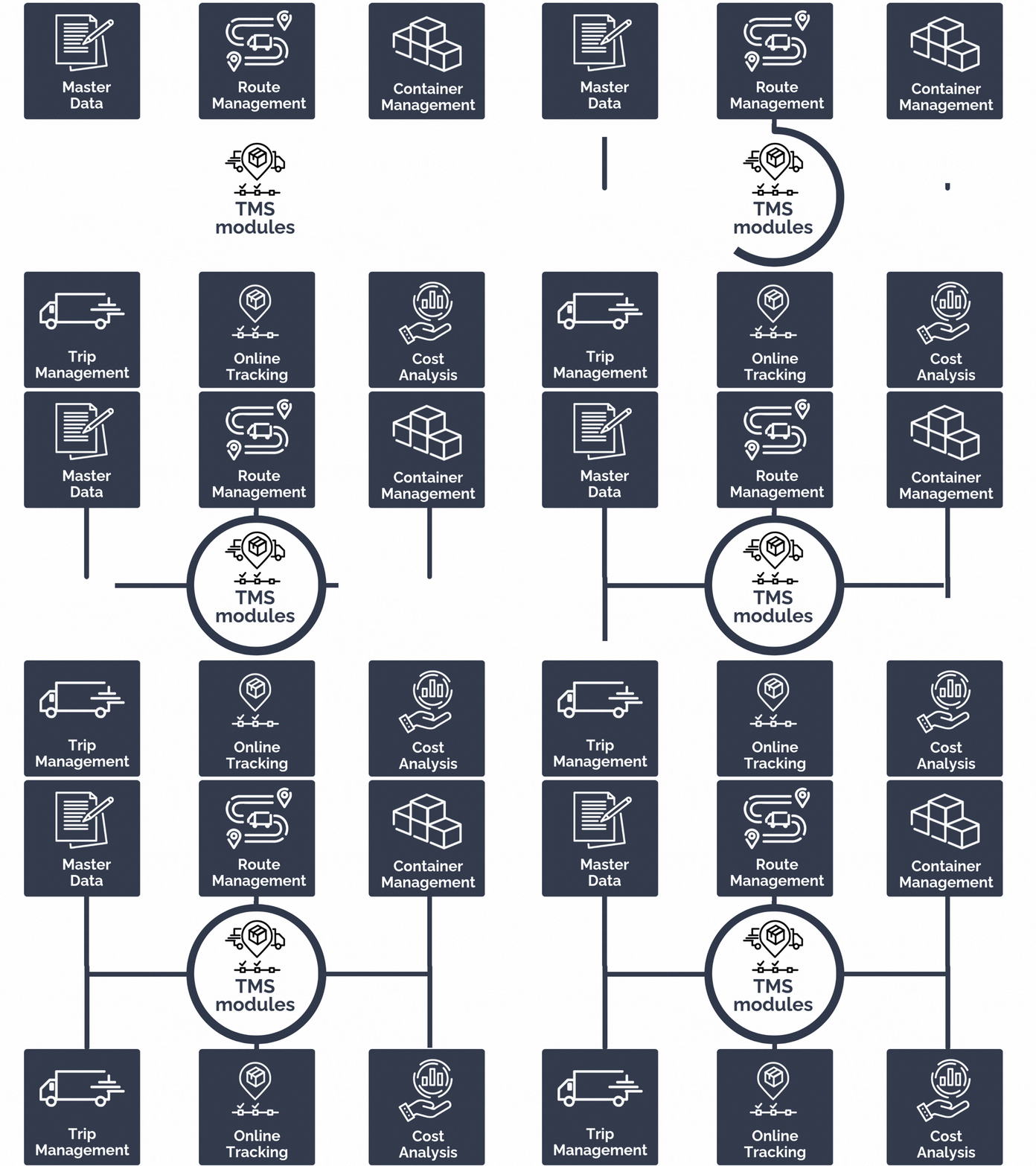
- Master Data Management: complete management of master data essential for operations, such as customers, vehicles, drivers (with payroll integration), subcontracted carriers (tariffs and price lists), suppliers and refueling, ensuring accurate and up-to-date control of resources and business partners.
- Trip Management: registration, monitoring, and planning of orders and customer confirmations with detailed analysis of loading/unloading, timing, costs, and route optimization through advanced mapping, dynamic management of returns, damages, and cash on delivery.
- Container Management: full handling and control of containers with automatic data entry into the trip order and generation of related transport documents, ideal for companies specializing in intermodal and maritime transport.
- Intermodal Management: integrated planning and management of multi-leg shipments (road, sea, rail, air) with dedicated waybill printing, real-time monitoring via automatic emails, and cost management with detailed quotations based on ship, train, and haulage price lists.
- Planners: graphical and weekly trip planning modules, automatic or manual assignment of vehicles, drivers, and carriers with route optimization tools and time-slot management, to maximize operational efficiency.
- Pallet Management: accurate accounting of pallets, trolleys, and containers, with customizable reports, non-conformance management, pickup/disposal vouchers, and precise control of availability by customer and carrier.
- Cost Analysis: automatic and detailed calculation of trip costs (tolls, fuel, maintenance, fines), useful for evaluating the profitability of each individual trip and managing financial relationships with third-party carriers.
- Online tracking: dedicated portal for real-time shipment traceability, also accessible to customers to view transport status and related documents, with automatic updates from apps and satellite devices.
In addition to core functions, a Transportation Management System (TMS) can also include modules integrated with other enterprise information systems (ERP, CRM, …), such as accounting and invoicing management, monitoring of administrative deadlines, and advanced reporting for the analysis of managerial and operational data. Although these features are not part of the prototypical operational core of TMS software, they enable more comprehensive and customized management of business processes.
TMS software and the technologies that enable innovation
A TMS software solution should not be seen only as an optimizer of transportation flows and processes, but also as an opportunity for innovation. Systems designed and developed by the right software provider can become true technological accelerators for companies. The best solutions today integrate advanced tools that transform the way transportation logistics operates.
- Mobile apps for Android and iOS connect drivers directly with the operations center, enabling trip management, refueling reporting, order submission, or maintenance requests, wherever they are.
- Optical document archiving, with automatic scanning and fast search, eliminates paper and simplifies the management of transport documents.
- AI and Machine Learning are revolutionizing the sector: they automate repetitive tasks, optimize costs and deliveries, and anticipate critical issues through increasingly accurate forecasts.
- IoT and smart sensors monitor vehicles and equipment in real time, suggesting maintenance interventions before they become problems.
- Advanced analytics and dynamic dashboards help make faster, more targeted decisions, adapting to changes in demand and operating conditions.
- Chatbots complete the digital ecosystem with a drastic reduction in support costs.
In summary, a modern TMS transportation management system, enhanced by new technologies, delivers automation, visibility, and operational intelligence: everything needed to compete (and win) in the era of digital logistics.
TMS: one software, many benefits
Adopting TMS software for your logistics means achieving:
- Reduced transportation costs: thanks to process automation, comparison of different carrier rates, and optimization of loads and routes. The system streamlines manual activities such as bookings, audits, contracts, and payments, reducing time and errors.
- Greater on-time delivery performance through proactive shipment management and automatic calculation of optimal routing, able to adapt in real time to traffic, unforeseen events, or operational changes.
- Real-time visibility: with continuous monitoring of land, sea, or air flows, up-to-date KPIs, and interactive dashboards for constant control of performance and critical issues. This functionality improves decision-making capabilities.
- Centralized control over all logistics and transportation flows with a single platform that integrates orders, shipments, carriers, documents, costs, and performance, improving coordination among the different supply chain stakeholders.
- Improved customer experience: thanks to automatic notifications, online tracking accessible externally, and digitalized management of documents and payments. Moreover, the best rates achieved through TMS optimization are often reflected in benefits for the end customer as well.
- Predictive analytics to anticipate delays, bottlenecks, or abnormal costs, enabling a more strategic approach to logistics management.
Transportation management software: who is it for?
A Transportation Management System (TMS) is useful for:
- 3PL and 4PL companies (including express couriers, groupage operators, last-mile logistics providers).
- Distributors and wholesalers.
- Retailers (including e-commerce and large-scale retail).
- Manufacturing companies (particularly in automotive, food & beverage, chemical, fashion, electronics, … sectors).
- Companies with an in-house fleet managing their own transportation.
Within the organization, it is also a key support tool for:
- Logistics and Supply Chain managers.
- Procurement managers.
- Warehouse managers.
- Customer service and after-sales teams.
SMEs can also gain significant benefits from TMS software, especially if they manage multiple carriers, high delivery volumes, or operate in international markets.
TMS software for the digital transformation
TMS in transportation is no longer a luxury reserved for large enterprises. With the growth of e-commerce and rising customer expectations, it has become a strategic asset even for small and medium-sized businesses. Choosing the right transportation management software means increasing competitiveness, reducing waste, and improving customer satisfaction.
The Transport Management System is now the engine of digital logistics and transportation. If you are looking for a flexible, scalable, and integrable tool to optimize your shipments, discover silwaTMS. Our TMS software is designed to adapt to the needs of dynamic companies, ensuring control, visibility, and cost savings.

Faq
What is transportation logistics management?
It is the set of activities that enable a company to plan, execute, and monitor the transportation of goods efficiently, cost-effectively, and on time. It includes the management of orders, routes, vehicles, carriers, drivers, costs, and documentation.
What are the differences between TMS, ERP, and WMS software?
TMS (Transportation Management System) focuses on transportation and shipment optimization and management, WMS (Warehouse Management System) strictly manages internal warehouse operations (receiving, storage, picking, inventory), while ERP (Enterprise Resource Planning) is the company’s overall management system, integrating accounting, sales, procurement, HR, production, and more. These three systems are complementary, and in modern companies they should be integrated with each other to ensure uninterrupted information flow across the entire supply chain.
Multimodal and intermodal transport: are they the same?
Both involve the use of multiple modes of transport (road, rail, sea, air) for a single shipment, but they differ in how they are organized:
- Multimodal transport: the shipment is managed by a single operator (transport company) under a single contract. This operator assumes responsibility for the entire transport, even if the means of transport change along the route.
- Intermodal transport: the goods travel in a single load unit (such as a container), but each leg may be handled by different companies or operators, each with its own contract. This offers greater flexibility but requires more complex coordination.
In summary, multimodal transport simplifies management with a single point of contact, while intermodal transport focuses on logistics efficiency by keeping the load unit unchanged and involving multiple stakeholders.
Less Than Truckload (LTL) or Full Truckload (FTL) transport?
In Less Than Truckload (LTL) transport, the goods do not occupy the entire available space and can be shipped together with loads from other customers, with shared costs. In Full Truckload (FTL) transport, a single load occupies the entire vehicle. It is faster and more direct, and often more cost-effective for high volumes.
What are the main challenges in implementing TMS software?
There are no major issues inherently related to the use and implementation of transportation management software. However, some criticalities may arise if the company is not supported by an adequate software provider. The most common include:
- resistance to change from operators accustomed to manual processes;
- complex integrations with existing ERP or SCM systems;
- low/bad adoption by external partners.
Preventing these issues is relatively straightforward and is linked to the choice of provider: it is preferable to select an experienced Software Factory and System Integrator that takes into account the existing IT structure and required carrier integrations. Even better if the provider includes staff training services within its offering. Contact Stesi to learn more.
How much does a TMS (Transportation Management System) cost?
The cost can vary based on several factors:
- required functional coverage (activated modules) and therefore the level of customization needed;
- number of users and integrations;
- deployment model (cloud vs on-premise).
Another important factor in evaluating the costs associated with transportation management software is ROI. A TMS is a system capable of generating a significant ROI (Return on Investment) that is often visible within the first year. If you are considering purchasing TMS software to manage transportation, book an initial free consultation to understand what your specific organization requires and the initial implementation costs.
