



APS (Advanced Planning & Scheduling) is a software solution designed to optimize production planning, procurement, and distribution. Unlike traditional ERP systems, APS software enables constrained and realistic planning by taking into account all the factors that affect the supply chain: production capacity, available materials, human resources, delivery lead times, and order priorities.
Today, APS software is a strategic tool for manufacturing companies that want to remain competitive in complex and volatile markets, with the confidence of planning based on concrete data and predictive scenarios that anticipate bottlenecks.
APS (Advanced Planning & Scheduling) to plan production, purchasing, and distribution
Advanced planning and scheduling software (APS) is a system that helps ensure alignment between demand and production capacity, optimize inventory, prevent critical issues, and support reactive and proactive management of the entire supply chain.
A well-designed APS, with a flexible and scalable structure, can adapt to multi-plant and multi-warehouse environments, offering advanced simulation, reporting, and management of physical and logical constraints.
Software APS: what it does and key features
An APS (Advanced Planning & Scheduling) should provide a wide range of functionalities to enable decision makers to make informed choices based on realistic forecasts that fully reflect actual available capacities and resources. But which software features allow such a level of control? Let’s look at some of them:
- advanced multi-level planning of bills of materials and production routings;
- “what-if” simulations to evaluate the impact of potential new orders, changes, or emergencies, based on economic and performance indicators;
- dynamic management of production capacity, including plants, workforce, and materials;
- inventory optimization and reduction of holding and procurement costs;
- automatic release of missing orders (purchasing and production);
- multi-plant and multi-warehouse management;
- multidimensional graphical and tabular reports for fast and informed decision-making;
- customizable interface based on user roles and business needs.
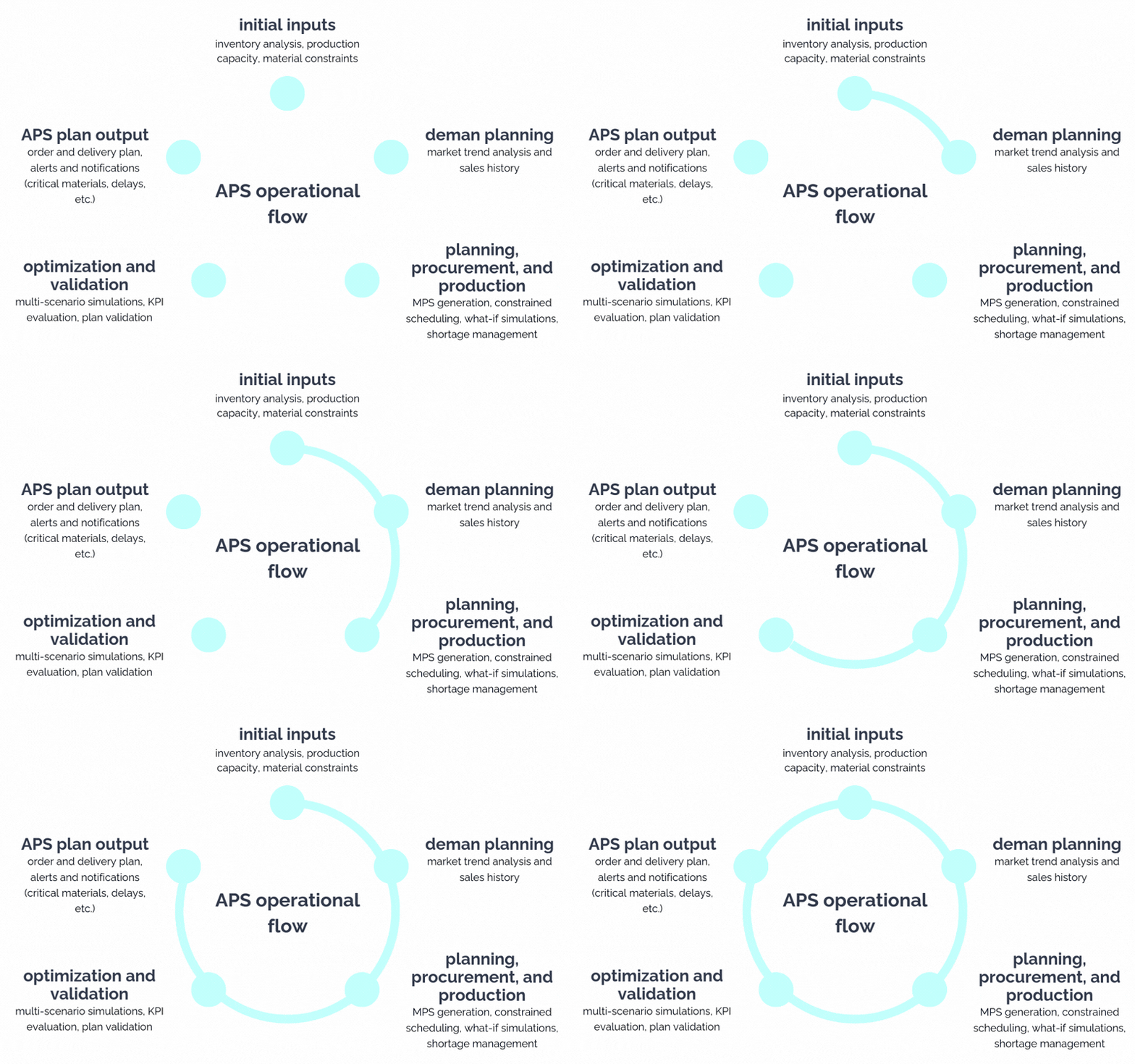
Advanced multi-level planning
APS advanced multi-level planning enables detailed and coordinated management of the different production phases by dynamically planning the Master Production Schedule (MPS). It considers multi-level bills of materials (BOM) and production routings, taking into account materials, lead times, resources, and constrained production capacities. This approach makes it possible to plan not only final production, but also all intermediate stages, optimizing resources and preventing bottlenecks.
“What-if” simulations
Multi-scenario “what-if” simulations allow alternative scenarios to be explored in order to assess the impact of variables or unforeseen changes. For example, what happens if an urgent order must be handled immediately? Or if a supplier delays delivery? APS simulations help predict problems or the consequences of potential changes and resolve them in advance. Thanks also to multidimensional graphical and tabular reports, APS makes it possible to identify the best trade-off between cost and time, simulate the impact of new orders, and simulate future cash flow.
Dynamic management of production capacity
APS software enables dynamic management of production capacity through continuous monitoring of resources (plants, machinery, personnel, and materials) and their optimal allocation. What if demand changes or unexpected events occur? The APS system automatically adjusts the plan, shifting workloads across different resources or adapting production schedules.
Automatic release of missing orders
This APS functionality automates the process of generating missing orders, both for material procurement and for production. If planning detects that a component is insufficient, the APS system automatically creates and sends a purchase order or a production order. This reduces downtime and improves the responsiveness of the entire supply chain. It is one of the features enabled by the integration of APS with the company ERP system.
Multi-plant and multi-warehouse management
The presence of multiple logistics plants has always represented a major challenge, especially when they are geographically dispersed. Yet even in this respect, advanced planning and scheduling software provides intelligent multi-plant and multi-warehouse management. APS is able to optimize planning and distribution across multiple geographically distributed plants and warehouses, taking into account: distances between sites, storage capacity, and priorities.
Who uses APS in a company?
Advanced planning and scheduling software directly involves several corporate roles, each with a key responsibility in operational management. The main ones are:
- supply chain and logistics managers, who monitor flows and constraints in real time;
- planners and production managers, who optimize routings and workloads;
- buyers and purchasing departments, who receive accurate inputs on requirements and lead times;
- top management and CFOs, interested in predictive scenarios for budgets, investments, and margins;
- IT managers, involved in the system integration and maintenance phase.
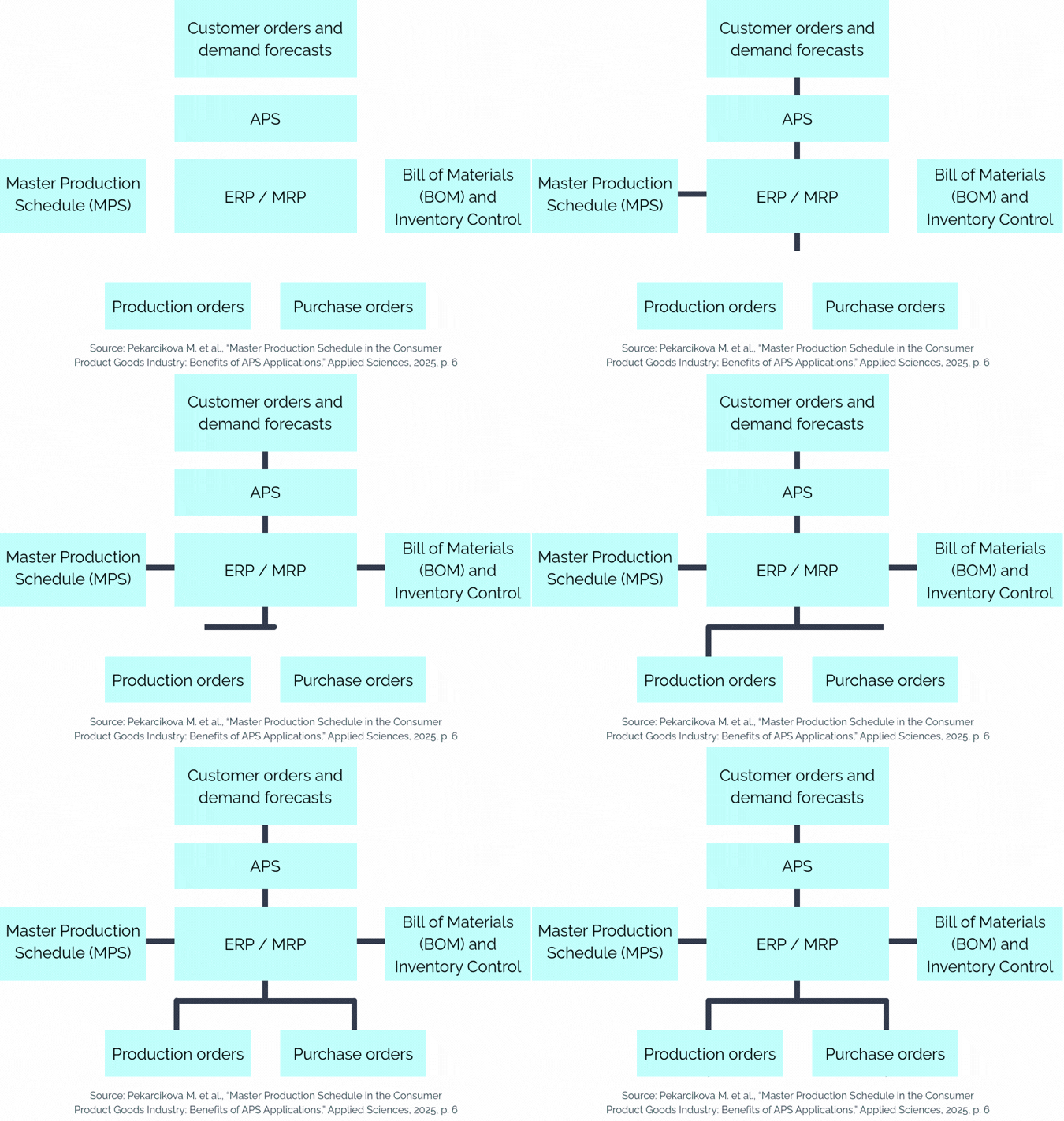
To better understand the role of APS within an integrated management environment, below is a diagram showing a typical ERP architecture in which advanced planning software is embedded. APS receives data from orders and forecasts and transforms them into optimized plans, integrating with ERP/MRP systems to trigger production and purchase orders.
Software APS: all the competitive advantages for manufacturing companies
Today’s market is complex, dynamic, constantly changing, and above all extremely competitive. Advanced Planning & Scheduling software represents an investment to gain a significant competitive advantage. How? Let’s briefly summarize it in the following points:
- perfect alignment between market demand and production capacity;
- reduction of costs related to inventory, procurement, and idle resources;
- greater on-time delivery performance, thanks to the prevention of delays and shortages;
- early identification of critical materials and bottlenecks;
- fast and realistic simulations for any type of future scenario;
- process automation, reducing manual work and human error;
- data-driven decisions, with complete analysis of costs, constraints, and alternatives.
In summary, on the one hand this means overall operational efficiency that increases company profitability, and on the other hand a better experience perceived by the end customer.
Conclusion: the future of the supply chain is predictive, flexible, and integrated
It is no longer just about planning. It is about forecasting, simulating, and responding quickly to any change. All this with an ergonomic interface, fast response times, and an easy adoption curve. silwaAPS represents a new generation of planning tools: intelligent, adaptive, and focused on business performance.
Whether you need to manage one or more plants, coordinate suppliers or subcontractors, or plan production and procurement, silwaAPS gives you full control, in real time and over future, simulated scenarios.

FAQ
APS software: what is it in IT?
APS software (Advanced Planning & Scheduling) is a system for advanced production and supply chain planning. It considers all real constraints (production capacity, materials, resources) and makes it possible to optimize lead times, costs, and operational sequences.
APS software: what is it used for?
It is used to improve production planning, reduce inventory and costs, improve on-time delivery performance, and manage production, purchasing, and distribution more efficiently.
ERP vs APS vs MES: what are the differences?
An ERP manages company operations (orders, accounting, procurement, …); an APS specializes in advanced production planning, taking constraints into account and making predictions; an MES focuses instead on shop floor operations, monitoring operation sequences, machine efficiency, and product quality. The three systems must be integrated with each other to provide complete and seamless management. If you still have doubts, consult this guide to software acronyms.
APS vs MRP vs MPS: how are they related?
The Master Production Schedule (MPS), Manufacturing Resource Planning (MRP), and Advanced Planning and Scheduling (APS) are all tools used for production planning, but with different purposes and approaches. MPS is a long-term plan that defines what to produce, how much, and when. MRP focuses on procuring the materials needed for production and ensures that resources are available when required. APS, on the other hand, optimizes production planning and scheduling by using advanced algorithms to manage production capacity and constraints. For example, if MPS plans 1,000 units, MRP calculates the required materials and APS optimizes the production sequence based on available resources. In short: while MPS sets the overall direction of production, MRP handles the operational details of procurement, and APS optimizes and adapts planning in real time in response to changes and disruptions.
The relationship between APS, MPS, and MRP was discussed by Pekarcikova et al. (2025) in the article: Master Production Schedule in the Consumer Product Goods Industry: Benefits of APS Applications, published in Applied Sciences.
How is APS software implemented in a company?
Implementing an APS system is not a plug & play operation, but it is not as complex as it may seem, provided the chosen vendor is an experienced System Integrator. The process generally consists of three phases:
- analysis and data collection: starting with a technical-functional assessment to understand existing processes, production constraints, and requirements;
- configuration and integration: the software is parameterized according to customer characteristics and integrated with ERP, MES, and other business systems;
- implementation and training: the most critical phase of all, which must be managed smoothly and in a controlled manner. The operations team is trained and supported even after go-live if necessary.
What is the best APS software?
Identifying the best APS software (Advanced Planning & Scheduling) is not easy and is certainly not an immediate process. Software should be seen like gloves: they must fit your specific reality perfectly. In general, however, a good APS system should:
- offer a wide range of functionalities, to cover business needs as comprehensively as possible;
- be scalable over time, so it can adapt to budget and production requirements as they evolve, supporting company growth;
- be easily integrable with other enterprise information systems such as ERP or MES (learn more).
For these reasons, it is essential to focus primarily on the vendor, who must have both Software House and System Integrator expertise. If you are unsure which solution is right for you, at Stesi we offer a free initial check-up with our consultants: take advantage of it.
