



For companies today, it is essential to do everything possible to transform Supply Chain complexity into a competitive advantage. This requires the adoption of solutions that optimize logistical and production flows, reduce time and costs, and facilitate the competitive growth of the company. Ideally, the choice should fall on an integrated solution capable of increasing warehouse competitiveness and at the same time reducing Supply Chain costs, while safeguarding safety and environmental impact, otherwise known as sustainability. But before reaching that point, method and study are required. In short? A warehouse logistics flow analysis is needed.
Logistics flows include all the stages an item passes through: from production to marketing, including transport, storage, and distribution. Accurate management of logistics flows, characterized by the constant movement of resources and information, is the first step toward having an optimized Supply Chain. This is why it is important, if not fundamental, to know the logistics of your company in detail.
Of all the stages a product can go through, from production to final delivery, this article will focus on the operational heart of logistics: flows inside the warehouse, meaning the set of physical and information movements of goods within logistics centers.
What are Warehouse Logistics Flows?
Warehouse logistics flows are the set of all operations and movements that take place precisely inside the warehouse: from receiving goods to storage, from picking to internal handling, up to shipping. These flows do not only concern the physical movement of goods but also involve information level processes, especially in the management and transfer of data and information.
These processes are managed, optimized, and automated by software systems such as the WMS (Warehouse Management System). Optimizing these flows does not only mean ensuring efficiency, error reduction, full traceability, and lower operating costs, but also significantly simplifying the work of operators, making it faster and safer.
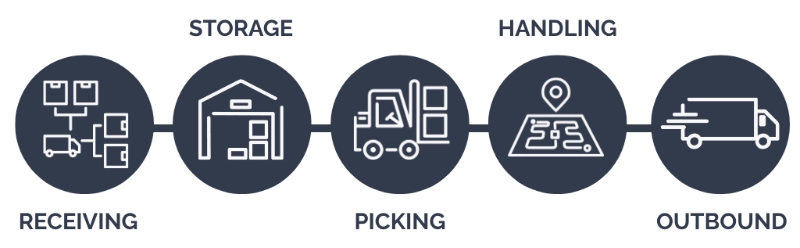
A warehouse that operates at its maximum efficiency becomes an invaluable competitive advantage, allowing customers to be served more quickly, inventory to be managed better, and ultimately strengthening the company position within the market.
All types of Warehouse Logistic Flow
1. By direction of movement
Based on the stage the items are in, it is possible to distinguish different logistics flows by the direction of goods movement, which represents the most intuitive classification.
Inbound Flows:
- goods receipt: all operations from the moment goods arrive at the warehouse (unloading from transport vehicles, documentation verification, quality and quantity control, cross docking);
- put away: physical transport and placement of received goods into their relative storage positions in the warehouse.
Outbound Flows:
- picking: the operation of identifying and collecting specific items from their storage positions to fulfill a customer order;
- packing: the stage of packaging, labeling, and arranging documents to prepare items for shipment;
- shipping: grouping packed orders by destination, loading onto transport vehicles, and sending them out of the warehouse.
Reverse Logistics Flows:
- returns management: entry into the warehouse of products returned by customers, requiring inspection, sorting (restocking, repair, disposal), and all connected movements;
- recycling/disposal: movements of materials or products no longer usable that leave the warehouse to be recovered or disposed of.
2. By type of flow
There are no movements of goods in the warehouse without information flows to coordinate and govern them. From this comes a classification of logistics flow by type, often ignored or underestimated, but without which intelligent optimization of internal warehouse processes is not possible:

- Physical flows: all spatial movements of materials (items), resources (operators and people), and vehicles (AGVs, forklifts, conveyors) within the warehouse, from the receiving dock to the storage aisles, to picking areas, and up to the shipping dock. They also include internal handling for reordering or stock reorganization.
- Information flows: the set of data, documents (paper or digital), and information that accompany and guide every physical movement. Essential for traceability, inventory accuracy, and planning. Examples include purchase and sales orders, picking lists, storage locations, real time inventory updates, shipping data, and performance reports. These are fundamental for planning and coordinating physical logistics flows and are managed by software systems such as the WMS.
3. By layout / operational characteristics
Strongly linked to the physical morphology of the warehouse, “operational flows” or “layout flows” directly influence how goods move:
- U flow: reception and shipping take place on the same wall of the warehouse. Goods move in a U shape, minimizing travel and maximizing space use. It is the most common;
- linear flow (or I flow): reception and shipping areas are located on opposite sides of the warehouse, creating a straight flow. Ideal for large volumes and to avoid crossings;
- L flow: reception and shipping areas are on adjacent walls;
- multi warehouse flow: occurs when the internal flow involves multiple distinct logistics areas or sites. Requires coordination with WMS software to have centralized visibility.
4. By rotation / frequency of movement
Different products, different needs. Take, for example, items with a near expiration date, such as food products: these need to be moved much more frequently than items without an expiration date, such as mechanical components. From this comes the classification of warehouse logistics flows by rotation:
- high rotation goods (fast movers): products that enter and exit frequently. Their flows are optimized for speed of access (often positioned in picking areas close to shipping);
- medium rotation goods: products with a regular but less intense turnover;
- low rotation goods (slow movers): products that remain in the warehouse for a long time. Their flows are optimized for long term space utilization.
These classifications often integrate with methodologies such as the ABC criterion (based on the value or criticality of the product) and FIFO (first in, first out) or LIFO (last in, first out) principles, which determine the order of movement based on deadlines.
Efficient management of Warehouse Logistics Flows: advantages, automation, and digital solutions
Optimal management of a company warehouse logistics flows is the key to reducing costs, increasing productivity, and ensuring customer satisfaction. Optimizing movements, information, and warehouse resources allows a cost center to be transformed into a strategic engine for logistics. Intelligent and guided coordination of warehouse processes helps from the very first moments to:
- reduce errors: fewer inventory discrepancies, fewer picking and shipping errors;
- improve space utilization: optimized layout and reduction of unused areas;
- increase productivity: fewer superfluous movements, faster cycles;
- obtain real time traceability: every item is always under control thanks to integrated information flows;
- reduce operating costs: less time waste, fewer errors, optimized movements;
- improve customer service: orders fulfilled faster;
- support decisions: data generated by software like the WMS helps to continuously monitor and improve performance.
Just consider that implementing one of the various types of automated warehouses and/or robotic handling equipment will allow for improved productivity, minimizing errors, making better use of information, building customer loyalty, and therefore ultimately reducing operating costs, which always represents one of the macro objectives of any corporate reorganization effort.
The validity of the WMS adopted is therefore fundamental to seize these advantages, and it is during the selection of warehouse management software that all available options should be evaluated and the most correct organizational improvement to be implemented should be assigned to each of them. Typically, some of the common problems encountered relate to the following aspects: the absence of standardization in the goods register; inventory discrepancies that create problems when performing counts of goods present in the warehouse, and the impossibility of a consistent and unique coding for all references. Therefore, one must always try to address such issues beforehand to put the adopted computer system in a position to provide highly useful support.
“The warehousing and storage services market is expected to grow with a CAGR of 4.33% by 2031”
Source: Mordor Intelligence
Transforming Warehouse Logistics Flows with automation and digitalization
Automation allows for the elimination of repetitive and error prone activities. AGV systems (Automated Guided Vehicles), collaborative robots, and automated conveyors make all internal flows faster and safer. The WMS, integrated with the company ERP system, coordinates every movement and updates the inventory in real time. This drastically reduces goods handling time and the margin of error, which is typically due to inventory discrepancies and the loss of the vision of the real state of the warehouse. Always knowing the exact location of goods stored in the warehouse and keeping track of every movement is something that cannot be given up. Furthermore, being able to derive statistics from all operations leads to a broad understanding of the warehouse functioning level and greater ease in finding a solution to any unforeseen events, thus ensuring the continuation of work without bottlenecks.
The creation of a highly digitalized warehouse can become the most powerful weapon to transform logistics into a competitive advantage. Indeed, in the coming years, warehouse automation will carry even more weight and technological innovation will bring with it new solutions to meet the growing demands of the sector. Artificial Intelligence and the Internet of Things (IoT) will make warehouse elements increasingly connected and able to adapt to specific needs. Excellent integration between automation and software will be necessary not to lose sight of internal warehouse logistics flows. Consequently, the role of personnel and their skills will also evolve.

Solutions for the management and optimization of Warehouse Logistics Flows
The market offers modular software solutions that allow customization according to the specific needs of companies. In the case of optimizing internal warehouse logistics flows, WMS software is required. Research should therefore be directed toward solutions that reduce Supply system costs and possibly achieve measurable savings on inventory times, space utilization, handling costs, and vehicle maintenance. In other words, optimizing all logistics activities thanks to powerful algorithms, thereby helping operators perform daily activities better. Solutions capable of supporting, for example, assisted driving of handling equipment and open to the world of automation go in this direction. To summarize, a flow management solution (WMS) must be:
- customizable, to adapt to specific operating models of each company and sector;
- scalable, to grow with the company without the need to disrupt the existing IT structure;
- modular, to add or remove functionalities based on the evolution of operational needs;
- integrable, with ERP, MES, TMS, IoT systems, and indoor/outdoor geolocation technologies.
Customization, scalability, modularity, and integration are fundamental requirements to respect for operating in today markets. Solutions that can integrate with all the most effective and promising functions of the logistics universe are needed, regardless of technology: geolocation systems, company information platforms, advanced automation technologies, with particular regard to the concept of logistics 4.0. Logistics automation has indeed become the choice many companies have adopted to remain competitive in a context where Industry 4.0 is the absolute protagonist. In this sense, logistics flow management improves considerably when operational cycles of the logistics chain are totally or largely automated, including the transfer of information.
Conclusions: top tier Warehouse Logistics Flows
Efficient management of logistics flows contributes to achieving the main objective of logistics: increasing the value of the product and service at the minimum cost. This is why modern WMS and SCES (Supply Chain Execution System) are a cornerstone of logistics 4.0: beyond robotics, AGVs, drones, and automated stacker cranes, it is they who coordinate activities and guide execution processes independently of people. Logistics flows are the milestone of evolved Supply Chains.

FAQ: frequently asked questions about warehouse flows
What is a linear flow warehouse and when is it convenient?
A linear flow warehouse is a type of layout in which goods follow a straight path, from the receiving area to the shipping area, without crossings or deviations. This type of flow is particularly advantageous for companies with high handling volumes and standardized logistics processes, as it:
- reduces the risk of congestion between inbound and outbound,
- improves operator productivity,
- simplifies the management of picking and shipping. It is the ideal choice for industrial and retail contexts with high goods rotation and a need for high throughput (meaning the amount of goods a warehouse can move in a given period of time).
Checklist to optimize warehouse flows in 10 steps: what must not be missing?
Here are the 10 steps to streamline processes and transform the warehouse into a concrete competitive advantage:
- clear classification of flows (inbound, outbound, returns);
- optimized layout (U shape, linear, L) based on volumes and rotations;
- mapping of logical and physical locations;
- implementation of a scalable and integrated WMS;
- real time traceability of every movement;
- automation in repetitive processes (picking, put away, replenishment);
- KPI dashboards (for continuous monitoring of lead times, saturation, errors);
- continuous training of operational personnel;
- integration with ERP and transport systems;
- periodic review of processes through internal audits or external consultants.
How is warehouse flow analysis done and what is it for?
Warehouse flow analysis consists of monitoring, mapping, and evaluating all internal movements (physical and informational) to identify bottlenecks, waste, areas for improvement, and potential automation. It includes the study of:
- inbound and outbound flows,
- physical layout,
- lead times,
- picking and storage frequency,
- space utilization. An expert consultant analyzes the data, suggests targeted interventions, and ensures a return on investment with measurable KPIs.
