



In the world of logistics, efficiency and the optimization of time and resources have always been the key to maintaining a competitive edge. This has become even more critical recently, given the need to accelerate warehouse operations to ensure end customers receive their orders as quickly as possible, a standard long since established by industry giants.
Since their introduction to the logistics sector in the 90s, pick to light and put to light (PTL) systems have revolutionized the processes of item collection and placement within warehouses and distribution centers. While pick to light utilizes light indicators to guide operators in picking items from the racks, put to light assists them in the accurate placement of gathered items. As we will explore in this article, the result of a conversation with Matteo Corazza, PO at Stesi, these systems optimize workflows, reduce errors, and accelerate warehouse throughput, allowing companies to improve customer satisfaction.
What is PTL
The acronym PTL is commonly used to refer to an innovative system that leverages small lights, and sometimes small displays, to facilitate warehouse operations for human operators. However, this acronym actually refers to two different systems used to optimize two distinct operations: on one hand, goods collection (pick to light), and on the other, their placement (put to light).
Pick to light
PTL in the sense of pick to light is a hardware tool designed to optimize the material picking process in warehouses and distribution centers. It consists of small lights and displays mounted on the racking units that guide the operator during the picking activity.
“Essentially, the lights turn on at the exact storage location of the goods to be picked, while the displays,” Matteo Corazza tells us, “provide operators with any additional information, such as the quantity of items to be retrieved.”
The goal of the pick to light system is simple: minimize errors and maximize operator efficiency by freeing them from the need to carry a handheld terminal to report their activities, such as scanning labels for picked goods. “A pick to light system grants operators the great advantage of being able to work hands-free. To confirm that a task has been completed, they simply press the light corresponding to the picked goods, as these indicators are actually physical buttons.” The direct consequence is, of course, increased operator speed, allowing them to retrieve, manage, and handle material with greater agility, even when working on multiple orders simultaneously.
But how exactly does the PTL system work when managing multiple orders?
“The interesting thing about this system is that you can freely set lights of different colors,” Matteo explains, “thereby signaling to the operator that they are handling more than one order. For example, a blue light indicates order 1 while a yellow light indicates order 2, helping them sort the material correctly.”
Put to light
“Put to light actually involves the implementation of the same devices (lights and displays) but this time to assist operators in placing goods within the warehouse.”
In this case, the purpose of the lights is to show the operator where the material needs to be positioned, simplifying goods sorting operations. This possibility is particularly valuable in cases where the operator is carrying multiple items and thus working on several orders at once.
Once again, the objective of the put to light system is to facilitate warehouse operations, freeing operators from the need to consult screens or constantly carry terminals. The guidance provided by the lights ensures greater efficiency and safety in the warehouse, allowing operators to focus on what matters most.
A put to light system use case
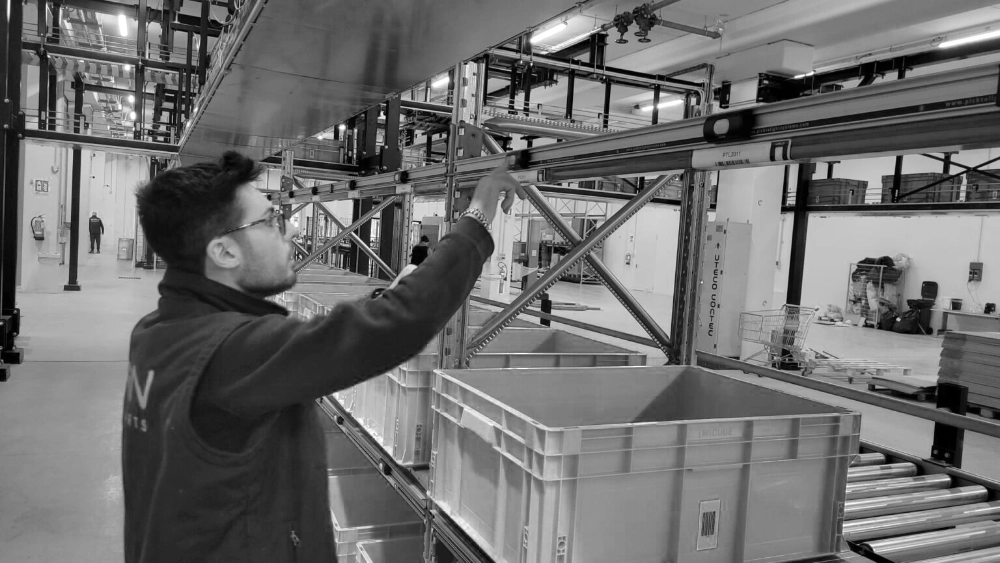
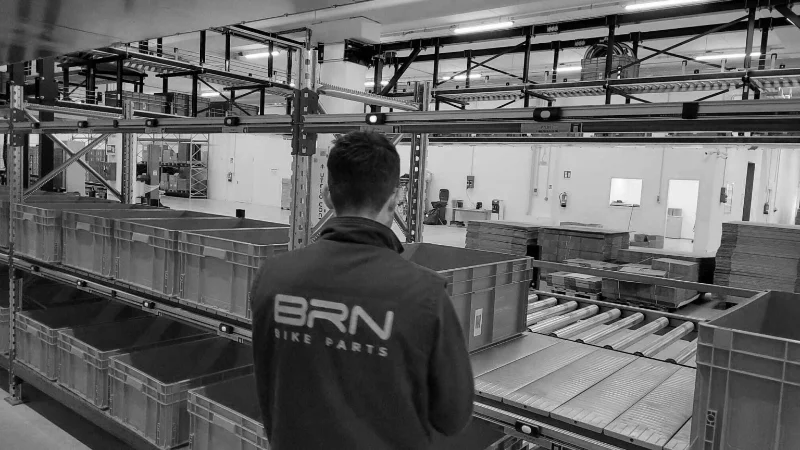
To best explain the advantages of applying a put to light system, Matteo decided to share the experience of BRN, a company specialized in the production of bicycle components that has long used the silwa WMS: “In BRN’s case, material is released from 13 vertical lift modules (VLMs) divided into 3 groups. For each group of VLMs, there is a rack with 40 slots, each equipped with a simple plastic bin. silwa not only communicates all the day’s orders to the 13 vertical warehouses but also defines the best picking sequence to make it as fast and effective as possible. For instance, if 100 orders need to be managed, silwa can facilitate picking operations by ensuring parallel processing of multiple orders, according to the most suitable logic to minimize operator movement, so they don’t have to deal with a single order at a time. Therefore, if the same SKU is present in 20 orders, the operator is prompted to pick 20 pieces.”
But how does the operator then know how to sort these 20 pieces? “When the operator picks the pieces, they confirm the operation by pressing the light, sending an immediate signal to silwa, which within milliseconds illuminates all the bulbs on the racks where the goods must be placed.” In short, thanks to the put to light system (associated with pick to light in BRN’s case), the operator simply picks the goods, signals the completed operation, and then follows the lights again. Once outside the vertical warehouse and reaching the 40-slot rack, the lights clarify where and how to sort the items. In this case too, to signal the completed operation, it is sufficient to press the light corresponding to the indicated location.
“An interesting thing to consider is that a put to light system associated with a high-quality WMS also allows for some customizations. For example, for BRN, we used a set of 13 different colors (one for each vertical warehouse) to further simplify sorting operations, considering that several people work simultaneously in each warehouse and group of warehouses. If the operator is working at the vertical warehouse with the blue light, for instance, they know they must follow the blue light to replace the goods, ignoring lights of other colors which refer to other warehouses.”
Pick to light and put to light: when to use them
As seen in the use case just mentioned, it is natural that pick to light and put to light systems are often used together to simplify both the retrieval and repositioning phases of goods. In cases like this, it is evident that operations are carried out in a decidedly faster and more optimized manner, thus simplifying the operators’ tasks.
But which companies should consider introducing these systems into their warehouses?
“Generally speaking,” says Matteo, “these systems are well-suited to all cases where operators usually work with small-sized goods that are easy to handle and often need to be sorted into multiple orders, as is typical of e-commerce for example. We must remember that one of the goals of these systems is to reduce order fulfillment times. Therefore, if there are many orders, perhaps all composed of a few pieces, it becomes necessary to perform a batch picking operation, that is retrieving all the goods at once which will then be sorted into the various orders. Beyond the picking phase, it is then a matter of optimizing the goods sorting stage: the put to light system simplifies a sorting process that would otherwise potentially need to be managed by other operators guided by a terminal.”
The importance of the right WMS
Colored lights and displays are obviously systems as simple as they are ingenious for simplifying warehouse operations, but it is clear that to obtain all the benefits associated with pick to light and put to light, it is necessary to integrate the PTL system with a warehouse management system like silwa.
PTL systems, as we have seen, are supported by hardware. There are currently many on the market, and this is where the consultancy of the Stesi team comes into play, but it is useful to emphasize that silwa is perfectly capable of interfacing with various brands and different types of tools in circulation, which the customer can choose according to specific budgets and needs.
The point is, in fact, that a WMS does not just deal with turning lights on and off (although, as we have seen, even this operation is performed following precise operational optimization rules), but also with providing a whole series of additional information. For example, how does an operator know when the order they are working on is ready to move to the next stage? This is just one of the many additional tasks of a WMS like silwa, which handles providing this information to the operator in specific ways: “in some cases, for example, it can make the light flash; in others, it can be associated with a printer and automatically proceed to the printing necessary for shipping.”
Other use cases with silwa
As we have seen, pick to light and put to light systems are very flexible and “customizable” according to requirements.
In the case of Samo, a client company specialized in the production of bathroom furnishings, the innovation concerned the labels. “Generally, the labels providing information are attached to the rack via a power cable, but at Samo, an alternative solution was chosen that instead involves the use of luminous electronic labels. These allow for the visualization of much more information than traditional ones, where only the LED appears. Solutions of this type naturally have pros and cons that every company must evaluate. For example, they have a decidedly lower update speed than traditional ones, but they can be moved more easily, even onto mobile carts.”
And Stelvio knows something about the utility of positioning luminous labels on mobile carts, having further optimized the pick to light and put to light phase by allowing the operator to prepare up to 12 orders simultaneously. What happens is that the silwa system creates the material picking sequence within the warehouse, allowing the operator to declare the pick according to the traditional methodology. In this way, silwa recognizes the completed pick and automatically triggers the lights, then handles signaling the quantity to be deposited into each box via the display. Upon confirmation, by pressing the button the light turns off, and silwa also confirms the completed retrieval and deposit of the material for that specific order.
“Generally, the system is applied to fixed racking, but these examples prove that it is perfectly adaptable to mobile stations as well. Naturally, in these cases, the initial study and analysis phases make the difference, serving to understand how to power and support the chosen PTL method on a case-by-case basis.”
Want to learn more or discover the key features of the silwa WMS? Contact us: we will answer all your questions.
