


In recent years, companies have faced increasingly complex logistical challenges: non-linear procurement, demand fluctuations, cost pressures, and the need for greater process visibility. In this scenario, the role of logistics consultants has become increasingly strategic, and consulting has transformed into a concrete lever for improving efficiency, optimizing inventory, and designing logistics and production solutions capable of sustaining growth over time.
At Stesi, logistics consulting has always been an integral part of the work carried out with clients. However, since October 2024, this activity has evolved into a dedicated Business Unit, created to provide structured support both to companies building their logistics from scratch and to those with existing systems who wish to improve efficiency and control.
We discussed this further with Andrea Leonarduzzi, Senior Advisor at Stesi and the protagonist of today’s interview.
Where logistics consulting truly makes a difference
Every consulting project stems from a different need. Some companies are in an expansion phase and must structure their logistics or production from the ground up, while others already have active solutions but want to improve their performance. Some find themselves struggling with poorly implemented or never fully adopted systems, and others feel abandoned by their vendor, lacking the solid ground needed for strategic decision-making.
In all these cases, the intervention of Stesi’s logistics consultants focuses on three recurring areas: facility design, inventory management, and operational visibility.
In this article, we will talk about specialized consulting in warehouse logistics and the optimization of WMS (Warehouse Management System) solutions, delving into strategies for efficient warehouse management. In the next article, we will focus on consulting for production process optimization, analyzing tools and methodologies to improve manufacturing efficiency.
Design and sizing of logistics hubs
Designing a new logistics hub, or reorganizing an existing space, is one of the most complex and strategic challenges a company can face. It is a process that goes far beyond choosing racks or machinery: it requires an in-depth study of flows, volumes, types of goods, and, above all, growth prospects.
If done correctly, this phase allows for optimized operations, reduced costs, improved customer service, and ensures the long-term sustainability of the entire system. This is why the intervention of a logistics consultant becomes decisive right from the early design stages. “The first step is always to analyze the data,” Andrea explained to us, “to understand what is needed today but also what will be needed tomorrow. The risk is always designing something that ends up being too small within a single year.”
Not surprisingly, the role of logistics consulting is precisely to transform into a technical and strategic guide, helping the company avoid unbalanced or undersized solutions. Whether it involves creating a semi-automated facility from scratch or recovering and reconfiguring existing spaces, the sizing phase is decisive for building a logistics infrastructure capable of adapting and growing alongside the business.
To delve deeper into this topic, read the article dedicated to warehouse mapping here.

Inventory management
Inventory management is one of the most delicate logistical issues. Excess inventory leads to increased storage costs, while a shortage can slow down or even block production and shipments. Finding an optimal balance between excess and stockouts is fundamental, but not always easy to achieve. This is where the experience of a team dedicated exclusively to logistics consulting comes into play.
“It often happens,” says Andrea, “that we encounter clients who purchase materials without a precise logic. Sometimes goods already present in the warehouse are bought because no one can find them. Other times, there is a total lack of awareness regarding what is in stock. Over time, this generates a layer of disorder that becomes structural.”
This is why consulting in this area always starts with a precise analysis of stock levels, flows, and procurement logic. Data is collected directly from the client’s ERP systems (average stock, picking frequencies, lead times) and an optimal model specific to each SKU is built.
Visibility in operations
Having visibility over logistical processes is an essential condition for correctly managing the warehouse, flows, and availability. Yet, many companies today still find themselves navigating “in the dark,” without tools capable of offering a clear and updated view of daily activities.
The lack of real-time visibility on shipment status and internal movements can cause delays, management errors, and a general decline in operational responsiveness. Without a clear picture of what is happening in the warehouse, and when, it becomes difficult to prevent critical issues or react promptly.
“Many problems emerge only when it is too late,” explains Andrea Leonarduzzi. “A blocked order, a missed shipment, a wrong pick… these are all signs of a system that does not have complete control over its operations.”
In these cases, the work of the logistics consultant is to analyze existing processes and understand where it is truly worth intervening with digital tools. Not everything should be automated, and not everything requires a WMS.
“There are flows that make no sense to digitize because they are too simple or marginal,” Andrea continues. “But there are other processes where the introduction of a system makes a real difference. Our job is to help the client distinguish between the two.”
Ultimately, logistics consulting helps build a clearer and more functional vision of internal business flows, precisely identifying which processes need to be tracked, monitored, and improved, and which can remain manual without generating a negative impact or limiting business growth.
The Stesi method: how our logistics consulting works
As we have seen, every consulting intervention starts from a specific need, but it is through a structured approach that concrete results are achieved. Stesi’s logistics consulting is based on three fundamental pillars: process analysis, strategic use of data, and the introduction of digital tools, when and where they are truly needed.
Process analysis: the first steps of good logistics consulting are always listening, understanding flows, analyzing operations, and mapping the current state. Process analysis allows for the identification of waste, bottlenecks, and low-value-added activities. “We always do this, even during WMS implementation,” says Andrea. “But when we operate in a consulting capacity, we go even deeper, putting the process at the center, regardless of the technology already present or to be implemented.”
Data-driven approach: to design or improve a logistics facility, a solid data base is needed. Often, however, the client does not have the information ready, and support is needed even just to extract it from the ERP. The goal is to translate numbers into decisions: average stock, delivery times, and turnover ratios become tools for building scenarios, sizing spaces, and optimizing inventory.
WMS software implementation: when the project requires it, we move to the implementation of a WMS. Not as a starting point, but as a natural result of an in-depth analysis. After all, the system allows for visibility over flows, performance measurement, and improved traceability. But the real value lies in having thought it out and modeled it on the client’s reality. “A WMS alone solves nothing. If you don’t start from the processes, you only risk digitizing the confusion,” Andrea explains.
Real cases: logistics consulting applied in the field
Every company has a different story, but many of the challenges they face are similar. It is precisely thanks to a flexible yet methodical consulting approach that Stesi has been able to intervene in very diverse contexts: from public mobility to dairy, from industrial production to food & beverage.
 Brazzale SpA
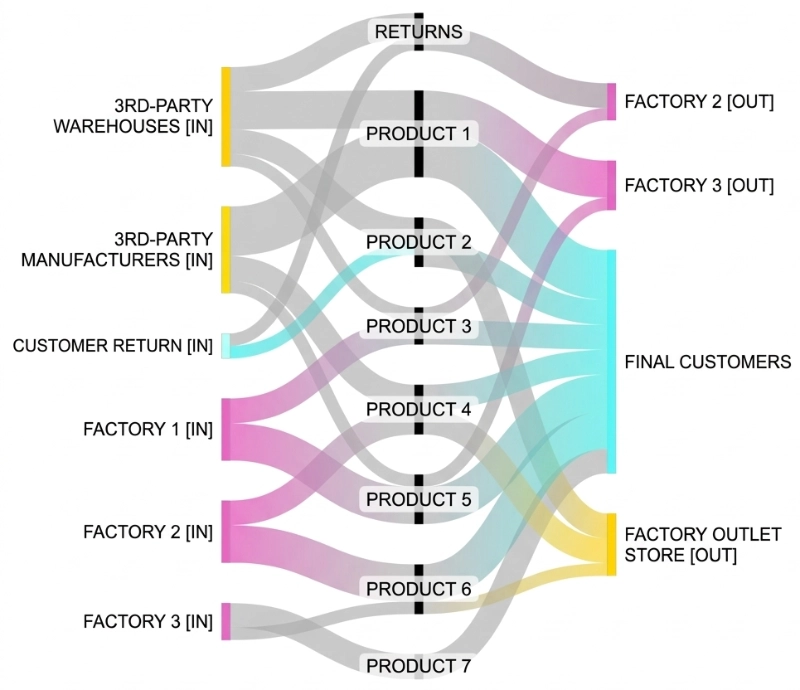
In the dairy sector, Brazzale involved Stesi in two parallel projects: the design of a new semi-automated logistics hub and the introduction of a WMS system at the headquarters. Both projects were supported by a data-driven approach, with an analysis of flows and storage needs related to both production and product aging.
ACTV
For ACTV, the company managing Venetian public mobility, the Stesi team performed an in-depth inventory analysis. The goal was to rationalize stock and identify an efficient reordering strategy. The work highlighted redundant purchases, critical shortages, and uncontrolled materials, improving traceability and optimizing storage costs.
IndustrialCars
For IndustrialCars, a reference center for Stellantis group spare parts in the North-East, Stesi managed the design of a logistics facility in an existing two-level building.
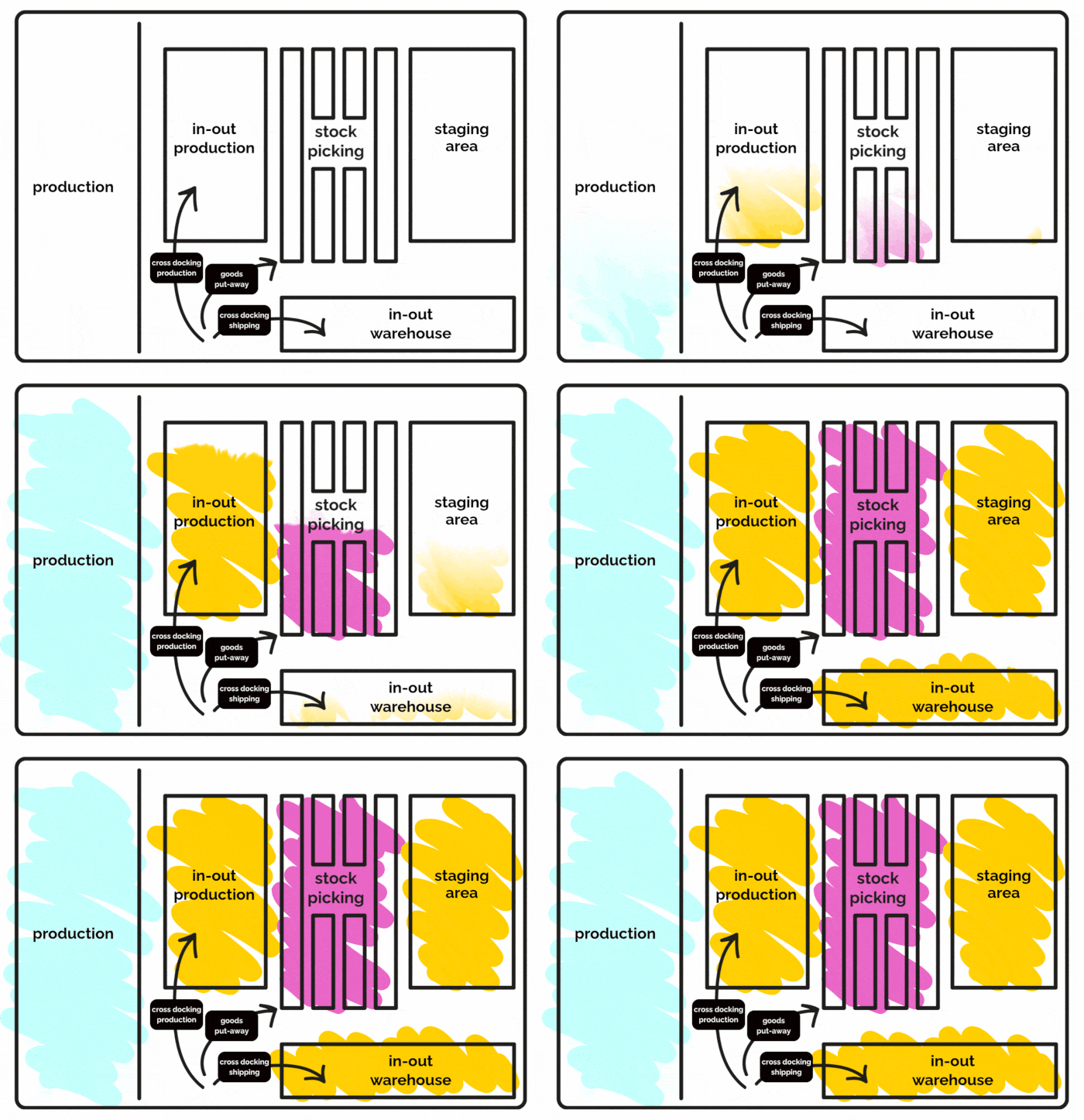

The project included a study for the introduction of a semi-automated system for small parts and the implementation of a WMS, with the goal of optimizing material layout and increasing fulfillment speed.
Italesse Srl
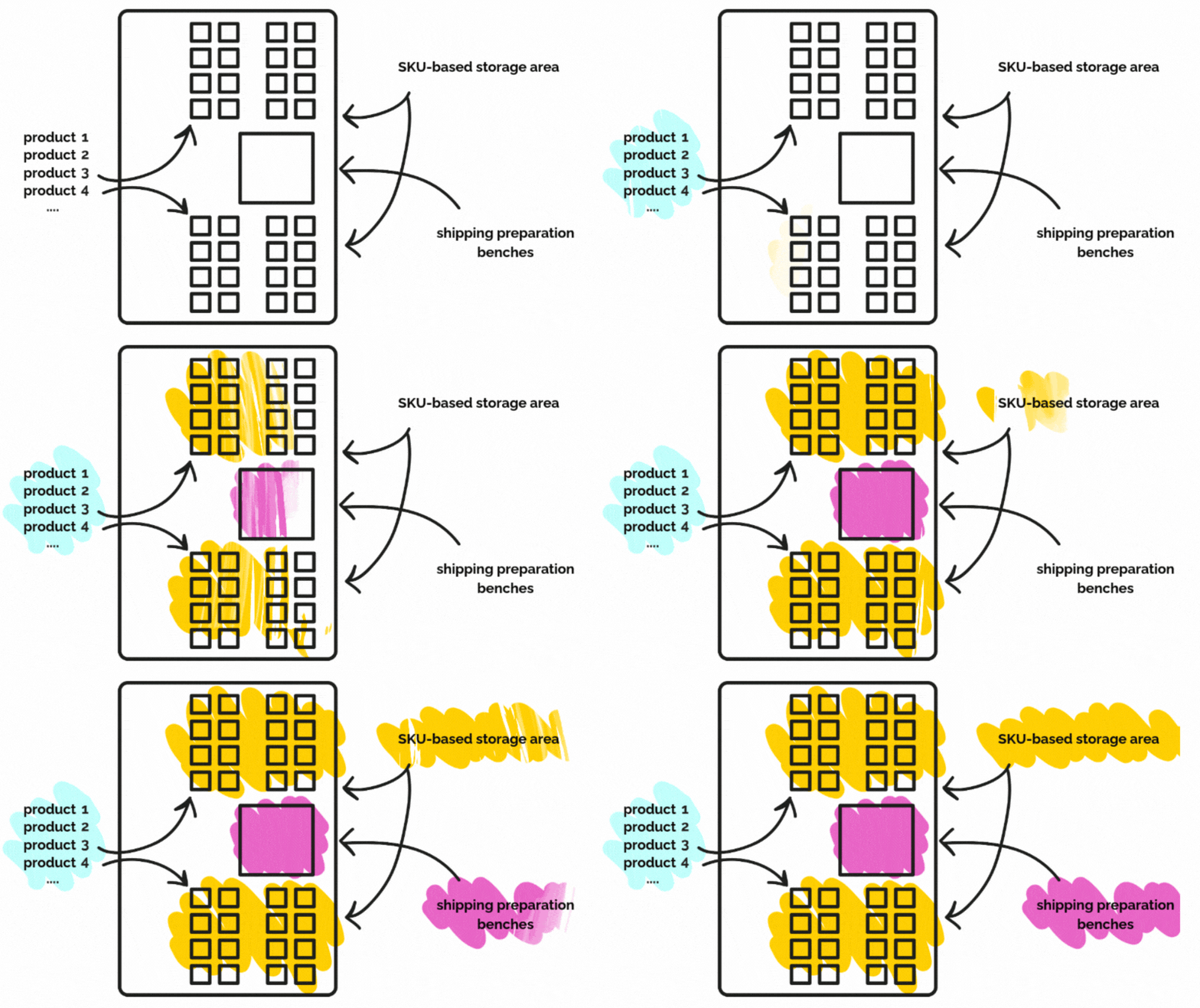
Italesse, a company specialized in glassware and accessories for the wine & spirits world, turned to Stesi to reorganize its warehouse after being left without support from their system vendor. Starting from the study of picking flows and preparation areas, the team suggested new positioning and buffer logics, calibrated to sales volumes and seasonality, improving efficiency and e-commerce management.
Infia Italia
Infia requested a consulting intervention during a phase of profound logistical reorganization. The project involved process analysis, the management of shuttling between five plants, and the introduction of a WMS to monitor production and logistics activities. Particular attention was paid to the logic of movement between facilities and the optimal planning of storage and loading/unloading areas.
Logistics consulting: value that lasts over time
As we have seen so far, logistics consulting is not an accessory activity, but a true strategic orientation tool. Whether dealing with growing entities, companies with existing systems, or logistical contexts to be restructured, the Stesi method adapts to offer concrete solutions based on data and a deep knowledge of processes.
“We always position ourselves in an agnostic way toward technology,” Andrea Leonarduzzi explained to us. “We delve into the process, regardless of the solution in use or to be implemented. Our task is to guide, not to sell.”
But what is the approach adopted by the Stesi team during the logistics consulting phase?
“It is almost always divided into two phases,” says Andrea, “a first snapshot of the current state (as-is), often useful for revealing unexpected aspects; and a tailored operational proposal (to-be), with clear and measurable objectives.”
If your company is also facing a change, a critical issue, or a phase of rethinking its logistics, our team can help you find the most suitable direction.
Contact us for a consultation: the first step is understanding, together.
