


For several years now, Artificial Intelligence and Machine Learning have begun to revolutionize the logistics sector and supply chain management. These technologies, capable of learning from data sets and making autonomous decisions, represent valuable assets in the warehouse for optimizing processes and improving operational efficiency.
Paradigms such as supervised and unsupervised learning, as well as reinforcement learning, are finding increasingly practical applications in warehouses, helping companies forecast demand, manage stock effectively, and plan transport, to name just a few examples. To understand how AI and Machine Learning are transforming the sector and warehouse management, we interviewed Mario Avdullaj, a developer at Stesi and an expert in Artificial Intelligence, who shared some of the most common application cases in the logistics field.
An overview of Artificial Intelligence
Artificial Intelligence has officially become one of the most discussed topics of the moment. There is hardly a newspaper, social media platform, or webinar that does not speak of it as a revolutionary innovation. Between supporters who celebrate its ability to amplify the scope of human work and detractors who describe it as a danger to be avoided at all costs, one thing is certain: there is still much confusion surrounding artificial intelligence.
This is why, before officially starting our interview, we asked Mario Avdullaj to clarify what AI actually is. “Artificial Intelligence,” he told us, “is a multidisciplinary field involved in developing algorithms and systems capable of performing tasks that would generally require human intelligence and decision-making.”
At the core of AI are Machine Learning algorithms that allow for intelligent decision-making and efficiency improvements within a logistics context. Machine Learning, often encompassing deep learning, is a branch of Artificial Intelligence focused on developing algorithms and models that allow computers to learn from data and improve their performance without being explicitly programmed.
“In short, unlike more classical paradigms where formulas and operations research algorithms are defined to maximize objective functions or minimize cost functions,” Mario explains, “these systems are able to perform much more difficult tasks because they rely on neural networks. This means that starting from knowledge of more or less organized data, they are able to interpret information and make decisions without being explicitly programmed to do so.”
Machine Learning and Artificial Intelligence: learning paradigms and their use in logistics
Before analyzing some of the uses of Artificial Intelligence in logistics, it is important to review the different types of learning paradigms. In fact, different types of data make it possible to train different types of neural networks, depending on the objective one intends to achieve. Specifically, among the most important paradigms within the logistics world, we can mention:
- Supervised learning: to apply this paradigm, it is necessary to have a large volume of labeled data (as is the case with WMS) to transform into training sets. This data allows the AI to perform binary classification (true, false) or multi-class (A, B, C) tasks, as well as regression (with value estimation). “In a warehouse, assuming a VisionAI context, this type of AI can be trained starting from images acquired by sensors and cameras, allowing it to recognize and classify all goods and pallets and identify the presence of operators.”
- Unsupervised learning: this paradigm is precious when the initial volume of data is neither labeled nor classified. An AI trained this way is able to recognize patterns within the data and group them according to specific characteristics or properties. “For example,” says Mario, “just think of clustering. Thanks to this form of learning, it becomes possible to categorize processes and separate them intelligently within the logistics field.”
- Reinforcement learning: “To explain this paradigm and the framework it is based on, I like to compare it to the way both humans and animals learn. There is always an entity, an agent, and an environment in which the entity lives and interacts by performing actions and making decisions. Guiding its interaction is a set of sensors (our senses, for example) that make it possible to perceive any changes in the environment. For every action or reaction, the entity can be rewarded or punished, thus reinforcing certain behaviors and patterns while eliminating others.” AI based on reinforcement learning, applied for example within Stesi’s proprietary WMS, silwa, is therefore constantly fed and trained by input data that helps it improve continuously. This learning paradigm, as we will see, proves fundamental for the Mission Manager.
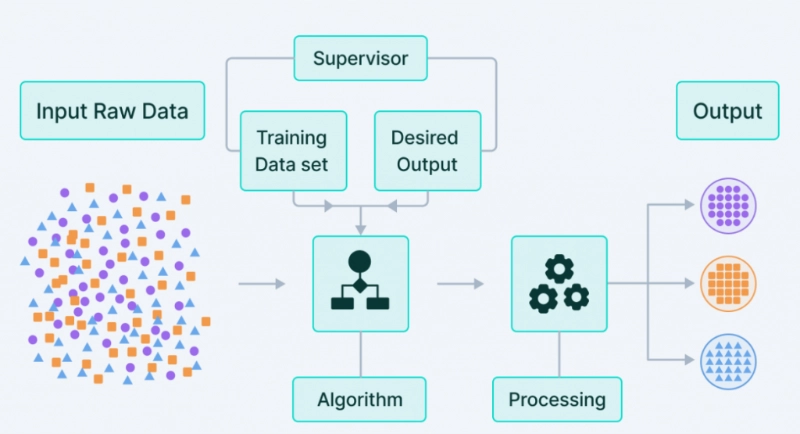
Example of a supervised learning architecture
Generative AI? It is now in the WMS
The paradigms we have seen are among the most important in Machine Learning. However, recently we have seen extreme interest in so-called Generative AI, fueled by the widespread use of applications and chatbots. Generative AI is, however, just one of the many sub-branches of Artificial Intelligence, which continue to increase day by day thanks to years of research concentrated in this field.
Nonetheless, generative intelligence is also proving valuable in the logistics sector. “At Stesi, we have also developed some prototypes and research and development projects in this area to integrate AI into our WMS, silwa,” Mario concludes.
Artificial Intelligence and logistics: the current state
Interest in the field of AI has led to the creation of increasingly complex neural networks capable of executing more general tasks, moving beyond the specialization of the past. The goal for some time has been to generalize AI capabilities using less specific and rawer data, as data is the most expensive resource to acquire.
“In the last decade,” Mario notes, “many Artificial Intelligence technologies have been adopted in logistics, contributing for instance to optimizing stock management, transport planning, demand forecasting, and much more.” AI has literally touched all supply chain processes across the board, affecting both inbound and outbound logistics.
Artificial Intelligence applications: some use cases in logistics
But what are the actual advantages of applying AI in logistics? Use cases for Artificial Intelligence certainly include:
- Order and planning optimization: AI algorithms can analyze historical data and market trends to forecast future demand.
- Inventory management: AI can be applied to inbound logistics in conjunction with IoT to predict replenishment times and reduce waste, as well as to optimize receiving processes and define the ideal distribution of goods in the warehouse.
- Disruption management and prevention: AIs trained in a supervised manner with historical data can help monitor the status of equipment and machinery to predict their condition and plan maintenance, thereby reducing downtime.
- Increased warehouse safety: IoT, sensors, robotics, and AI allow for monitoring the safety status of warehouse spaces by recognizing the presence of operators and evaluating data on machines and equipment. “Currently, there is a lot of research aimed at making AI not only capable of recognizing the human operator but also predicting their intent. This would be even more revolutionary in terms of warehouse safety.”
A focus on the Mission Manager
Reinforcement learning can also be adopted within the Mission Manager. This software component is responsible for managing and optimizing transport missions within the warehouse and is primarily concerned with coordinating and planning operational activities by assigning specific tasks to available resources based on priorities.
AI applied to the Mission Manager allows for the optimization of mission dispatching to save time, increase operational efficiency, ensure adaptability, and reduce downtime costs.
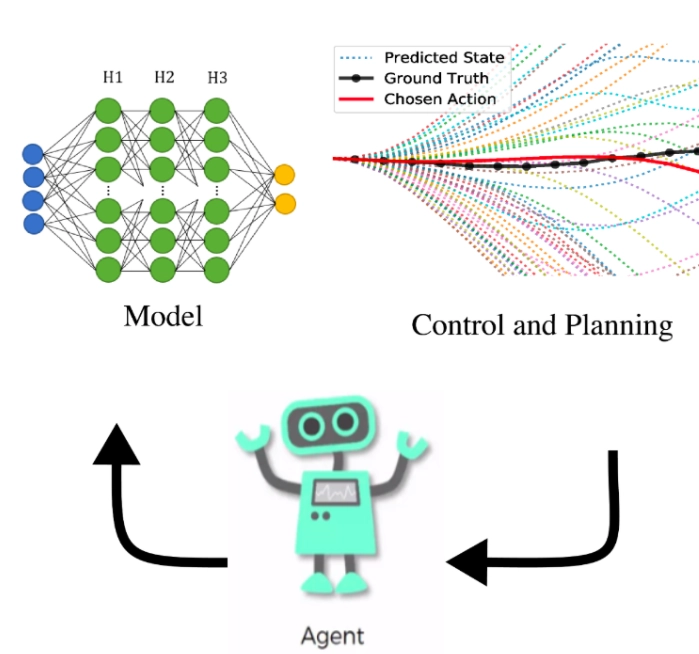
Example of reinforcement learning applied to the Mission Manager
AI at Stesi
“In recent years at Stesi, we have implemented several Artificial Intelligence projects. For example, in silwaCAM, our RTLS system, we implemented a neural network trained to recognize fiducial markers. These markers are then used to understand where forklifts are located in the warehouse and to estimate their exact position.” This works regardless of lighting conditions, background, orientation, or general environmental variations.
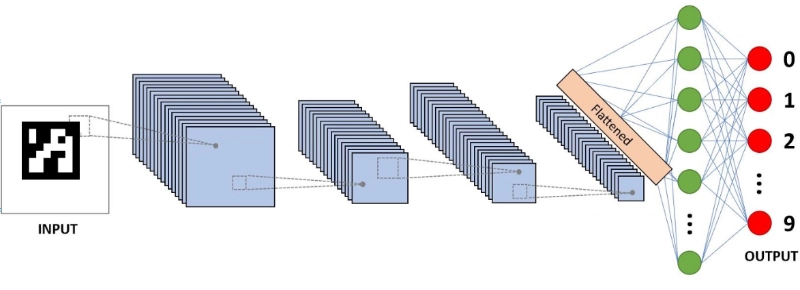
Example of a convolutional neural network application for silwaCAM markers
Among Stesi’s clients, many have already chosen to use this form of AI in their warehouses. Examples include Alpla, as well as EuroCarta and Ideal Standard.
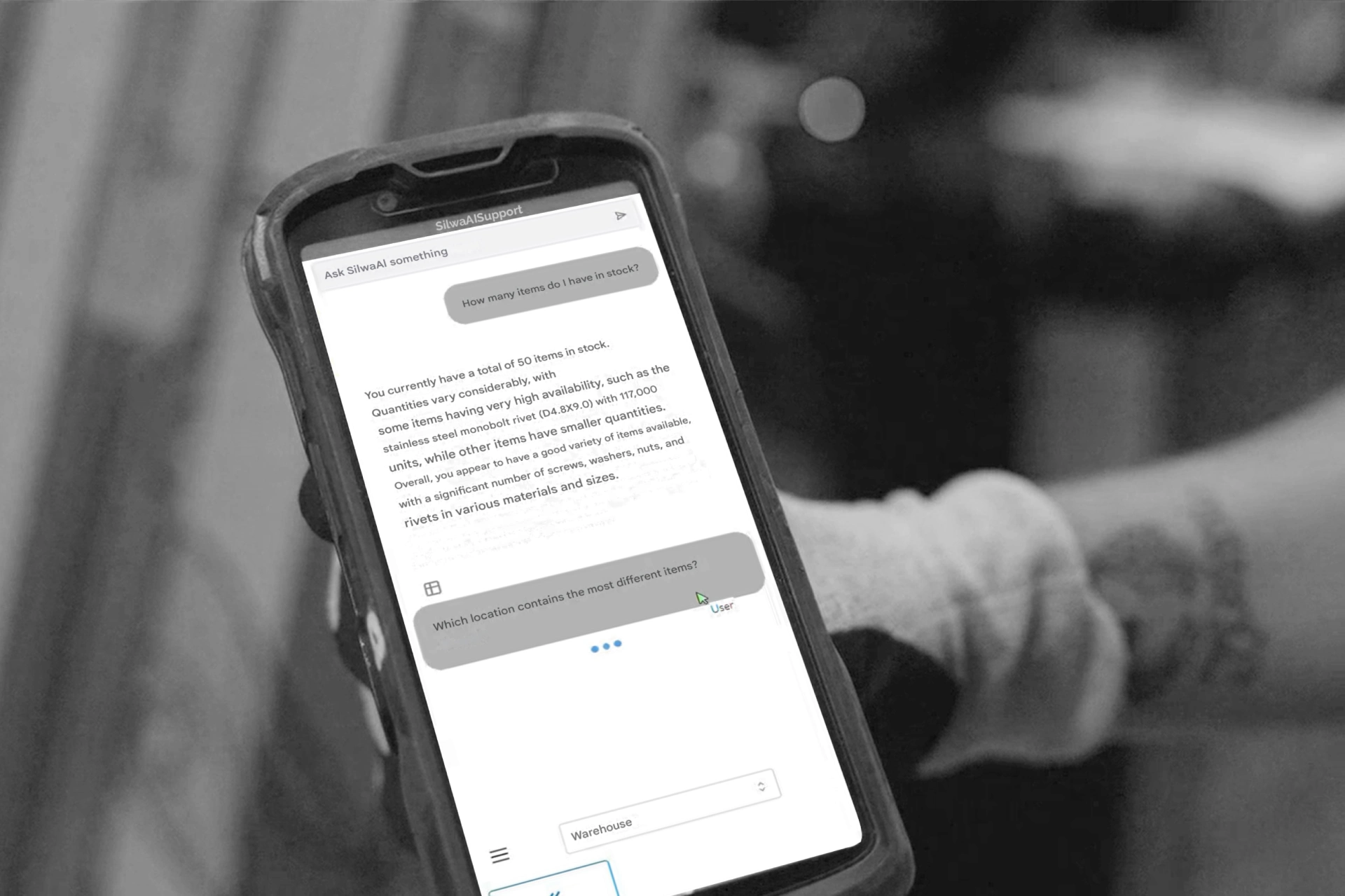
Regarding Generative AI, as mentioned earlier, Stesi has been experimenting for some time with the use of generative models like OpenAI’s GPT-4, training the Artificial Intelligence on specific project-related silwa documentation. This aims to create integrated chatbot prototypes capable of assisting users and WMS operators, providing them with exact answers to specific questions ranging from how certain mechanisms work to data extraction. All of this, naturally, through the use of natural language.
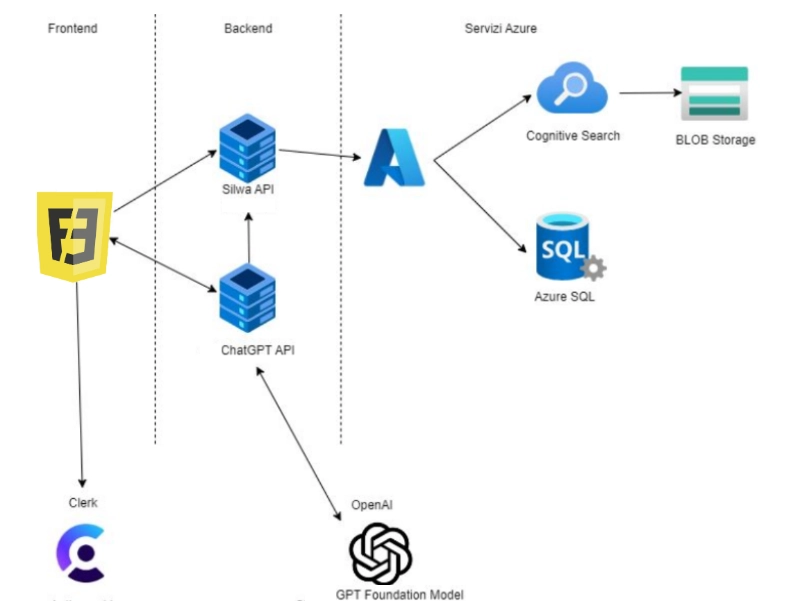
An example of chatbot architecture using OpenAI’s GPT models
This project was carried out with the contribution of students from the Liceo Flaminio in Vittorio Veneto during the project “work after studies is not uncertain“.
A conclusion
What can we expect regarding Artificial Intelligence and logistics in the near future? “In the medium term, emerging technologies such as IoT, robotics, and natural language processing will certainly contribute to greater integration and automation of logistical processes. AI could become increasingly central to supply chain management, helping companies anticipate market needs and adapt to variations in operating conditions.”
One thing is certain today: AI is proving to be an invaluable resource in the logistics field, allowing for the optimization and streamlining of processes. “What matters, however, is knowing that Artificial Intelligence brings new opportunities but also new challenges, especially regarding data security.”
Do you want to delve deeper into the subject? Contact us to learn more. In the meantime, take a look at Humason, the corporate group that Stesi has been part of for some time, which specializes specifically in RPA and AI.
