


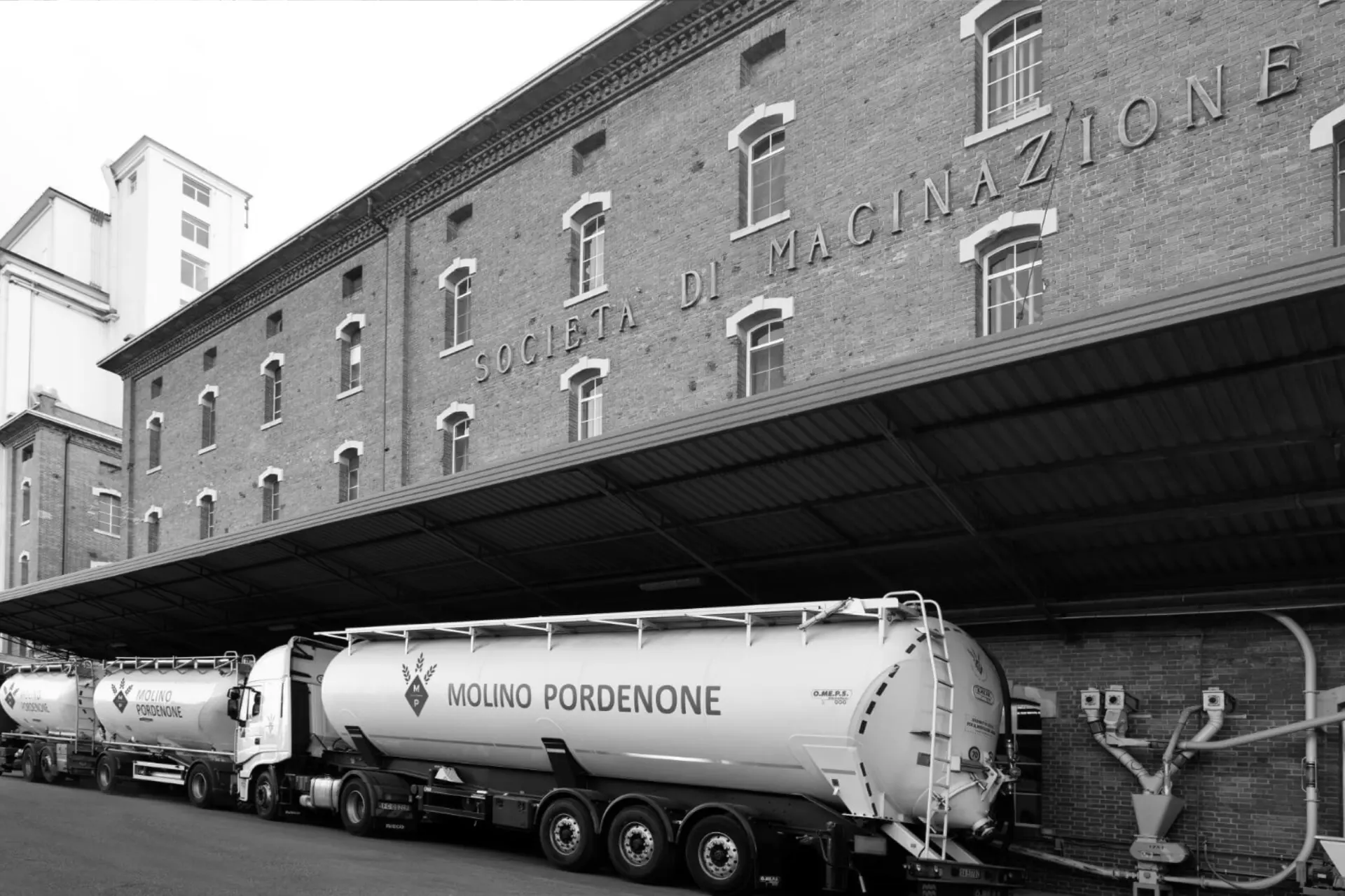
The collaboration between Stesi and Molino Pordenone, a historic name in the Italian food industry, sits firmly within the broader journey toward efficient logistics.
The implementation of the silwaSUITE has represented an important step forward in the digitalisation of the Friuli-based company’s production and logistics flows.
Molino Pordenone: flour for baking professionals
Molino Pordenone was founded in 1923 and over the course of a century has become a benchmark in the production and distribution of high-quality flour for professional bakers, pastry chefs and pizzaioli. The company’s flours have always been formulated to suit the specific characteristics and requirements of the final product. The range is divided into three main lines: products for bread-making, pastry and pizza.
Molino Pordenone is a fully industrialised operation with technologically advanced facilities built on the Industry 4.0 paradigm, ensuring constant process control, high productivity and consistent end-product quality. Among the figures that reflect the company’s production capacity and quality standards are 70,000 tonnes of grain processed every year, 2,800 trucks of raw materials analysed on arrival, 3,500 internal and external analyses, and 640 milling lots analysed annually.
Efficient logistics: from ERP to the power of a WMS
As is often the case, the opportunity to upgrade the technology stack in support of more efficient logistics was triggered by a relocation from the company’s historic premises to a new facility, better suited to the demands of the present and the ambitions of the future.
Before silwa was implemented, lot management was handled manually. While the company managed its movements in an agile and effective way, the limited level of digitalisation exposed processes to productivity and efficiency constraints, and to the risks inherent in any manual activity, starting with human error. For logistics flow management, the company was using an ERP developed by a local software house, which raises the well-known question of whether a management information system is truly adequate for governing complex logistics environments.
The role of silwa in the new logistics environment
The floor space of the new warehouse, in line with the needs of a solid and growing business, is covered by ground-level storage areas divided into high-rotation and low-rotation zones. Materials are stored in non-stackable units and handled using counterbalance forklifts and pallet trucks. To optimise logistics flows well beyond what the ERP could deliver, the silwaSUITE was selected for its robustness, modularity and future development potential. It is worth noting that silwa‘s broad functional coverage does not come at the cost of flexibility: the suite can be integrated with purpose-built technologies such as RTLS systems, automation equipment and any future evolution in line with the Industry 4.0 paradigm.
Within Molino Pordenone’s production and logistics environment, silwa is used for lot management in support of traceability, which is fundamental in the food industry, as well as for supervising the logistics flows of goods acceptance, stock management, picking, packing and dispatch. Thanks to the software, the company is able to streamline all internal logistics activities, achieving concrete benefits in terms of lead time, logistics costs, safety, compliance and sustainability. The future-proof nature of the solution already mentioned is an additional advantage.
Compared to the standard configuration, Molino Pordenone uses a specific approach at the labelling stage: rather than following the GS1 standard, which proves difficult to print and apply correctly on flour sacks, a QR code is printed directly onto the sack instead. This QR code carries all the product master data required for traceability purposes. In this way, silwa is able to keep lots, movements and transfers under full control, successfully orchestrating a modern and efficient system.
