



In recent years, Italian logistics has found itself at the intersection of two forces that are reshaping the global economy: digitalization and sustainability. Both are now strategic levers that are more essential than ever for business competitiveness, especially in a country characterized by a strong manufacturing base and a productive fabric dominated by SMEs. In this context, Artificial Intelligence is playing an increasingly important role, acting as a true enabler of efficiency, cost savings, and reduced environmental impact.
At Stesi, we see this every day. We know that route optimization systems can reduce transport-related emissions by up to 20%, while predictive demand models can cut excess inventory by as much as 25%. Economic and environmental benefits that are increasingly aligned.
It is within this framework that the work of Mattia Ulleri takes place. As part of his Master’s degree in Marketing, Consumption and Communication at IULM University in Milan, Mattia developed his thesis “Artificial Intelligence and Sustainable Logistics: perspectives and experiments from the Italian landscape”. His research offers an in-depth and revealing analysis of the relationship between Artificial Intelligence and the green transition within the Italian supply chain.
Among the case studies analyzed, Stesi represents a privileged observatory: an Italian software house that has been developing advanced supply chain management systems since 1996 and that belongs to the 7% of Italian companies using AI in a structured way. Thanks to the technical contribution of Mario Avdullaj, Software Developer and member of Stesi’s R&D team, whom we had previously interviewed on the impact of AI in logistics, the thesis explored real-world projects and highlighted how Artificial Intelligence can become a key driver for greener and more competitive logistics, provided it is supported by the right skills, reliable data, and targeted investments. And it is precisely from those who are already building this future, such as Stesi, that the most valuable experiments emerge.

The context: digitalization and sustainability are no longer separate paths
In recent years, the industrial world has been undergoing a double transformation. On one hand, global economic change marked by geopolitical instability, protectionism, and fragmented supply chains; on the other, growing environmental urgency, driven by resource scarcity, biodiversity loss, and increasing social and regulatory pressure. In this scenario, digitalization emerges as an indispensable transformation lever, enabling companies to address resilience and sustainability challenges with greater confidence.
Automation today evolves into a fully integrated technology ecosystem, combining:
-
IoT (Internet of Things) to optimize physical processes such as logistics, inventory, and maintenance.
-
Data-driven models, where data becomes “the new gold” for strategic decision-making.
-
Artificial Intelligence, the ultimate ally for prediction and decision support.
All of this has direct impacts on efficiency and sustainability. New technologies make it possible to reduce energy consumption, optimize transportation, avoid overproduction, minimize errors across the supply chain, and even simulate scenarios through Digital Twins.
Of course, digitalization also has an environmental cost: energy-intensive data centers, e-waste production, extraction of critical resources (such as lithium), and pollution. At the same time, however, it is precisely digital technology that enables companies to design measurable and truly green logistics practices, including:
-
dematerialization,
-
real-time environmental monitoring,
-
full traceability (e.g. blockchain for ethical supply chains and carbon credits),
-
consumption optimization,
-
circular economy models.
All these elements are made possible by digital technologies, which therefore represent a cornerstone of green Industry 4.0 and Smart Factories, where humans and machines collaborate safely and efficiently.
“The adoption of higher levels of digitalization in business processes supports the verification of greenhouse gas emissions and the creation of digital product passports, improving the traceability of materials and components and enabling circular economy models, while also ensuring adequate monitoring of operational and energy-related process parameters.”
— Digitalization & Decarbonization Report 2023, Energy & Strategy
Supply chain is the prime field where the synergy between digitalization and sustainability fully unfolds. A modern supply chain is agile, transparent, measurable, and data-driven: it can forecast demand in advance, reduce unnecessary inventory, optimize routes to cut time and consumption, improve service quality, and minimize environmental impact.
As highlighted by Mattia, the supply chain is the real laboratory where companies can turn environmental urgency into a concrete competitive advantage. This happens through:
-
Sustainability as a competitive advantage: emission reductions (electric or hybrid vehicles), eco-friendly packaging, and circular economy practices lower costs and create value.
-
Enabling technologies: IoT tracks goods and conditions, AI forecasts demand and optimizes routes, blockchain ensures transparency and authenticity, and Digital Twins simulate and optimize the entire supply chain.
All of this requires a cultural shift. Companies that succeed in combining technological innovation with environmental responsibility will not only achieve operational efficiency, but will also redefine their market value in the eyes of customers and partners who are increasingly attentive to impact and sustainability.

Artificial Intelligence in sustainable logistics
As Mattia Ulleri writes, Artificial Intelligence represents the cognitive infrastructure for proactive, agile, and sustainable logistics: “If data are the ingredients of a recipe, the algorithm represents the steps needed to prepare it.” AI is therefore the engine that transforms data into operational efficiency (reducing costs, time, and errors) and, inseparably, into environmental sustainability, by cutting waste, emissions, and resource consumption. In the supply chain of the future, being data-driven automatically means being both more competitive and greener. The challenge is not only technological, but also one of integration and corporate culture. That said, “Artificial Intelligence” is often used as a catch-all term. In reality, AI consists of four main technologies:
-
Machine Learning (ML): systems that learn autonomously from data to predict trends, optimize processes, and automate decisions. It is the foundation of predictive analytics.
-
Deep Learning (DL): an advanced form of ML that uses artificial neural networks (such as CNNs for images or RNNs for time series), ideal for complex tasks like real-time visual recognition of goods or defects.
-
Natural Language Processing (NLP): enables machines to understand and generate human language. In logistics, it automates document management (delivery notes, orders), enhances customer service chatbots, and analyzes feedback and claims.
-
Computer Vision (CV): gives systems “eyes”. Through cameras and algorithms—mainly CNNs—it enables goods inspection, code reading, quality control, warehouse safety, and autonomous vehicle navigation.
Integration into logistics processes: where AI makes the difference
AI integrates into every link of the supply chain, creating a data-driven, predictive, and self-optimizing supply chain.
- Predictive analytics: the “killer application”. AI analyzes historical and real-time data (from IoT sensors, market trends, etc.) to:
- accurately forecast demand, reducing excess inventory and out-of-stock situations;
- enable predictive maintenance, preventing failures and production downtime;
- optimize inventory, transportation, and reverse logistics.
- Warehouse optimization: AI turns warehouses into intelligent environments. Combined with IoT (RFID, sensors) and robotics, it enables:
- dynamic slotting, automatically positioning goods based on demand and turnover;
- robot-assisted picking, with autonomous mobile robots (AMRs) collaborating with operators to increase productivity and safety;
- real-time monitoring and automated quality control through Computer Vision.
- Transportation optimization: one of the areas with the highest cost and environmental impact, especially in last-mile logistics:
- intelligent route optimization, with algorithms calculating routes in real time based on traffic, weather, consumption, and delivery windows, reducing empty miles, fuel costs, and emissions;
- load optimization, maximizing vehicle utilization while respecting weight, volume, and safety constraints;
- autonomous driving, still under development, but with strong potential to transform deliveries in controlled environments and last-mile scenarios.
- Process automation: AI goes beyond rigid automation, making processes adaptive. By combining RPA (Robotic Process Automation), Computer Vision, and robotics, it automates repetitive tasks (from order processing to inventory checks) minimizing human error.
- Generative AI (GenAI): the emerging frontier, with strong potential in planning, decision support, and document management thanks to large language models (LLMs).
The tangible impact on sustainability and the environment
The adoption of AI in logistics delivers measurable and mutually reinforcing benefits. From an operational efficiency standpoint, companies that integrate predictive and automated systems report cost reductions between 5% and 15%, higher productivity (up to +25%), and fewer unplanned downtimes thanks to predictive maintenance, which can reduce machine downtime by up to 25%. Delivery punctuality also improves significantly, with gains of up to 15%.
At the same time, the workforce is not replaced, but repositioned toward higher-value roles such as data analysts, robotics technicians, and system supervisors, creating a more resilient operating model.
From an environmental perspective, the impact is even more evident. Accurate demand forecasting reduces waste and excess stock, cutting overstock by 10-40% and stock-outs by 20-50%, with a substantial reduction in unnecessary production and handling. Transportation optimization (both in routing and loading) reduces empty kilometers and fuel consumption, contributing directly to lower CO₂ emissions. Some estimates indicate a potential 4% reduction in global emissions by 2030 thanks to AI-enabled logistics.
In warehouses, AI enables smarter energy usage by managing lighting and climate control according to actual needs, saving over 90 kWh per square meter per year on lighting alone. With mobile robots capable of operating even in the dark, energy consumption can be reduced even further.

The Italian landscape: a sector in transformation, with its contradictions
In his thesis, Mattia Ulleri provides a realistic snapshot of the state of sustainable logistics and AI adoption in Italy, revealing a sector in transition but marked by strong contradictions.
The Italian logistics sector is increasingly central to the economy. Recent studies by the Politecnico di Milano (2025) report a 36% increase in turnover since 2019, reaching €118 billion in 2024. This growth has been accompanied by regulatory pressure and incentives, such as the PNRR and the Transition 5.0 plan, offering tax credits from 15% to 45% that push digitalization as a necessary path to sustainability. Stakeholder pressure (from investors, customers, and banks) on ESG issues is also rising sharply.
However, Italian logistics still lags behind, constrained by:
-
structural dependencies: 92% of goods are transported by road, far from EU intermodality targets. Italy’s geography and low load saturation (“load factor”) make transport energy-intensive;
-
inefficient warehouses: often characterized by uneven space utilization and manual processes, leading to high energy consumption for lighting and climate control.
Sustainability, therefore, is widely acknowledged but struggles to become a concrete reality. The Green Logistics Survey 2024 (LIUC), involving around 500 logistics managers, depicts a sector in motion: about 70% of companies declare sustainability goals, but only 40% actively pursue them, and mostly for less than five years. Among SMEs, these percentages drop sharply, highlighting their difficulty in absorbing related costs.
Interestingly, the area with the highest investment is warehousing and intralogistics, driven in part by the energy crisis, followed by transportation, packaging, and supply chain organization. Companies that take action report tangible benefits: lower energy costs, reduced waste and emissions, and greater operational resilience. The use of KPIs to monitor environmental performance also becomes central, as a prerequisite for meaningful, needs-based improvements.
What about AI adoption in Italian logistics? Interest in AI is high, but operational maturity remains low. Data from ISTAT 2025 and LIUC-Columbus AI Radar reveal a significant gap:
-
structural delay: only 8.2% of Italian companies with more than 10 employees use AI, compared to a 13.5% EU average, with adoption concentrated mainly among large enterprises;
-
a worrying paradox: 30% of companies claim to have implemented AI, but only 7% actually use it operationally. The rest remain in experimental phases.

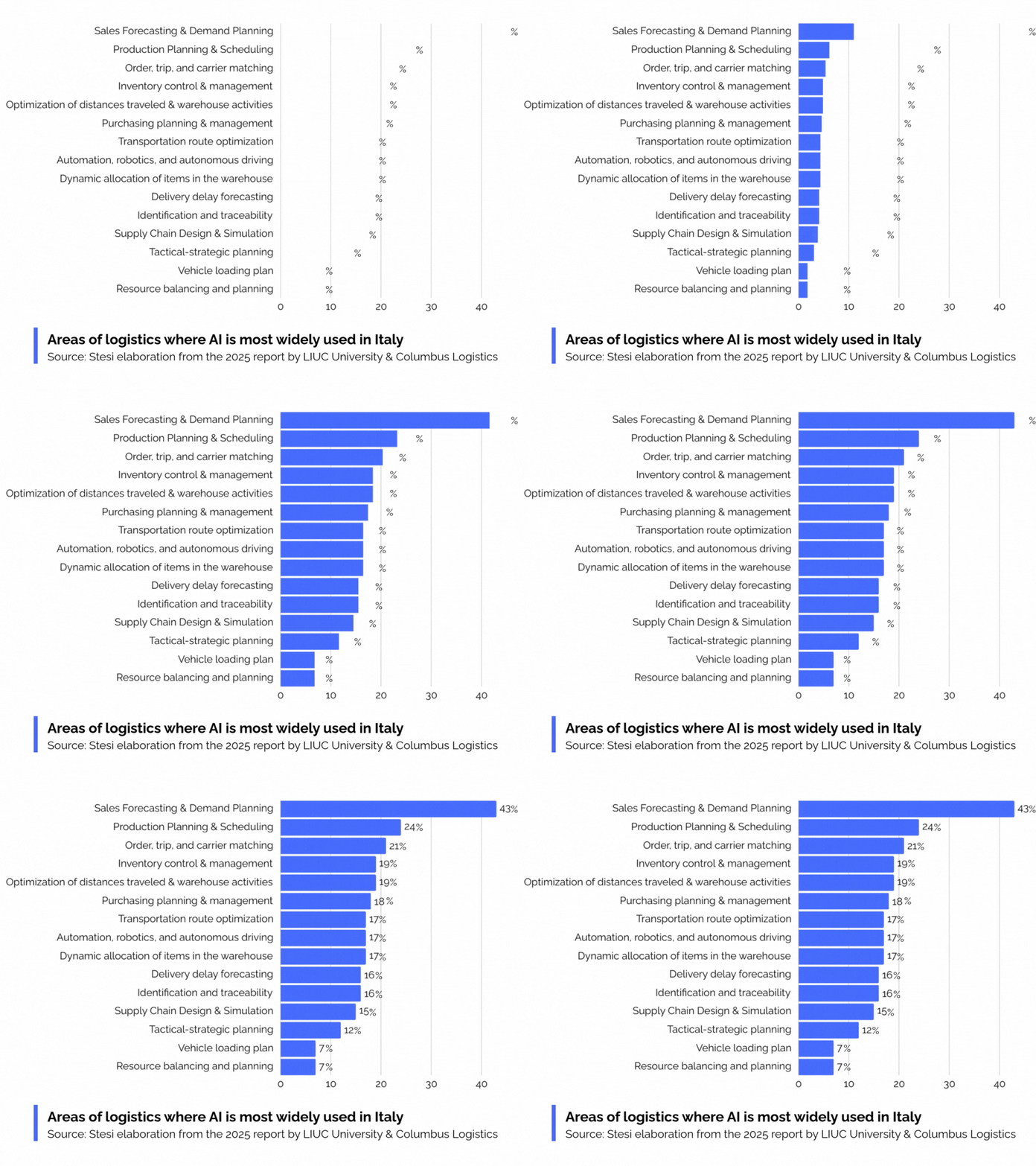
The main barriers to adoption are lack of internal skills and concerns about IT costs. Among companies that do adopt AI, the primary area of application is supply chain planning, historically the first domain for algorithmic development. 43% of companies with at least one AI application identify sales forecasting as the main use case, followed by inventory management, transportation, and warehousing.
According to Mattia, companies adopt AI primarily for efficiency, service quality, and cost reduction. Sustainability is often a secondary benefit rather than a primary driver. Looking ahead, 60% of companies plan to invest in AI within the next two years, with the highest growth potential in smart warehouses (robotics and space optimization), simulation models (Digital Twins), and transport optimization.
In summary: Italy has a clear understanding of its logistics and environmental challenges and a strong political and economic commitment (through initiatives such as the PNRR, Agenda 2030, and Transition 5.0) to address them. However, the path toward data-driven and sustainable logistics is marked by a double gap: a technological gap compared to Europe, and a structural gap between large enterprises and SMEs. Artificial Intelligence is widely recognized as a strategic lever, but its real operational integration remains extremely limited. The challenge of the coming years is not only technological, but cultural and skills-based: transforming interest into concrete, systemic projects that turn sustainability into a real competitive advantage.
Artificial Intelligence and sustainable logistics in the Stesi case: turning intention into reality
Mattia Ulleri identified Stesi as a concrete example of how Artificial Intelligence can be successfully integrated into the Supply Chain. In Stesi’s approach, the focus on sustainability is strong: investments in Research & Development are directed toward three specific areas, demonstrating how AI is not just theory, but practical application:
- 3D space optimization: thanks to AI algorithms that calculate the optimal arrangement of goods on pallets, internal handling becomes more efficient and truck saturation improves. This not only speeds up operations, but also reduces the number of pallets used by 20% and cuts energy consumption by 10-20%.
- automated mission management: the Mission Manager redistributes warehouse tasks in real time by analyzing operational data. The results include cost reductions of 5-10% and a reduction in lead time from 4.8 to 2.5 days. The system continuously “learns” through reinforcement learning techniques, fueled by IoT data and logistics KPIs.
- intelligent assistance: with the development of SilwaAISupport, a chatbot integrated into its systems (WMS and MES), Stesi provides real-time technical support to operators. Based on advanced models and Cognitive Search, it ensures time savings, operational autonomy, and reduced support costs.
A responsible and forward-looking approach: Stesi does not develop solutions recklessly. Before go-live, software is tested in simulated environments and virtual “sandbox” settings, a method that not only ensures reliability, but also minimizes resource waste and emissions already during the experimentation phase.
Stesi’s vision sees AI as a multiplier of efficiency and an enabler of sustainability, a crucial tool for meeting the goals of the 2030 Agenda. This case study demonstrates that, even within an Italian landscape still considered “lagging behind,” it is possible to combine technological innovation, competitiveness, and environmental responsibility, creating tangible value for client companies and for the country as a whole.
Conclusions: technology matters, but corporate culture matters more
Mattia Ulleri’s research clearly highlights a fundamental point: good intentions exist, but what is often missing are the prerequisites and tools to turn them into reality. This is where Stesi comes in: the Italian software house positioning itself as a facilitator of Artificial Intelligence applied to Supply Chain sustainability. In an Italian context still marked by structural limitations (SMEs with limited resources, insufficient digital skills, fragmented processes, and a corporate culture resistant to change) Stesi stands out as a solid partner, capable of filling precisely those gaps that currently slow down AI adoption.
We bring innovation closer to those who would struggle to reach it on their own. We design scalable and sustainable solutions also for SMEs, helping them overcome cost barriers and transforming “good intentions” into measurable results. Stesi’s philosophy places the well-being of both the environment and workers at the center: a supply chain in which AI does not replace, but empowers. This is why we invest in supporting operators, guiding them through continuous training and upskilling paths that elevate digital skills and make innovation truly usable. At the same time, we enable companies to make data-driven decisions, managing data centrally instead of dispersing it across heterogeneous systems.
With a pragmatic approach and a solid methodology, Stesi creates the technical, cultural, and operational conditions for AI to become a real engine of the green transition. The course is set, the rest is up to you.

FAQ: frequently asked questions about Artificial Intelligence and sustainability
Will AI replace warehouse personnel?
AI transforms and enhances human work, rather than replacing it entirely. As demonstrated by Mattia Ulleri’s research, the shift is mainly a reconfiguration of roles: repetitive tasks are reduced in favor of more specialized roles focused on supervision, exception management, robot maintenance, and data analysis. The real challenge lies in investing in training and reskilling the workforce.
My company is an SME. Is AI only for large corporations?
Absolutely not, although this concern is understandable in the Italian context. The good news is that accessible paths do exist. Thanks to Transition 5.0 incentives and the possibility of relying on specialized partners like Stesi, SMEs can also integrate modular solutions. The journey often starts with a single high-ROI application, followed by the gradual integration of more advanced features as the company and its operational needs grow.
How can we avoid AI projects that fail to deliver results?
First and foremost, it is essential to start from the problem, not the technology. Then, objectives must be clearly defined, key indicators identified to measure results, and the people who work in logistics every day involved through targeted training programs. Finally, it is crucial to choose a provider with proven experience in your specific industry. If you are unsure which solution best fits your needs, book a free initial check-up with Stesi to be guided toward the solution that truly works for you.