


In the high-end Hospitality sector, excellence is not only seen, it is felt. It is reflected in precise gestures, perfect timing, and that silent balance that makes guests feel at the center of a multisensory experience with the highest standards. But behind the scenes of customer service, the story is quite different: inbound and outbound flows, warehouse movements, stock picking, and millimetric logistics synchronization. While a guest enjoys a perfectly served glass of wine, material handling equipment is continuously at work in the warehouse to ensure it reaches them in the right way and at the right time.
This is where Stesi’s inventory management system comes into play, now also implemented in the Hospitality sector. A system that orchestrates, simplifies, and automates every backstage flow (from the warehouse to the various consumption points) freeing up time, resources, and attention to focus on what truly matters: the guest experience.
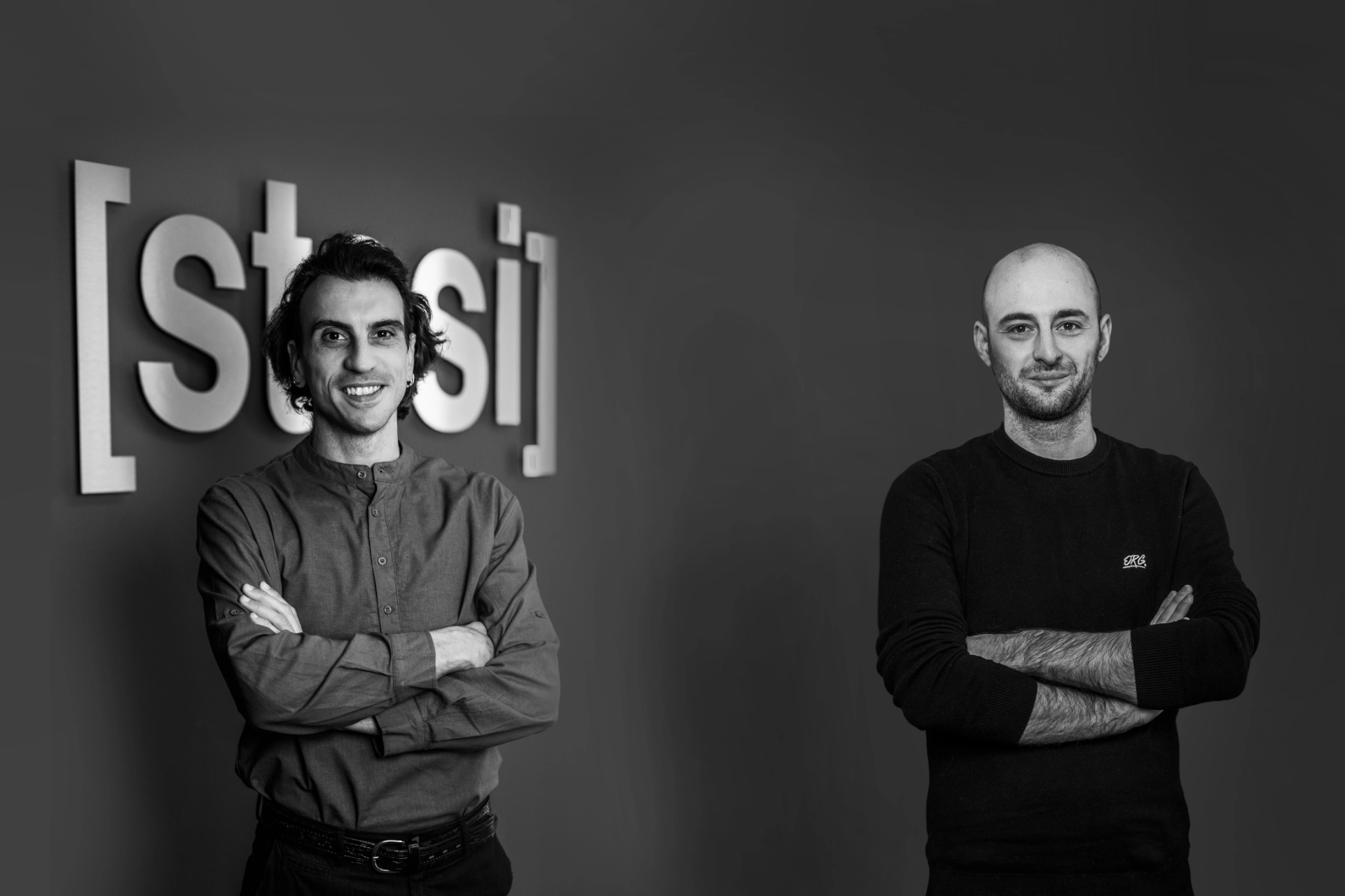
To better understand the features of an inventory management software applied to a specific sector such as Hospitality, we spoke with Alberto Serio and Catalin Cernea, backend and frontend developers at Stesi respectively. They explained how they translate the logistics requirements of luxury hotel estates (often spread across several hectares) into a digital platform capable of simplifying flows, making data accessible, and streamlining daily operations while maintaining high efficiency.
How a hotel inventory management system transforms logistics
When it comes to Hospitality facilities (especially in the luxury segment, but not only), we often refer to true distributed ecosystems made up of multiple main warehouses and numerous consumption points, including bars, restaurants, shops, offices, and other services. Until recently, this logistical complexity was managed without a unified view, with the risk of delays, overlaps, and a lack of material traceability.
“The main requirement is not only knowing how much stock is available, but also exactly where it is located” says Alberto. “At that point, the need for a stock management software (like a WMS software) becomes inevitable: you need a tool that can simplify inventory management and make distribution between the various areas of the resort or estate smoother”.
Alongside the need to centralize information, there is also the requirement to make the system accessible across a very wide range of devices, from tablets and Android handhelds to Windows PCs and Macs, and to ensure a consistent user experience for people with different roles and responsibilities.
“It is clear that the interface must be flexible and intuitive,” adds Catalin. “It has to adapt not only to devices, but also to the needs of very different user profiles: warehouse operators, outlet managers, administrators”.
A tailor-made web portal: from technology to user experience
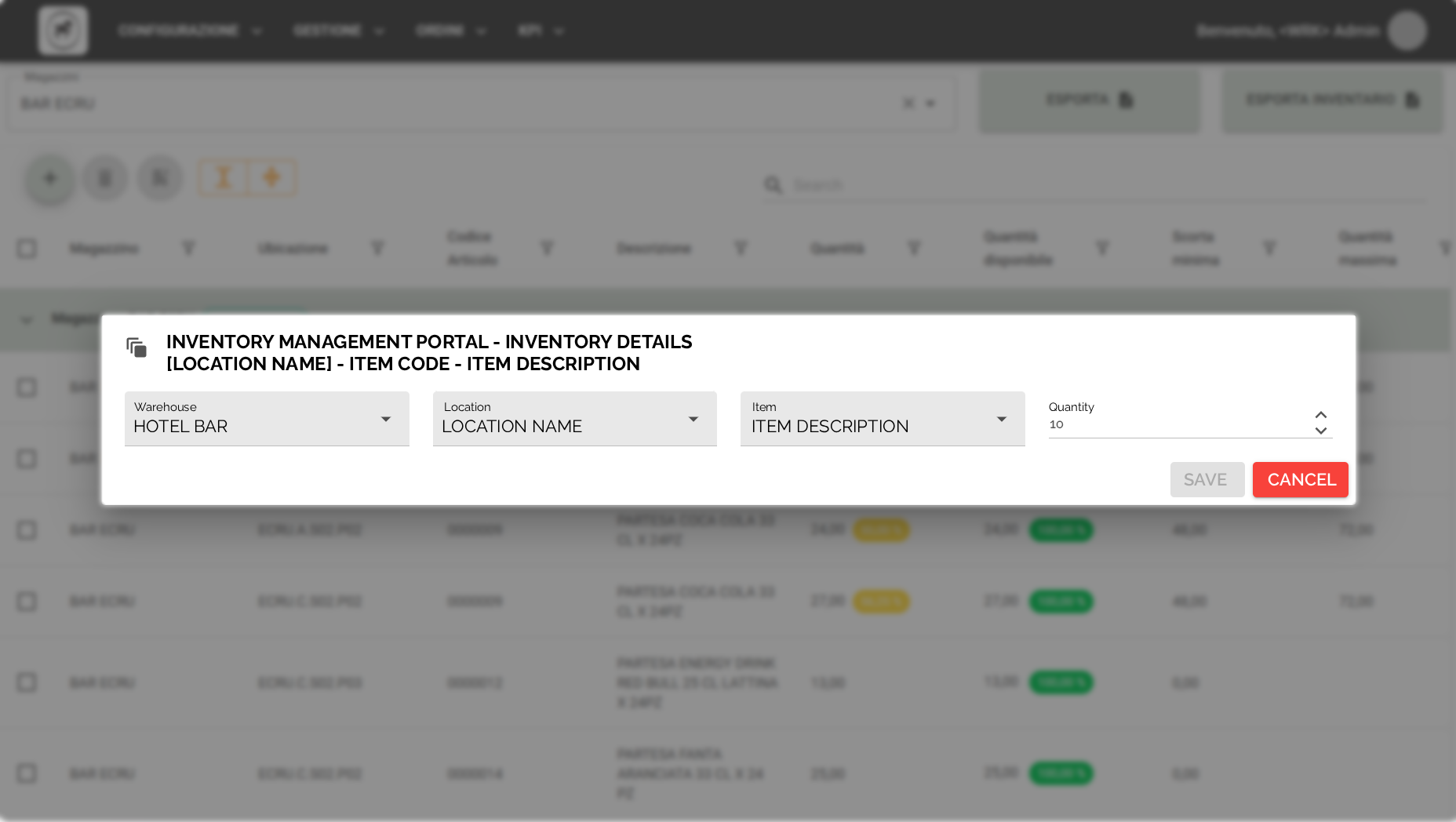
To meet these requirements for accessibility and versatility, the Stesi team designs web-based solutions, accessible via browser and compatible with all the devices used by hotels and resorts. The core of the software is a portal built with Blazor technology, which acts as the main interface for all activities related to inventory management, order creation, and stock monitoring.
“Our Hospitality customers ask for a modern hotel inventory management system or WMS platform that is also consistent with the interfaces they already use” explains Catalin. “We choose a UI framework that allows us to easily customize the layout, reuse the fonts, colors, and graphic style already adopted by the customer, so users do not feel they are working with something foreign”.
Special attention is also given to operational simplicity: each action is distributed across dedicated pages, with few, clear elements and a system of visual feedback that immediately shows users whether an operation has been completed successfully.
“We always prefer to split functionality into multiple focused components rather than concentrate everything on a single page. This makes the experience more orderly and less confusing, especially for those who use the software every day for very specific operations,” Catalin adds.
A backend designed to simplify complexity
Portal design does not happen in isolation. From the earliest stages, interface development is supported by joint work on the backend to ensure consistency between business logic and technical structure. This synergy is essential, especially in a context where business requirements are both diverse and highly specific.
“Rather than starting from a standard to adapt, we built the system around the customer’s real processes,” explains Alberto. “This allowed us to develop targeted, lightweight, and fast interfaces that return only the data that is actually useful to the user.”
From automatic recognition of the facility associated with each operator to role-based profiling, every element is designed to ensure clarity, relevance, and speed of action. Users only see what they need, when they need it. This applies to everything: from stock visibility and minimum threshold management to KPI access and reporting.
“We implement middleware that handles much of the complexity behind the scenes,” he continues. “From the user’s perspective, the software looks simple and immediate. Under the hood, however, there is an infrastructure that automates many of the heavier operations, reducing time, errors, and confusion”.
Control, automation, and visibility: a system that works for the user
Beyond operational management, one of the main challenges is providing users with a tool that can anticipate needs, simplify decisions, and reduce the margin of error. The softwares developed by Stesi for Hospitality customers integrate intelligent stock management mechanisms that make it possible to manage minimum levels precisely and automate replenishment requests.
“silwa WMS can automatically generate a request when an item drops below a defined threshold,” explains Catalin. “This means outlet operators no longer need to manually check stock levels: the system does it for them”.
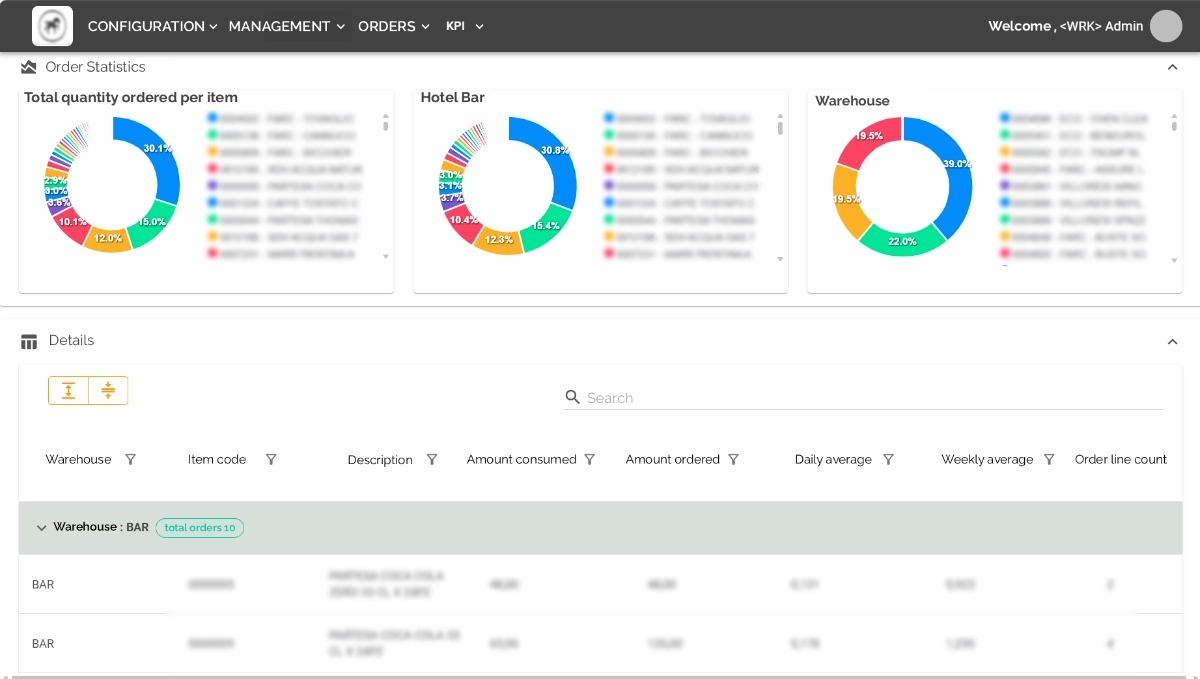
KPI management is also designed to adapt to very different requirements. Data visibility can be configured by role, allowing administrators to decide exactly which information is available to each user.
“Every action can be enabled or disabled based on role,” Catalin continues. “Even viewing a KPI is treated as a specific permission. This way, those who manage the software have full control over what each operational role can do and see”.
This flexibility enables not only safer use of the software, but also deep customization of the user experience, resulting in higher efficiency, fewer errors, and more informed decisions at every stage of the internal supply chain.
WMS integration with ERP and Hospitality-specific consumption logic
Another key aspect of Hospitality projects is integration with the ERP systems in use, enabling continuous flow between purchase orders, goods receipt, and internal movements. This connection is essential to ensure consistency and traceability throughout the logistics chain.
“In this case, we develop ad hoc consumption logic,” says Alberto. “For example, with premium wines, for security reasons it is not possible to order a single unit, only a full case”.
In addition to these customizations, the software allows operational notes to be associated with movements, so that additional information travels together with the goods and is immediately visible to the recipient. A detail that helps make every stage clearer, more accurate, and better coordinated.
Tangible results: a new organization for flawless hotel inventory management
Just a few months after the introduction of the new hotel inventory management system, the benefits are already clear. The system makes the handling of thousands of items smoother and fully traceable, with a monthly average of over 500 transfers between the various facilities where Stesi has implemented the solution.
Digitalization of flows also has a direct impact on day-to-day work quality. Operators, now supported by intuitive tools and smart automation, can focus on higher-value activities, reducing error margins and processing times. The availability of KPIs and up-to-date data has also fostered a more informed view of stock management performance, making it easier to take decisions on reordering, minimum thresholds, and allocation.
But the most important result may be the least visible one: today, the resorts and hotel estates that have chosen Stesi’s WMS can guarantee an even higher level of service without guests perceiving any complexity. Logistics works silently, yet decisively, to make every stay smooth and flawless.
Hotel inventory management system: an experience that creates value
Every project brings new challenges and, when approached with the right mindset, new expertise as well. The experience gained in the Hospitality sector has enabled Stesi to further refine its approach, strengthening its focus on operational detail and consolidating a methodology that is increasingly flexible, scalable, and user-centered.
In a particularly complex context such as luxury Hospitality, the importance of designing solutions capable of naturally adapting to a wide range of needs and operational roles has clearly emerged. And it is precisely this kind of sensitivity, born of real, structured experience, that Stesi now makes available to very different organizations, united by the need to make their internal processes smoother, more reliable, and more strategic.
Stesi’s inventory management system for hotels has not merely been a successful project. It has become one of the benchmarks that continue to inspire the way Stesi approaches every new challenge, with the awareness that true innovation comes from the ability to listen, interpret, and build solutions that truly work.
And it is precisely from this listening-driven approach that Stesi has chosen not only to offer software solutions for medium and large organizations, but also to expand its portfolio with products suitable for smaller businesses. SilwaGO, the “ready-to-go” WMS with core functionalities (such as stock management) was developed to fit the budgets of small Hospitality facilities that still want to provide impeccable service to their guests.
Have you recognized something of your own reality in this article?
Let’s talk about it. Discover how we can build a tailored solution for your business.
