



Supply Chain Execution Systems (SCES) are today, in a historical period in which logistics is under growing pressure across every sector, an indispensable and decisive tool for any business. Consumer demands are increasingly varied and exacting, speed and traceability have become non-negotiable requirements, customization has become the norm, and e-commerce continues to push toward fast, digital, and integrated processes. In this scenario, the automation and computerization of operational flows are no longer a competitive advantage but a necessary condition for remaining in the market.
Against this backdrop, logistics and production are progressively converging, and for companies operating within the supply chain, it is no longer sufficient to manage various processes as separate from one another. What is needed is an integrated perspective and robust management tools covering every step of the chain, for the control and optimization of the entire supply chain. Supply Chain Execution Systems (SCES) represent a winning solution in this regard.
According to a Gartner report, by 2027 more than 75% of manufacturing companies will have adopted an integrated SCES platform for the operational management of their supply chain, demonstrating just how central these tools are becoming in industrial strategies. Let us look in detail at what they actually are.
Supply Chain Execution Systems (SCES): what are they?
Supply Chain Execution Systems (SCES) are software platforms that manage and optimize the operational execution of the entire supply chain, from logistics through to production. Unlike individual vertical software solutions (such as WMS for warehouse management, MES for production control, or TMS for transportation), an SCES integrates them into a single coordinated platform, offering a unified, real-time view of all the supply chain’s operational processes. These are therefore systems capable of acting as a single end-to-end supervisor, managing logistics operations such as order management, warehouse management, product sourcing, and transportation. This makes it possible to reduce the inefficiencies that are typical of fragmented management.
A Supply Chain Execution System is therefore a strategic and irreplaceable tool for any business: it acts as the definer and guarantor of supply chain execution processes, and deploys a broad spectrum of solutions and technologies to implement the required outcomes in an effective, ergonomic, and cost-efficient manner. A strong SCES is also capable of collecting and providing decision-makers with a wide range of real-time information, which is invaluable for monitoring performance and improving efficiency with the goal of optimizing the service level delivered to the end customer.
Supply Chain Execution Systems (SCES): key features
What are the features that SCES platforms offer in an integrated manner across the supply chain?
- Order management: inventory management applications provide an overview of product pricing, stock levels, and the location of goods within the warehouse. It is possible to automate seasonal price variations, plan product reordering in advance, and simplify internal procurement procedures.
- Sourcing and packaging.
- Warehouse management and inventory control: real-time measurement of stock levels to know which products are available, in excess, or running low.
- Dynamic transportation management: setting deadlines for product deliveries, calculating the shortest routes to reduce fuel consumption, and creating optimized product loads to maximize distribution efficiency.
- Returns and recall management.
- Workforce management and planning: using real-time data to maintain consistent staffing levels.
All the applications managed by Supply Chain Execution Systems ultimately serve to reduce operating costs and increase competitiveness, contributing to overall business success. Fulfilling orders more quickly and efficiently leads to greater customer satisfaction, making customers more likely to use the company’s services again. Reducing packaging waste generates production savings. By streamlining orders, procurement, and transportation, the company can avoid the additional costs associated with late deliveries or inconsistent orders.
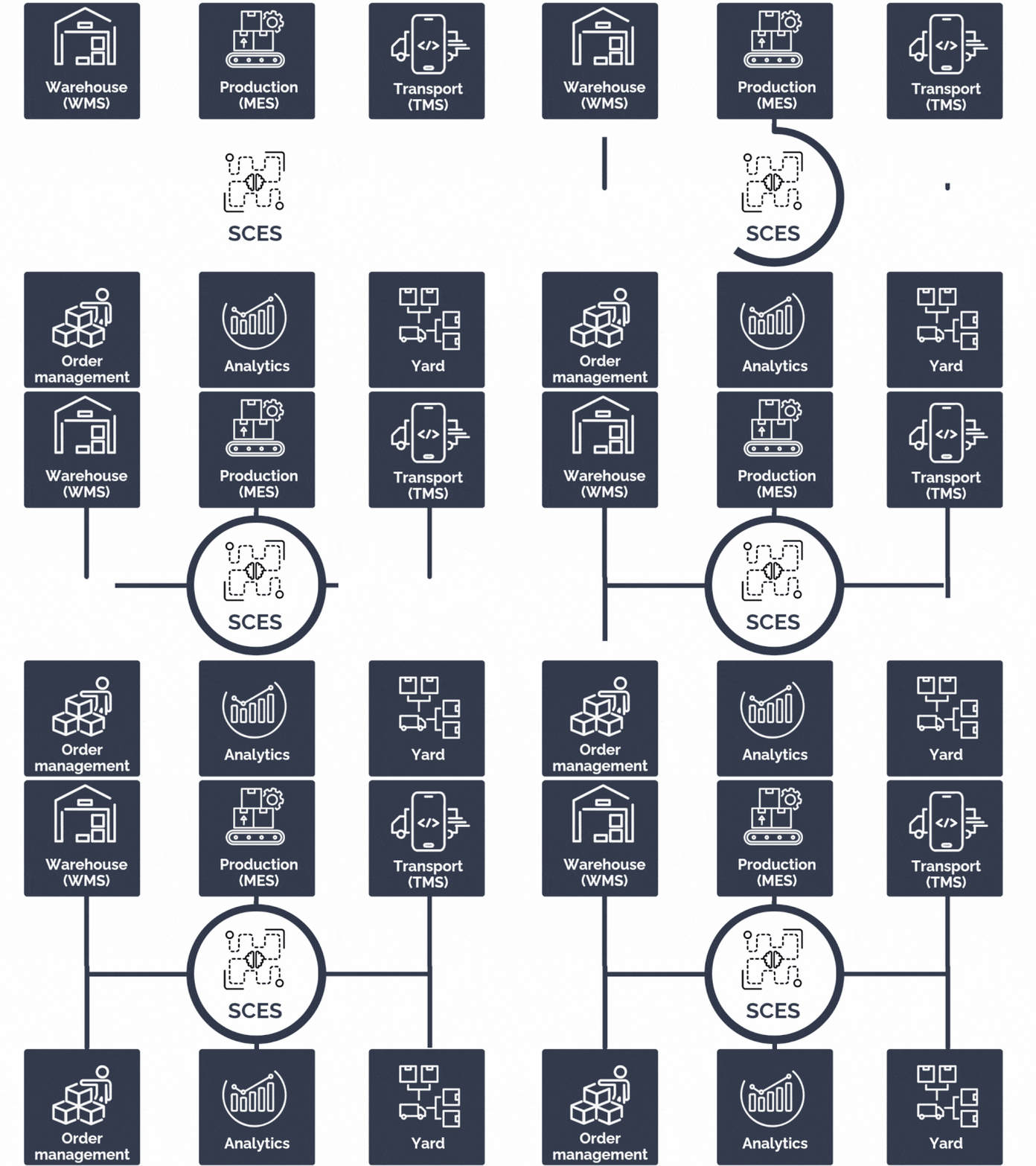
The vertical software modules integrable into a Supply Chain Execution System
Supply Chain Execution Systems (SCES) are distinguished by their ability to integrate multiple vertical software modules into a single coordinated platform, each one specialized in managing a specific operational domain. Depending on the provider, the architecture of an SCE supervisory system may vary, but the following are among the main software modules most commonly integrated within an SCES:
- WMS (Warehouse Management System): a warehouse management system that optimizes space, picking processes, storage, and order preparation.
- MES (Manufacturing Execution System): a production control system that connects manufacturing processes with the supply chain and enables real-time visibility.
- YMS (Yard Management System): a yard management system that coordinates the movements of vehicles, containers, and trailers at logistics hubs and manufacturing facilities.
- Slotting software: a goods placement optimization tool that improves picking performance and reduces errors.
- WCS (Warehouse Control System): a warehouse automation control system that manages equipment such as conveyor belts, sorters, and robotics.
- LMS (Labor Management System): a workforce management system that dynamically assigns resources and measures productivity.
- TMS (Transportation Management System): a transportation management system that plans, tracks, and optimizes shipments by road, air, and sea.
Supply Chain Execution Systems: enabling technologies
SCES platforms must be able to rely on a solid foundation of enabling technologies, which are increasingly spreading across warehouses and throughout the supply chain and are progressively guiding more and more companies toward an Industry 4.0 approach. Among the most significant:
- IoT devices
- Client/Server architectures
- Cloud and hybrid-cloud solutions
- Real-Time Location Systems (RTLS), especially next-generation systems based on laser and UWB technology
- Virtual and augmented reality
Data analytics technologies deserve a separate mention: the new generation of intelligent devices is capable of collecting a wide variety of real-time data, which can then be analyzed and processed to extract information that is useful for optimizing processes and operational models. The result is a notable increase in the company’s decision-making speed, in an era where choices must necessarily become faster, data-driven, and dynamic.
Completing this picture, artificial intelligence (AI) and in particular machine learning (ML) are emerging as key factors in the evolution of SCES platforms. As highlighted in a recent article by Vlachos and Reddy (2025), ML is establishing itself as a “disruptive” technology for the optimization of numerous supply chain processes, from demand forecasting to procurement, from risk management through to logistics network optimization.
“ML has emerged as a disruptive technology, significantly benefiting supply chain planning, execution, and control.” (Vlachos & Reddy, 2025, Machine learning in supply chain management: systematic literature review and future research agenda)
The research also highlights how the combination of ML, generative AI models (GenAI), and Large Language Models (LLMs) is opening new frontiers, offering companies the possibility to build more resilient, intelligent, and proactive supply chains. The framework proposed by the authors, based on the four Vs (Volume, Variety, Variation, and Visibility), helps to understand how these technologies can address real operational complexities, transforming the entire supply chain execution from reactive to predictive.
Critical issues resolved by an SCES (Supply Chain Execution System)
Many companies live with silent inefficiencies, sometimes considering them inevitable (such as inventory errors) and sometimes treating them as almost “necessary” (such as operators wandering around looking for something, or long onboarding times for new hires). Yet none of this is either useful or necessary for business growth. This is precisely where an SCES comes into play: a system capable of orchestrating and optimizing the entire supply chain execution.
Here are some of the main challenges an SCES resolves:
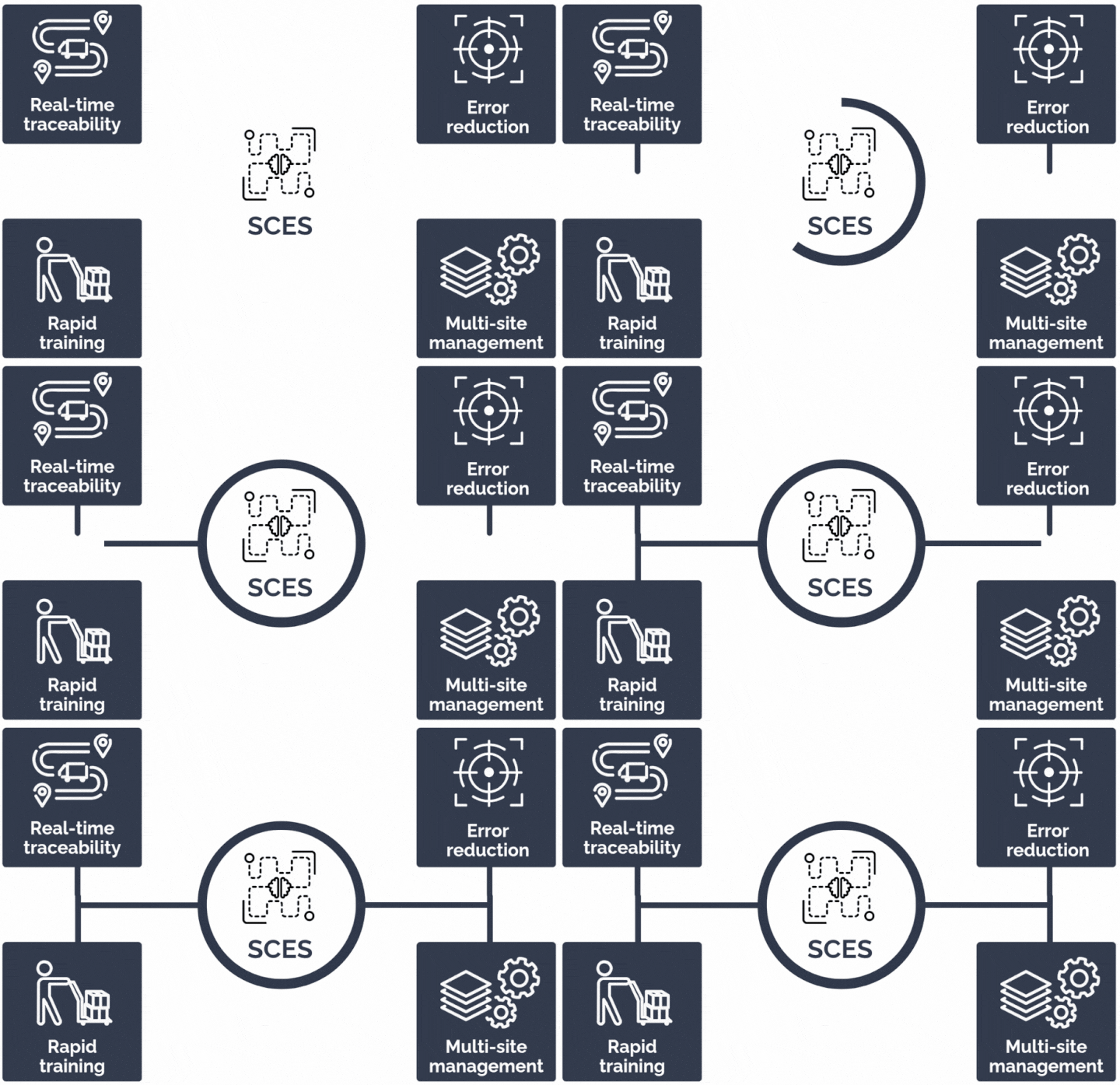
- Real-time traceability: an SCES guarantees continuous visibility over every item, logistics unit, and production order. There is no longer any need to “ask around” or chase down Excel spreadsheets: every movement is recorded, traceable, and accessible in a few clicks.
- Drastic reduction of operational errors: from eliminating double handling to the automatic printing of labels, an SCE software platform reduces human error. Picking is no longer a matter of guesswork but a guided process verified step by step.
- Fast and standardized onboarding: with intuitive interfaces and digitalized workflows, even a new operator can become fully autonomous within a few days. Processes are supported by on-screen instructions, barcodes, and predefined logical pathways.
- Multi-site efficiency and centralized management: multiple warehouses, remote locations, or temporary depots: an SCES can coordinate all logistics units, even when physically disconnected, integrating them into a single, centralized view.
Agile readiness for growth: are volumes increasing? Are flows changing? Are there new customer requirements? A configurable SCES is capable of adding a new flow or reconfiguring a picking logic in days rather than months.
SCES vs vertical software: which solution is right for your supply chain?
When a unified SCES is the better choice:
- Integration and complete visibility: if the company needs a holistic, real-time view of all operational activities, a unified SCES makes it possible to eliminate information silos and improve coordination between the warehouse, production, and transportation.
- Reduction of IT costs: a single platform reduces licensing, maintenance, training, and integration costs compared to multiple vertical software solutions, especially over the long term.
- Scalability and growth: for companies expanding rapidly or managing complex processes, a unified system facilitates scalability and the handling of large volumes of data and transactions.
- Faster decisions and centralized data: the centralization of data improves analysis, reporting, and decision-making capacity at the managerial level.
When vertical software is the better choice:
- Highly specific requirements: if a company has very particular processes or requires advanced functionality in a specific area (for example, warehousing or production) that a standard SCES does not cover optimally, a specialized vertical software solution may offer greater functional depth.
- Limited budget: for smaller companies or those in the early stages of digitalization, it may be simpler and less expensive to adopt individual vertical modules and integrate them at a later stage.
- Flexibility and customization: vertical software solutions often allow more targeted customization without the need to modify a complex, integrated system.
The choice between a unified SCES and vertical software therefore depends on: the size and complexity of the company; available budget and resources; the need for integration and real-time visibility; and the specificity of operational processes. A balanced approach could be, for example, to begin with vertical software for specific needs and then migrate toward a unified SCES as business growth and complexity require it.
Conclusions: a unified view is a winning view with SCES
To summarize what has been covered in this article, SCES softawre (Supply Chain Execution Systems) are software solutions designed to unify the management of highly varied logistics, production, and distribution processes that have traditionally been handled separately. A good supply chain execution software platform must offer broad functional coverage, must be scalable over time, flexible, and easily integrable with the company’s ERP systems.
A concrete example of an SCES with a remarkable range of features is silwaSUITE, a supervisory platform that has optimized the production and logistics flows of hundreds of companies, helping them keep pace with market evolution over the years. The suite integrates a wide range of modules into a single platform: from WMS for warehouse management to MES for production control, from WCS for automation management to the Slot Management module for the dynamic management of loading and unloading bays.
It also includes the Dispatcher module for flow orchestration, Yard Management for coordinating arrivals and departures, and Analytics for the collection and analysis of operational KPIs. Completing the platform are vertical modules such as Middleware for integration with other systems, FGS for assisted vehicle guidance, Batch for lot tracking, 4ERP for native ERP connectivity, B2C for managing shipments to end customers, Label for label printing, the 3D module for virtual reality simulation, and Safety for process safety management.

FAQ
Supply Chain Execution System: how much does it cost?
The implementation cost of an SCES (Supply Chain Execution System) can vary based on the size of the company, the complexity of its logistics and production flows, the number of sites involved, and the modules activated. Solutions range from simple single-warehouse deployments to advanced systems for multinationals operating across multiple countries. It is important to evaluate the return on investment (ROI) over the medium to long term, which is often very significant. Book a free initial consultation with Stesi to receive a tailored answer based on your specific situation.
How long does it take to implement an SCE software platform?
Implementation timelines depend on the level of customization required and the existing IT infrastructure. For leaner projects, two to three months may be sufficient, while complex and/or multi-site solutions can take anywhere from six to twelve months. A good SCE software partner accompanies the company step by step, not only through the design and go-live phases, but also with dedicated post-implementation support.
Can a Supply Chain Execution System (SCES) replace an ERP?
No. An SCES does not replace the ERP but integrates with it. The ERP handles administrative and accounting processes (orders, invoices, master data), while the SCES is responsible for operational execution on the ground (movements, picking, production, shipments). It is true that some ERP modules partially handle logistics processes. However, these represent temporary, off-the-shelf solutions that do not adapt well to companies aiming to grow and develop a genuine competitive advantage in the market.
Is it possible to integrate an SCES with existing software technologies already in use at the company?
Yes. Modern SCES platforms are designed to be interoperable with other company systems, both hardware and software: ERP, CRM, TMS, production software, IoT devices, robotic systems, automation infrastructure, and more. The use of Middleware connectors facilitates integration without disrupting the existing IT ecosystem. For this reason, companies looking for supply chain management software should above all consider the vendor, who should preferably be a System Integrator capable of delivering a smooth, seamless implementation.
What is Supply Chain Management?
Supply Chain Management (SCM) is the integrated process that coordinates and optimizes all the activities required to transform raw materials into finished products and deliver them to customers. It encompasses planning, sourcing, production, inventory management, warehouse logistics, distribution, and transportation. Supply Chain Management (SCM) is an umbrella term that encompasses both Supply Chain Planning (SCP) and Supply Chain Execution (SCE).
Supply Chain Planning (SCP) vs Supply Chain Execution (SCE): the differences
Supply Chain Planning (SCP) is the strategic planning process that enables companies to balance supply and demand across the entire supply chain. Through the analysis of historical data, market trends, and sales forecasts, SCP defines how, when, and in what quantities goods must be produced, procured, and distributed to meet future demand.
Supply Chain Execution (SCE) is the operational phase that follows planning: it concerns the concrete execution of logistics and production processes, and includes activities such as order management, inventory control, transportation, and distribution. In summary:
- SCP means planning what to do (forecasts, strategies, future scenarios);
- SCE means putting the plan into practice (day-to-day operations, management of physical flows).
Supply Chain Execution: how to optimize it?
Optimizing Supply Chain Execution requires improving every operational phase of the logistics chain, from inventory management through to shipment. To do this effectively, it is essential to adopt advanced technologies, plan demand based on historical data, select reliable suppliers, and strategically distribute stock.
Key actions include:
- choosing local suppliers and manufacturers to cut logistics costs;
- implementing intelligent inventory management systems to avoid stockouts and overstocking;
- using multiple warehouses when serving a broader geographical area to reduce shipping times and costs;
- planning in advance for demand peaks such as seasonality or promotional events;
- maintaining constant communication with suppliers and 3PLs to manage delays or unforeseen events;
- monitoring partner performance with clear and verifiable KPIs;
- adopting a continuous improvement approach to progressively reduce inefficiencies over time.
With the right combination of technology, analysis, and optimized processes, it is possible to increase the speed, reliability, and sustainability of the supply chain.
What is the best software for Supply Chain Execution?
The best SCE software does not exist in absolute terms. Or rather, the best software is the one that best fits your company’s specific needs. For this reason, if you are looking for a unified supervisory software platform, you should ensure that it has the following characteristics:
- scalability and modularity, meaning a customizable and integrable structure that allows modules to be added over time so that the system can adapt to your company’s evolving needs;
- flexibility and integrability with the information systems already in place within the company, such as ERP platforms;
- a modern and intuitive user experience, enabling warehouse operators to learn the software quickly;
- multi-site and multi-language support, meaning the software must be compatible with any logistics system and network, supporting multi-site, multi-company, and multi-language configurations where required.
A concrete example is silwaSUITE, the SCES with broad functional coverage that since 1996 has been optimizing and reducing the logistics and production costs of hundreds of companies across all sectors.
If you are unsure which solution is right for you, book a free, no-obligation check-up with us. We will guide you through a detailed analysis of your needs and all the optimization potential of your facility.
