



Lead time is the time range required for a company to fulfill a customer’s request. It is a metric that can be broken down into smaller components, such as procurement, production, warehouse, and transportation lead times.
“Time is money” is probably the most overused cliché, repeated to exhaustion, yet within the supply chain domain, it represents the very focal point of the problem.
The longer the time taken, the higher the inventory cost will be, and the slower the response to customer requests, carrying the additional risk of incurring penalties. Whether dealing with B2B industrial partners or final consumers, customers are increasingly sensitive to the time factor, which influences their purchasing decisions when choosing between different suppliers or brands. This is because, from their perspective, it is not just the price that must be evaluated, but also the cost of the waiting time for shipping and delivery, which adds to the overall expense. For this reason, lead time is perhaps the most crucial competitive variable in today’s market: it has a direct impact on customer satisfaction, operational efficiency, and corporate profitability.
What is lead time in logistics? Definition and meaning
Lead time is the time span that elapses between the moment a customer places an order and the delivery of the goods. Also known as “throughput time,” “response time,” or “delivery time,” it remains a fundamental concept in any management engineering or logistics handbook. This is especially true in the e-commerce era, where it plays a strategic role, but also as a general indicator of warehouse efficiency.
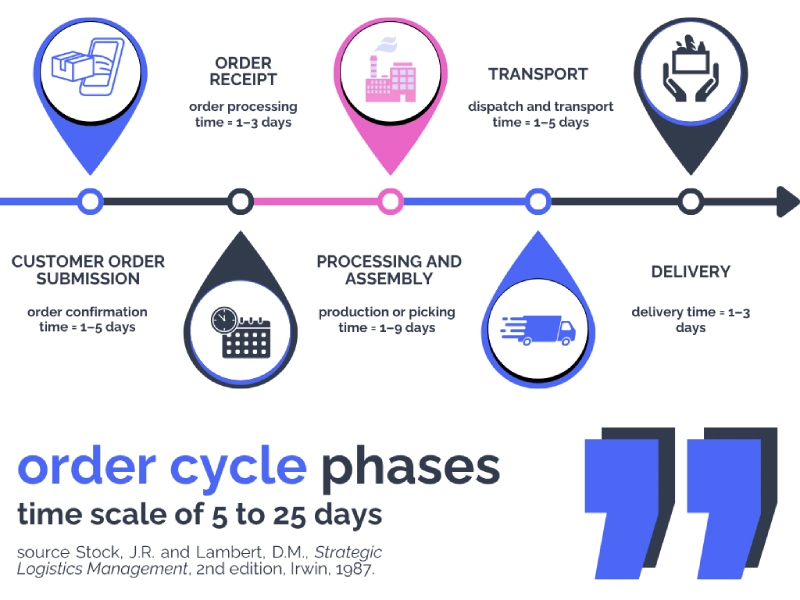
From the customer’s point of view, lead time therefore represents the time between order and delivery, where one can effectively speak of order cycle time (OCT) or the order-to-delivery cycle. In this case, it is nothing more than the algebraic sum of the time spent on every action that has the ultimate purpose of fulfilling an order, including order registration and transmission, order receipt, production or assembly, transfer to the warehouse for shipment composition, preparation of the necessary documentation for goods outbound, packaging, transport, and delivery. It is important to understand that each of these phases involves execution times that, due to inefficient processes or bottlenecks, can expand significantly and generate a cumulative effect on the total lead time, ranging from 5 to 25 days in the worst cases.
From a financial perspective, the cash-to-cash cycle time is also relevant: the time that elapses from paying suppliers (cash outflow) to collecting from customers (cash inflow). The longer this cycle, the greater the working capital requirement. Reducing operational lead time contributes directly to shortening the cash-to-cash cycle.
The different types of lead time in the supply chain
“Lead time” is an umbrella term under which several time metrics fall, each referring to a specific phase of the supply chain:
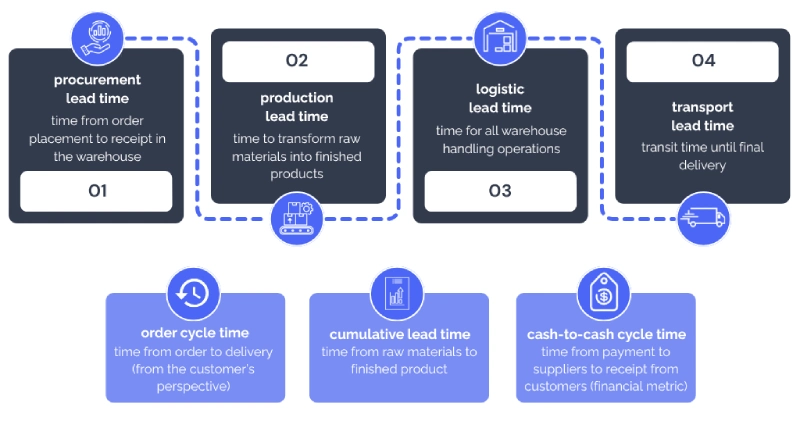
- procurement lead time: the time from placing an order with a supplier to receiving the goods in the warehouse. It includes order processing, supplier production, transit, customs clearance, and inbound quality control;
- manufacturing lead time: the time required to transform raw materials into a finished product. It comprises machine setup, processing, assembly, quality testing, and waiting times between phases. It varies from hours for simple productions to months for complex products;
- warehouse/fulfillment lead time: the time from warehouse operations to shipment, including picking, packing, inspection, document preparation, and loading. In warehouses optimized with a WMS, it takes 0.5 to 2 days; without a WMS, it takes 3 to 7 days;
- transportation lead time: pure transit time from departure to final delivery. It depends on distance, mode of transport (air, sea, road, rail), and customs clearance;
- order cycle time (order-to-delivery): total lead time from the customer’s perspective, from order issuance to delivery. It is the sum of all the partial lead times listed above.
- cumulative lead time: the sum of all lead times from raw material to the delivered finished product. Useful for strategic analysis and what-if simulations.
- cash-to-cash cycle time: a financial rather than purely operational metric, representing the time from paying suppliers to collecting from customers. It includes DIO (Days Inventory Outstanding) + DSO (Days Sales Outstanding) – DPO (Days Payable Outstanding).
Why is it so important in the supply chain?
It goes without saying that lead time is an increasingly critical factor: the context in which businesses operate is fast-paced, and responses must be immediate. Consequently, warehouses become the arena where the game of competitiveness is played: the customer is satisfied with the service if their request is fulfilled in the shortest possible time. Service quality is measured, also and indirectly, by this metric. At the same time, however, the warehouse is an increasingly complex place where the number of references constantly grows. This has repercussions on stock and inventory levels. Reducing lead time also presents the opportunity to lower stock levels without risking any stockouts.
Inventory depends on lead time
Stock management plays a central role in a smart warehouse, primarily because it represents costs for the entrepreneur: experts claim that proper inventory management can decrease warehouse value by up to 40%. However, for efficient and effective logistics that today more than ever requires record times in order fulfillment, stock must be managed optimally. While it is true that from a purely administrative point of view inventory can be interpreted as an accumulation of tied-up capital, it is equally true that it represents a service to the customer. In other words, it simply needs to be managed and understood through KPIs. Moreover, the inventory level is not an empirical number but is governed by two variables: the lead time level and the safety stock level. Therefore, it is a number that changes over time, making continuous monitoring of this performance metric highly strategic.

How to reduce lead time: 3 key strategies
Lead time will be shorter in a warehouse that works effectively and efficiently, while it will reach biblical proportions in warehouses where everything is left to chance. According to a lean approach, it is fundamental to eliminate the “3 Japanese Mu”: muda (waste), muri (overburden), and mura (unevenness). It is from this concept that the concrete objective of lead time management develops: linking production and procurement times with real market needs. Here, a distinction must be made between:
- value-added time: time spent on activities that create a benefit for which the customer is willing to pay, such as production, physical movement to the point of sale, etc;
- non-value-added time: time during which the product is stationary, such as storage in a warehouse, which only adds costs and no value.
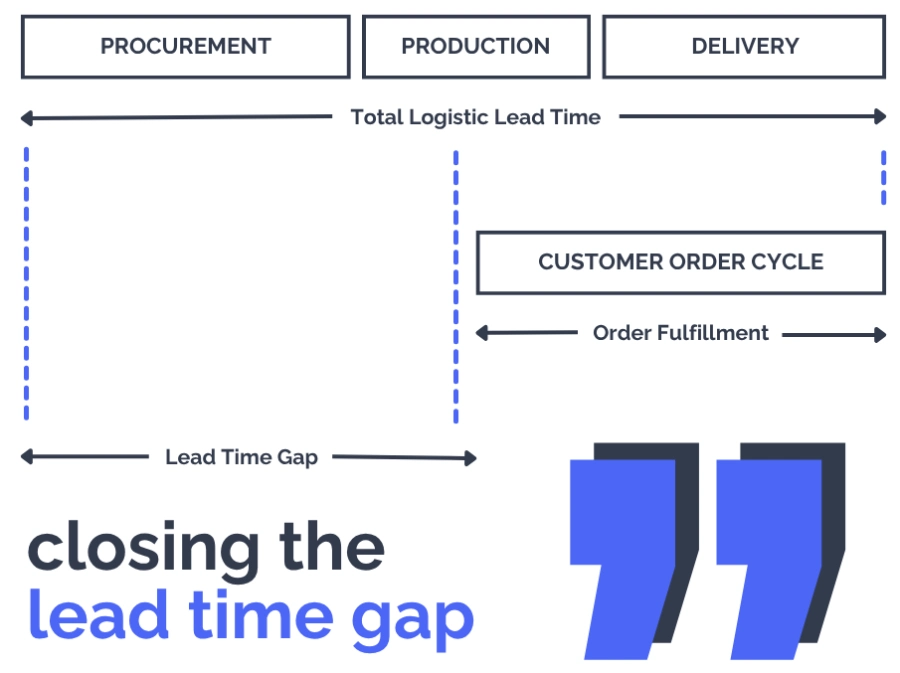
In many supply chains, flow efficiency is low: often less than 10% of the total pipeline time is actually value-added. According to Martin Christopher in his book “Logistics & Supply Chain Management” most organizations suffer from a lead-time gap: the time it takes to source, produce, and deliver a product (total logistics lead time) is longer than the time the customer is willing to wait (customer’s order cycle).
Traditionally, this gap is filled with inventory based on forecasts, which are often inaccurate. The strategic solution consists of reducing this gap by shortening logistics times and improving visibility of real demand to “anticipate” customer needs. Here is how to reduce lead time in 3 main steps:
- supply chain mapping: graphically representing “horizontal” time (process time) and “vertical” time (standing time as inventory) to identify where time is wasted without adding value;
- bottleneck management (OPT – Optimized Production Technology): concentrating improvement efforts on the slowest activities in the chain, as these determine the total lead time of the system;
- the supply chain fulcrum: shifting the point of commitment (fulcrum) as close as possible to real demand through visibility (knowing what the market wants) and speed (the capacity to react quickly).
Reducing lead time in the warehouse: mapping, layout, and WMS software
The logistical flow in a warehouse has a very simple purpose: moving goods from location A (place of production) to location B (place of delivery). The task of efficient logistics is to manage and optimize space and the phases that occur between point A and point B so that this distance is covered in the shortest possible time.
The first thing to do is reduce unnecessary operations, meaning all those daily routines that have persisted in the warehouse without any real need, such as empty journeys, searching for misplaced packages or materials, etc. Here are the steps to reduce logistical lead time in the warehouse:
- warehouse mapping: performing a graphical representation of the space available for goods storage, taking into account dimensions, coordinates, height, and the relationship with other locations.
- redesigning the warehouse layout: rethinking the positioning of goods intelligently to avoid unnecessary operations. For example, a layout based on ABC logic, where A represents the top-selling items and C the least moved ones, allows for a rational use of the warehouse. In this phase, it is useful to seek the opinion of a logistics consultant, who can offer the best solution thanks to experience gained across different sectors, but also of the operators, who can offer the viewpoint of those working in the warehouse daily. Involving staff is not a return to the past; on the contrary, it is a way to increase human capital engagement, even when the warehouse features a high rate of technological innovation.
- implementing WMS software: a Warehouse Management System is a digital tool that, through routing and dispatching algorithms, allows for optimizing paths, reducing throughput times, and slashing lead time by days. It also enables the implementation of advanced logic, such as grouping multiple orders based on delivery times or delivery zones, performing a single journey for multiple orders, and activating assisted picking and forklift guidance systems (FGS), among others.
For example, the “Mission Manager” module of the silwaSUITE WMS leads to a 5-10% reduction in costs and cuts throughput times from 4.8 to 2.5 days. Stesi customers in the food e-commerce and retail sectors have successfully reduced delivery lead times to 1.5 days.

Reducing manufacturing lead time: Just-in-Time and MES software
While the warehouse optimizes space and movement, production must optimize throughput time. Intervening in manufacturing lead time means transforming the shop floor into a fluid ecosystem, eliminating the “downtime” that adds no value to the final product. Here are the pillars for reducing production lead time:
- reduction of setup times: one of the main time thieves in production.
- decoupling point and Just-in-Time (JIT): inverting the logic from push (producing for the warehouse) to pull (producing because there is an order) allows for producing only what is needed, when it is needed, and in the required quantity.
- reduction of WIP (Work-in-Progress): an excess of semi-finished material between phases is not a safety cushion, but an obstacle. Reducing WIP means freeing up physical space, reducing tied-up working capital, and shortening the time that elapses between raw material entry and finished product outbound.
- digitalization with MES software: a Manufacturing Execution System monitors machine performance (OEE) in real time, tracks cycle progress, balances lines, eliminates bottlenecks, and instantly reports anomalies or downtimes. The total visibility guaranteed by the MES allows for timely intervention in process deviations that expand lead time.
- supply chain synchronization: integrating production data with demand and warehouse data to synchronize material procurement with the actual needs of the assembly lines.

Time is money
Product life cycles are shortening. A combination of technological changes and evolving consumer demand leads to the emergence of a volatile market, where a product can become obsolete almost immediately after its introduction to the market, or at least as soon as the next generation of products arrives.
What does this entail for the supply chain?
Shorter product life cycles inevitably require shorter lead times. This means that companies are called upon to respond very promptly to customer requests, and the situation undoubtedly complicates when these requests are customized. The range for calculating timelines in these cases does not stop at the time between order and delivery; rather, it extends from design to procurement, production, handling, and final delivery.
True strategic lead time management, however, does not only account for speed; it also accounts for reliability. To keep pace, it is fundamental to achieve a level of logistical and production optimization where every phase of the supply chain is studied and managed with method and strategy. At Stesi, we do exactly this: with experience dating back to 1996, we accompany companies along their digitalization journey, transforming the supply chain into a competitive advantage. If you want to reduce the impact of time on your company’s performance and costs, let’s get in touch. You can book 4 hours of free logistics consulting with our team.
FAQ
What are all the types of lead time?
Within the supply chain context, several types exist, each relating to a specific phase of the process: procurement lead time; production lead time; logistics lead time; order cycle time (order-to-delivery); transportation lead time; delivery lead time; cash-to-cash cycle time; and end-to-end lead time, which relates to the entire supply chain.
How is lead time calculated?
There are various ways to calculate it. In the supply chain domain, the standard calculation is as follows:
Lead time = Delivery date – Order date
For a granular analysis, the total time can be broken down into its main components:
Total lead time = Pre-processing time + Process time + Waiting time + Transporation time