



MES software (Manufacturing Execution System) is an enterprise information system for managing manufacturing and production operations. It is a digital system that monitors, controls and optimizes production workflows within a factory.
MES acts as an enabler of a structured lean manufacturing approach: the availability of reliable, up-to-date data makes it possible to identify inefficiencies and reduce waste. This results in better control over production lead times and a greater ability to respond to changes in demand.
But what are the key features of a Manufacturing Execution System? We asked Andrea Leonarduzzi, Senior Advisor at Stesi and an expert in software development and supply chain processes, who explained the characteristics that can turn MES software into an essential tool for the Smart Factory and Industry 4.0.
Manufacturing Execution System (MES) market
Global market size in billions of US dollars.
CAGR 9,23%
Source: Mordor Intelligence 2026
MES software: what it is and what it means
A Manufacturing Execution System (MES) is industrial software that manages, monitors and optimizes the execution of manufacturing processes on the shop floor, connecting enterprise management systems (ERP, APS, …) with production line equipment (PLC/IoT). It provides complete supervision of the production department: it gives office teams a complete, real-time view of order progress and machine downtime; manages lot traceability, production routings and material feeding; supports assembly, testing and quality control; digitalizes every individual production stage and provides dashboards for reporting and performance KPI analysis.
“The first MES systems emerged in the 1970s to facilitate shop floor activities,” explains Andrea. “In the past, production departments in most companies collected production data locally using paper forms, Excel spreadsheets or other databases. This was difficult to maintain and scale, making data consolidation challenging.” It was precisely with the aim of eliminating paper-based work and integrating multiple point systems that software developers began bringing all production execution functions together in the form of MES software.
Over time, some Manufacturing Execution Systems have evolved to integrate additional functional extensions beyond basic digitalization, introducing operator guidance, advanced reporting capabilities and predictive maintenance functions. This approach has led to the concept of Smart Factories, where wireless and mobile information and communication technologies (ICT) become key enablers of the Industrial Internet.
In modern manufacturing environments, MES helps connect planning, logistics and production by integrating with different systems and physical entities:
ERP (Enterprise Resource Planning): provides production orders, master data and bills of materials (BOMs);
APS (Advanced Planning & Scheduling): supports advanced production planning and scheduling;
WMS (Warehouse Management System): manages warehouse operations and exchanges information with the MES regarding material availability and line-side material feeding;
PLC, SCADA and IIoT systems: provide data directly from physical machinery, allowing the MES to monitor what is actually happening on the production floor.
MES software features
According to models developed by MESA and ISA-95, MES falls within the scope of Manufacturing Operations Management and supports activities including production execution, resource management, data collection, quality management and traceability.
A study conducted by Soujanya Mantravadi and Møller in 2019 (An Overview of Next-generation Manufacturing Execution Systems: How important is MES for Industry 4.0?) identified the main drivers encouraging companies to digitalize their factories:
- value of data (manufacturing intelligence): transforming raw data into knowledge to develop an Industrial IoT ecosystem, coordinate business units and enhance capabilities;
- process efficiency and control: streamlining production workflows to reduce costs, increase flexibility and strengthen competitive advantage;
- operational visibility and responsiveness: using shop floor dashboards to provide transparency to operators, respond quickly to fluctuations in supply and demand, and optimize supplier management.
Over the years, MES software has evolved by expanding its functional scope to integrate with the enabling technologies of Industry 4.0 and Industry 5.0. Beyond production execution, modern MES systems now incorporate advanced capabilities such as predictive maintenance, AI-driven prescriptive analytics, Digital Twin simulation and Energy Management.
Of all its features, this article focuses on 9:
1. Production order execution
2. Machine and labor time tracking
3. Lot traceability
4. Inefficiency analysis
5. Direct operator support
6. Raw material line-side feeding
7. Automated testing and quality control
8. Machinery and automation integration
9. Predictive maintenance

1. Production order execution monitoring
“One of the main features of MES software is the real-time monitoring and supervision of production order execution,” highlights our Senior Advisor. This feature allows production managers to closely monitor the progress of every order, from release through to completion.
An MES system can provide managers with an overview of production orders, expected delivery dates, production types and characteristics, as well as many other operational aspects.
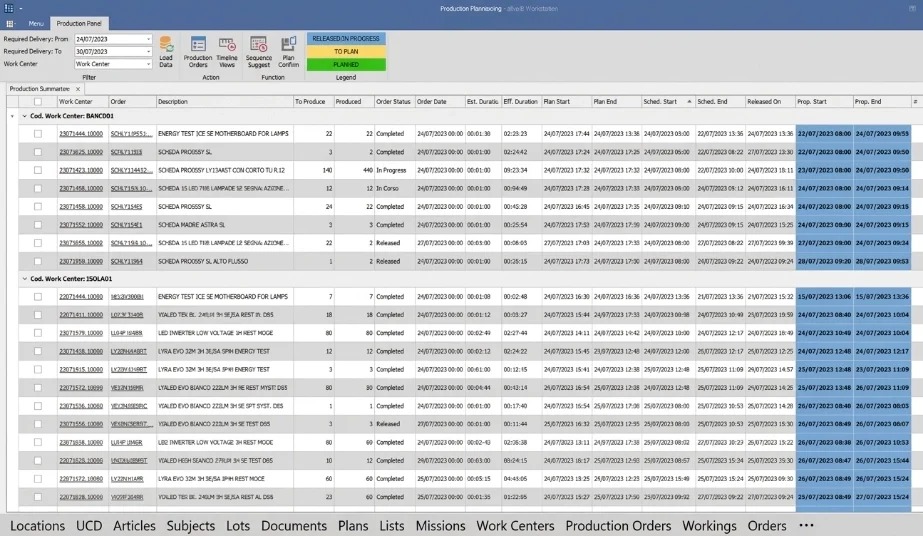
One example is silwaMES, a Manufacturing Execution System that optimizes production workflows in the factory. It does this through intuitive and customizable dashboards that clearly show which production orders need to be monitored day by day or shift by shift. silwaMES is already used in manufacturing environments operating across multiple shifts. One example is the Roberto Industria Alimentare case, where continuous production is organized across three separate shifts.
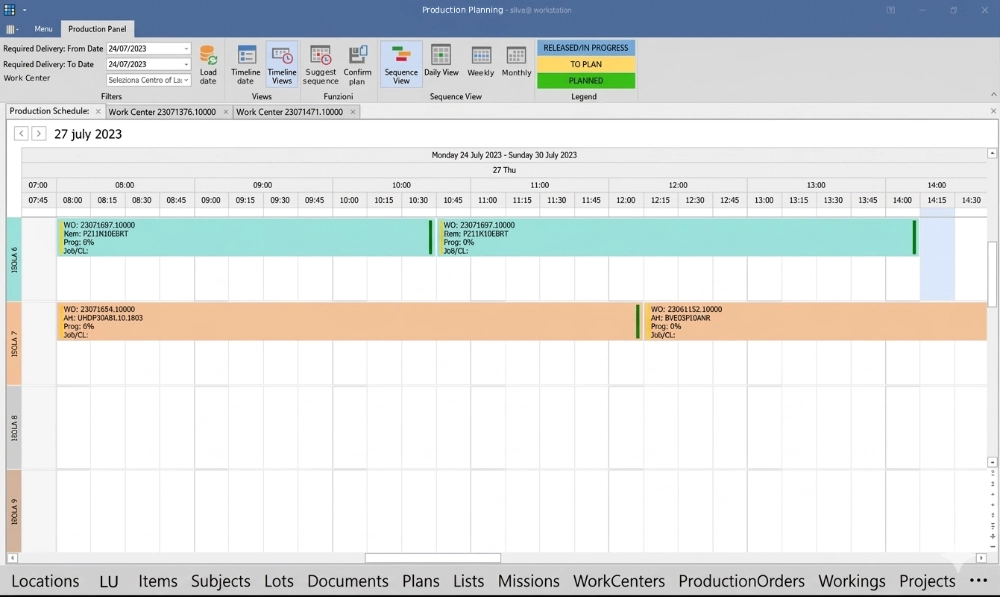
2 Accurate machine and labor time tracking
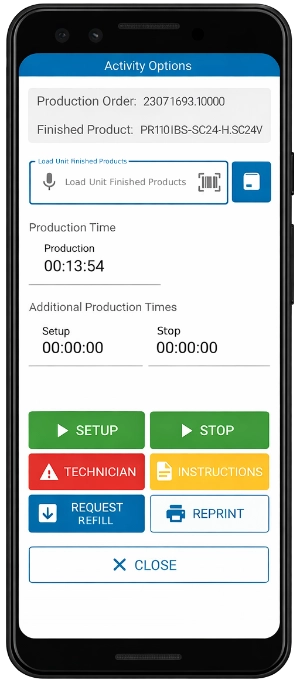
Another important feature of MES software is the accurate collection and analysis of machine and labor times across the different stages of production. By communicating with terminals, work centers and machines, the MES can collect important information about components, products and, naturally, production times.
This makes it possible to identify production inefficiencies, optimize resource allocation and consequently adjust cycle times by identifying areas for improvement. Knowing precisely the extent of unplanned downtime is particularly important for identifying recurring issues and implementing the most effective corrective actions.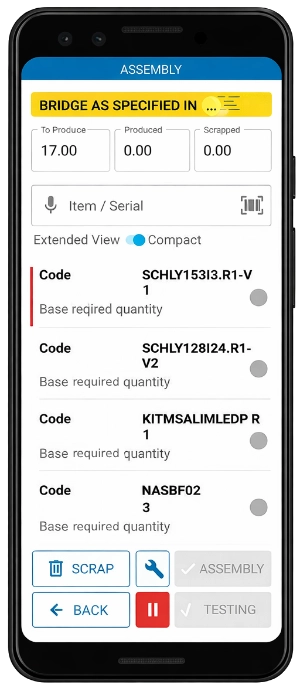
Being able to collect objective data that provides a concrete measurement of production inefficiencies is a significant advantage for a company. “In practice,” explains Andrea, “this feature allows companies that do not yet have a precise understanding of their cycle times to finally gain a transparent overview of what is happening, enabling them to build an increasingly sophisticated and reliable production planning system.” In other words, detailed time tracking is essential for accurately assessing performance, implementing continuous improvement strategies and calculating key indicators such as OEE (Overall Equipment Effectiveness), the metric used to measure the actual productivity of an asset and support continuous improvement strategies (Kaizen).
3 Lot traceability and product genealogy
Traceability is far from being exclusive to the food industry and is also a regulatory requirement in many other sectors. Traceability allows you to maintain the quality and safety of products released onto the market, while ensuring that defective products or batches can be identified and recovered through appropriate recall campaigns.
An MES system can record information relating to raw materials, batches, production processes, operators, machinery and finished products, creating what is known as product genealogy. If necessary, this makes it possible to trace a product’s history backwards and identify the materials and processes that contributed to its production.
4. Inefficiency analysis with MES software
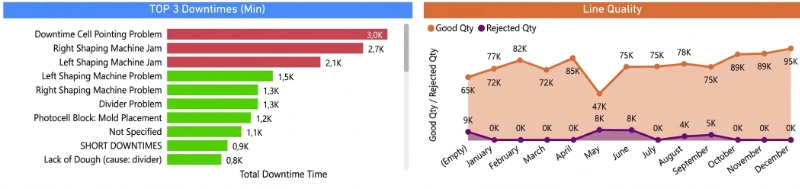
As mentioned above, MES software makes it possible to identify and accurately record production inefficiencies. This data can then be processed to generate meaningful statistics and identify the main causes of production interruptions or slowdowns. This detailed analysis helps companies make informed decisions about which issues to address, reduce waste and improve overall efficiency.
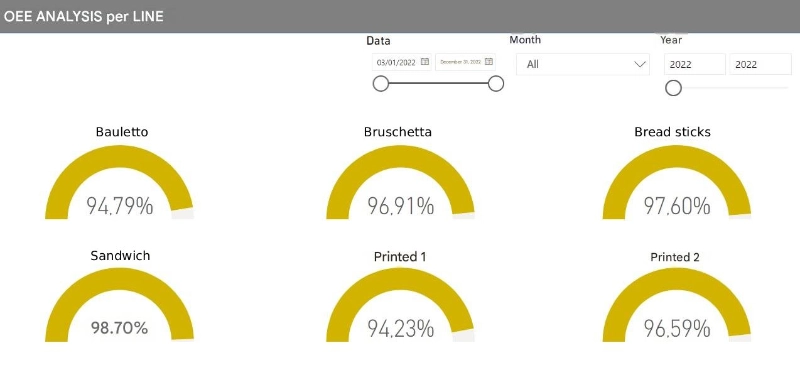
For several years now, the concept of the data-driven company has become firmly established across the industrial sector. In environments that generate increasingly large volumes of data, being able to collect, process and interpret signals from different sources is the only way to base business decisions and strategies on reliable, accurate, transparent and real-time information.
From this perspective, analyzing inefficiencies through an MES means not only optimizing operations by identifying problems as they occur, but also using historical data to identify recurring patterns, supporting planning through APS and preventing inefficiencies from recurring.
5. Direct and automated support for production operators
An especially interesting feature of more advanced MES software is its ability to provide direct support to shop floor operators. But what does this mean in practice?
Some Manufacturing Execution Systems, such as silwaMES, include several modules specifically designed to automate direct operator support, simplifying the distribution of documents, diagrams and work instructions directly to production personnel. This reduces the risk of human error, improves work quality and helps ensure compliance with company standards.
“An interesting example is certainly Linergy, a company specializing in lighting and emergency lighting production, for which Stesi installed monitors inside the production department,” Andrea Leonarduzzi explains. “When an operator starts working on a new production order, the automated silwaMES system displays the assembly sheet on the touchscreen panels installed at the production line, together with all the supporting documentation and instructions for correctly assembling the product, from electrical diagrams to the operations required for the final inspection.”
This provides significant support not only for operators, but also for the company itself, which can rely on high-quality production capable of fully meeting customer requirements.
From this perspective, Andrea Leonarduzzi points out, Stesi’s support went far beyond simply supplying silwa. Technology can be an extremely valuable tool, but to fulfill this role it needs to be combined with new approaches and new methods for managing organizational knowledge. This is why, for Linergy, Stesi also worked on structuring the knowledge repository so that it could be made available to all operators in a simple and direct way.
6. Support for raw material feeding at work centers
Another advantage offered by silwaMES, working in synergy with WMS logic, is support for raw material feeding at work centers. This means that the system can monitor raw material levels at different points in the production chain and trigger replenishment orders in a timely manner.
This prevents production interruptions caused by material shortages and contributes to a more continuous and efficient workflow. Examples of these implementations can be found at Euromacchine, Modialforni, Linergy, Fluidotech and Samo, where the software also manages material feeding for lines equipped with AGVs.

7. Automation of testing processes for quality control
MES software plays a crucial role in quality control. By automating testing processes, the system ensures that each product undergoes rigorous testing before being approved for shipment. This approach ensures consistent final product quality and reduces the likelihood of defects in products delivered to customers.
Stesi supported Linergy in redesigning the production process for emergency lighting products by introducing dedicated automated testing routines, parametrized according to the characteristics of the finished product.
Effective quality control also requires accurate tracking of non-conforming material. MES software allows rejected quantities to be recorded in real time along the production line, accurately tracking and categorizing the causes, such as component defects, calibration errors or processing issues. By synchronizing actual material consumption reporting (both through precise production reporting and backflushing) the system immediately updates warehouse inventory levels and adjusts the order cost sheet.
8. MES software and advanced integration with machinery and automation
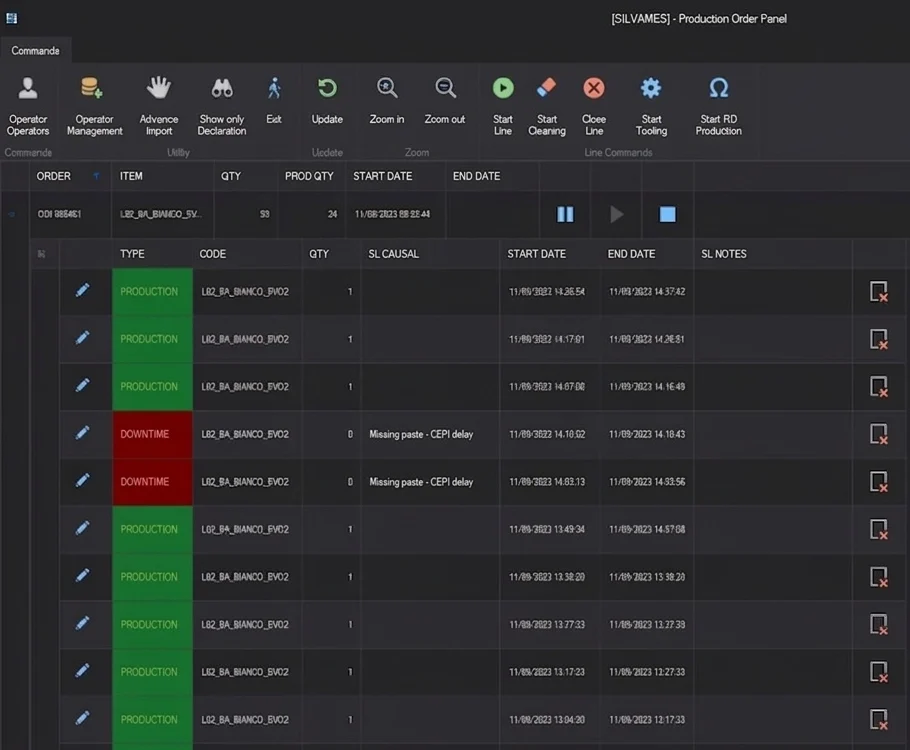 An important characteristic of modern MES systems is their ability to integrate with industrial automation systems, including support for PLC (Programmable Logic Controller) systems. This enables real-time machine monitoring and control, optimizing operations and reducing the need for manual interventions when setting up machines.
“silwaMES has been integrated with a wide range of established communication standards, from Modbus to proprietary protocols used by major market players (such as Siemens, Omron and Rockwell). It also integrates with Industrial IoT (IIoT) architectures through open standard protocols such as MQTT and OPC-UA” highlights our Senior Advisor.
By integrating entire production lines and implementing machine setup workflows, operator intervention can effectively be eliminated. Otherwise, the operator would have to configure each individual machine while moving along the production line. In the case of Roberto Industria Alimentare, a Stesi customer, production line machinery is tightly integrated to automate production reporting, raw material consumption data collection, time tracking and alarm data acquisition.
9. Predictive maintenance
Thanks to direct connectivity with physical machinery and the use of industrial IoT sensors (IIoT), modern Manufacturing Execution Systems such as silwaMES can detect machine parameters (temperature, vibrations…) and, based on historical degradation patterns, estimate the remaining useful life of components before a failure occurs.
This functionality is known as predictive maintenance and makes it possible to keep machines in optimal operating condition at all times.
MES software: adoption barriers and strategic vision
The main barriers to the adoption of Manufacturing Execution Systems include:
- cybersecurity and information security;
- software acquisition costs and the implementation costs of smart manufacturing systems and devices;
- general skepticism towards cloud manufacturing;
- vertical integration challenges and integration with legacy systems;
- lack of digital culture within the organization.
Despite these challenges, there is no doubt that an increasing number of companies are investing in advanced management software to manage production effectively. Scientific literature shows that companies investing more heavily in technology-driven initiatives achieve greater competitiveness in more volatile markets. IT capabilities are already recognized as a key skill for digital leaders.
“The time is ripe for companies to integrate their IT strategy with their business strategy […] MES software is fundamental to enabling Smart Factories and plays a key role in Industry 4.0 manufacturing systems.” ⁓ Soujanya Mantravadi et al. (2019)
The transition towards increasingly connected and data-driven factories is also driving demand for MES software. According to Mordor Intelligence‘s 2026 to 2031 estimates, the global Manufacturing Execution System market is estimated to be worth USD 18.87 billion in 2026 and is expected to reach USD 29.35 billion by 2031, with a CAGR of 9.23%.
Companies that are leaders in their industries have already invested in Manufacturing Execution Systems. If you also want to digitalize your manufacturing operations and gain greater control over your factory production, let’s talk: together, we can analyze your company’s specific workflows and help you identify the solution that best fits your industry.

FAQ: common questions about MES software
What does OEE mean?
OEE (Overall Equipment Effectiveness) is a performance metric that measures the overall effectiveness of a production asset, taking into account availability, performance efficiency and quality rate.
ERP vs MES vs APS: what are the differences?
ERP (Enterprise Resource Planning) defines the production order, meaning what and how much to produce. APS (Advanced Planning and Scheduling) processes planning algorithms to sequence orders, meaning when and where to produce. MES (Manufacturing Execution System) executes, monitors and tracks production in real time directly on the shop floor, showing what is actually happening in the production department.
What does MOM mean in manufacturing?
MOM (Manufacturing Operations Management) is a strategic approach to managing manufacturing processes. Its best practices also include the use of MES (Manufacturing Execution System) software.
Glossary
| Term | Definition | Role of the MES |
| Lean Manufacturing | an industrial philosophy originating in Japan that aims to reduce waste (muda) and maximize value. | provides real-time data on inefficiencies, scrap and the causes of downtime. |
| Kaizen | =”continuous improvement”. An approach based on small, incremental process improvements. | historical MES data measures the impact of implemented changes. |
| Just-In-Time (JIT) | production management model that produces only what is needed, when it is needed and in the required quantity. | synchronizes material feeding from warehouse logistics to production lines. |
| Production Lead Time | time required to manufacture a product. Calculation formula: Procurement Time + Processing Time + Waiting Time. | calculated and tracked by the MES to identify bottlenecks and delays. |
| Smart Factory | highly digitalized and interconnected manufacturing environment using Industry 4.0 technologies such as IoT, Cloud Computing, AI, robotics and MES software. | the MES acts as the “operational brain” connecting the shop floor with central systems. |
| Kanban | = “signboard” in Japanese. A visual system for managing material flow designed to prevent waste and overproduction. | the MES digitalizes Kanban by automating replenishment requests to the warehouse. |
| Backflush | automatic reporting of material consumption based on the quantity of finished goods produced. | eliminates manual recording of raw materials by automatically deducting components from the system. |