


Imagine having to make an important decision: reorganising the warehouse layout, relocating a production line, installing new racking, changing forklift routes. These are all choices that can improve business performance, but they can also introduce unexpected complications.
Now imagine being able to simulate each of these scenarios in a virtual, risk-free environment and test every possible outcome before applying it in the real world.
This is the principle behind the Digital Twin: a technology that makes it possible to create a virtual copy of processes, facilities or entire supply chains in order to simulate future events, identify critical issues and support more informed decisions.
What is a Digital Twin?
A Digital Twin is the virtual representation of a physical entity (a system, a process, a facility, and so on) that allows different scenarios and outcomes to be simulated and tested in a digital environment, without any real-world risk. It is a tool that enables potential issues to be anticipated and better decisions to be made.
In logistics and industrial language, the term Digital Twin (DT) is often used as a synonym for a 3D model, layout mapping or simulation. In reality, a digital twin is a more nuanced and complex structure. It is like having a living digital replica of a physical entity, continuously fed by data from sensors and devices in order to faithfully reproduce its real-world behaviour.
Digital twins therefore create simulation models that update and change as their physical counterparts change. In a supply chain context, drawing on data from IoT sensors or systems (WMS, WCS, PLC, MES, ERP and others), the digital twin replicates the behaviour of its real-world equivalent and continuously monitors its state.
This connected, real-time updating nature is what sets it apart from a generic simulation. The continuous link between the physical and the digital makes it possible not only to show what is happening or has happened, but also to explore what could happen if different decisions are made. Every significant decision can be tested in advance, with its impact on key performance indicators assessed before it is applied to the physical system.
All the types of Digital Twin
McKinsey identifies more than one type of Digital Twin. Different models can be developed depending on the objective:
- Product Twin: represents a product throughout its entire lifecycle, from design through to end use.
- Data Twin: digitally reproduces an environment or system based primarily on data.
- Infrastructure Twin: represents physical infrastructure such as buildings, facilities, airports, ports or transport networks.
- System Twin: models the functioning of complex processes and the interaction between multiple systems. It is the most widely used type in logistics and industrial environments because it makes it possible to simulate automated warehouses, production lines and entire supply chains.
| Type | Operational focus | Data inputs | Use in logistics and supply chain |
| Product Twin | Single product across lifecycle | CAD, PLM data, usage sensors | Packaging design and load unit footprint verification |
| Data Twin | Dynamic context monitoring | GPS, traffic, weather, external APIs | Fleet tracking and estimated time of arrival (ETA) |
| Infrastructure Twin | Buildings and physical facilities | BIM models, environmental sensors | Space management, layout planning and building maintenance |
| System Twin | Complex processes and interactions | WMS, MES, PLC, IoT sensors | Simulation of automated warehouses, production flows and logistics chains |
Digital Twins in the supply chain
The modern supply chain is more complex, volatile and dependent on suppliers, carriers and logistics partners than ever before. A digital twin makes it possible to create a virtual replica of the entire logistics chain and simulate events before they actually occur. For example:
- What happens if a supplier is delayed?
- What is the impact of opening a new warehouse?
- What happens if new production lines are introduced?
- What is the impact on cycle times if the order mix changes?
- What happens when market demand shifts?
- How much does energy consumption increase if speed is prioritised over efficiency?
There are contexts where even small operational changes can have effects on performance that are not always intuitive or predictable. This is especially true in highly automated facilities (multi-shuttle systems, AS/RS automated warehouses and similar) where modifying small variables, such as order sequencing or mission priority, can trigger chains of unexpected events, congestion, energy waste or stoppages.
According to McKinsey, supply chain disruptions can cost companies up to 45% of a year’s operating profits. For this reason, 86% of organisations are investing in supply chain digital transformation.
By combining Digital Twins with analytics and Artificial Intelligence, companies can test what-if scenarios in a risk-free environment and identify the most effective strategies in advance.
For example, a manufacturing company wants to increase production capacity by 20%. Without a digital test, it would have to modify real processes directly, with the risk of generating inefficiencies or slowdowns. With a digital twin, it can instead simulate adding a new shift, introducing a new line, increasing raw material stock levels or reorganising the layout. The system identifies which scenario produces the best result in terms of productivity, costs and service level before anything is implemented.
How to build a Digital Twin in 3 steps
Behind the apparent magic of a Digital Twin there is no magic wand, but a precise methodological journey. Three fundamental steps are typically followed.
- Define the objectives: the first step is strategic. It involves establishing which assets to map (forklifts, loading bays, production lines and so on) and in which order to do so in order to maximise ROI.
Example: prioritising the packaging line because that is where the most frequent bottlenecks occur. - Build the base twin: in this phase, which typically takes three to six months for a facility of medium complexity, the team engineers the data. This means collecting both structured information (such as stock levels from the WMS) and unstructured data in order to create the first graphical visualisations. Perfect data is not required to get started.
Example: connecting the digital twin to the machinery’s IoT sensors and to the MES software flows. - Technical enhancement: once the first use cases are up and running, it is time to scale, potentially adding layers of advanced analytics and AI. At this point the Digital Twin stops being a passive representation and becomes a predictive tool.
Example: the digital twin now uses AI algorithms to simulate what-if scenarios, testing virtually what would happen if shifts were increased by 20% and generating precise prescriptions on how to act.
The success of this kind of project depends in equal measure on the technology and on the people involved. A company needs to bring three types of expertise to the same table:
- The Business and Operations Manager (internal): the Plant Manager or Logistics/Production Manager who knows the real bottlenecks and defines the success KPIs.
- The Software and IoT Integration Partner (external/software house): the industrial digitalisation expert who knows how to get real operational systems (WMS, WCS, PLC, MES, ERP, field sensors) to communicate with the virtual platform.
- The Analyst/Data Engineer (internal): the person who structures data flows to ensure the virtual representation stays continuously synchronised with reality in real time.

Digital Twin architecture
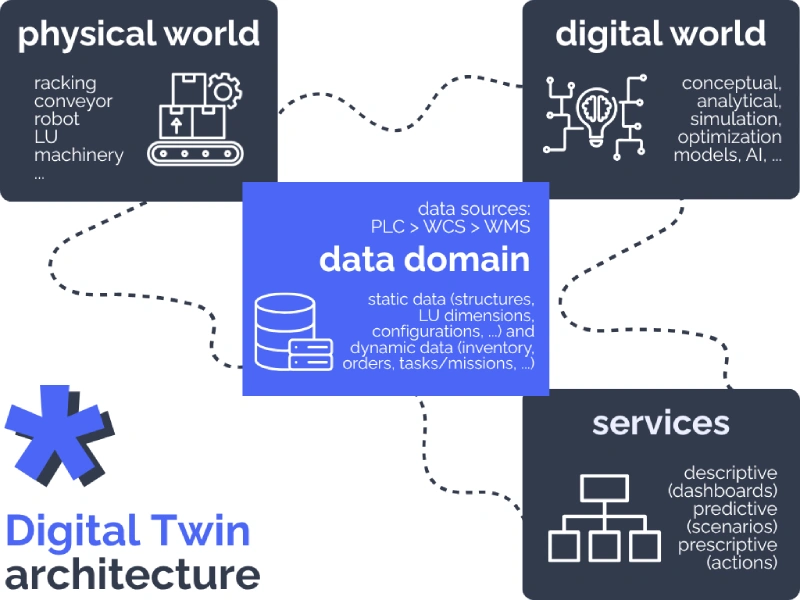
As we have seen, a Digital Twin is not simply a collection of software systems but an ecosystem that interweaves the physical, digital, data and service worlds. Andrea Ferrari and Carlo Rafele of the ResLog Research Group (Politecnico di Torino, 2026) identify four fundamental domains that constitute it.
- The physical system: the real warehouse and its physical components (racking, shuttles, conveyors, AGVs, load units, stacker cranes and so on). This is the domain in which every movement, every mission and every pick generates information that feeds the digital twin: execution times, stock quantities, load unit positions, bottlenecks and more.
- The digital system: the set of models that make up a virtual twin of the facility. These include conceptual models (describing entities and operational rules), analytical models (estimating operational performance), simulation models (reproducing flows over time), optimisation engines, and AI components.
- The data domain: the layer that connects the physical and digital worlds. WMS, WCS, PLC and MES software and systems act as sources of two types of data: static data (structural, layout-related) and dynamic data (orders, stock levels).
- The services layer: where the Digital Twin becomes a management tool that provides concrete answers to business needs. This is the world of capabilities that allow real-time understanding of what is happening (descriptive), simulation of future scenarios (predictive) and recommendation of the best actions to take (prescriptive).
Conclusions: toward an adaptive supply chain
The evolution of logistics is undergoing a paradigm shift that is hard to ignore. Where in recent years attention was focused on hardware (speed and performance), today the focus has shifted to simplifying supply chain complexity and governing it proactively. The data confirms this:
the global Digital Twin market is projected to grow from 49.2 billion dollars in 2026 to over 228 billion by 2031 (with a compound annual growth rate of 35.95%, according to Mordor Intelligence).
The digital twin enables supply chain managers to simulate and optimise order sequences, resource allocation and energy consumption in the virtual world before applying them in the field. Maximum value is extracted from existing assets without necessarily having to invest in new physical capacity.
Want to transform your warehouse into an intelligent, responsive system? At Stesi, we help you eliminate investment risk by integrating simulation and optimisation logic directly into your WMS and MES operational flows. Book 4 hours of free logistics consultancy with our experts and discover how mapping, data and prescriptive algorithms can make your supply chain ready for any future scenario.
Digital Twin Market
Global market size in USD millions.
CAGR 35.95%
Source: Mordor Intelligence 2026
FAQ
Can Digital Twins be combined with Artificial Intelligence?
Yes. Artificial Intelligence and Digital Twins are symbiotic technologies that, when combined, deliver results that are exponentially superior to what either can achieve alone. Generative AI is capable of structuring inputs and synthesising the outputs of digital twins. Digital Twins, in turn, can provide a valuable testing and learning environment for AI.
Do Digital Twins improve sustainability?
Yes. By simulating processes and consumption before intervening in the real world, Digital Twins help reduce waste, energy consumption and inefficient use of resources. In logistics, they can help optimise transport, stock levels and warehouse space utilisation. In production, they make it possible to reduce material waste and raw material consumption.
What are the applications of Digital Twins in logistics?
Automated warehouses (AS/RS) are the ideal environment for Digital Twins, given their high data density and operational complexity. Digital Twins offer: adaptive and dynamic planning (analysing workload and order mix in real time and adjusting management rules based on what is happening); sequence optimisation (simulating and evaluating different combinations of machine missions in advance); and balancing speed against energy consumption.
In which sectors are Digital Twins useful?
The value of Digital Twins does not depend on the sector but on operational complexity. A wide range of industries benefit, including: manufacturing and automotive (for just-in-time supply); food and pharmaceutical (for expiry date management and cold chain control); e-commerce and retail (for demand volatility and seasonal peaks); and third-party logistics (3PL) (for simulating the impact of new clients or workload peaks on facility capacity).
What is predictive maintenance?
Predictive maintenance is an asset management strategy based on the continuous monitoring of machine health. By detecting physical parameters (vibrations, electrical absorption, temperatures), it identifies degradation patterns to estimate the remaining service life of components before a failure occurs. In this architecture, the Digital Twin integrated with the MES acts as a simulation and data correlation engine: it compares IoT data sent from the field with the mathematical and physical models of the machine to detect deviations from nominal performance.
