


The convergence between the digital and physical worlds has now become one of the fundamental trends for the digital transformation of businesses. Consider smart thermostats, fitness trackers, or the IoT in logistics and fleet management solutions, that inform us when our packages will arrive: IoT (or the Internet of Things) is now an integral part of consumer life and business operations.
It is not difficult to imagine how the rise of IoT has also revolutionized supply chain management, particularly the way organizations monitor, analyze, and optimize supply chain operations. In this article, Giovanni Gallo, Team Manager at Stesi and expert in software development and logistical flows, will explain what the IoT in logistics and supply chain is and how it works, as well as all the pros and cons of using it.
What is the Internet of Things (IoT)?
The Internet of Things (IoT) is a term used in the field of computer science to indicate the application of the internet to the world of objects, which obtain a sort of “digital identity” so they can communicate with other objects connected to the network.
“Essentially, IoT is a concept that revolves around the idea of connecting everyday objects (such as devices or sensors) to the internet, allowing them to collect and exchange data autonomously,” explains Giovanni. This interconnected network of smart objects forms a vast system that enables real-time monitoring, data analysis, and improved decision-making. “The implications of IoT go beyond mere convenience, as they promise to revolutionize industrial sectors (including supply chain management) in order to improve visibility, efficiency, and operational performance,” concludes our Team Manager.
How does IoT work?
“To put it very briefly, the Internet of Things operates through interconnected physical devices that collect field data, transmit it, and transform it into useful information for making operational and strategic decisions.” In the supply chain context, this means, for example, having pallets or vehicles equipped with sensors that communicate position, status, and environmental conditions in real time, or production lines capable of self-monitoring to prevent machine downtime. To be more specific about its actual operation, IoT architecture is typically based on a 7-layer model (which is not a standard model but a common simplification) that follows how data is born, travels, and generates value.
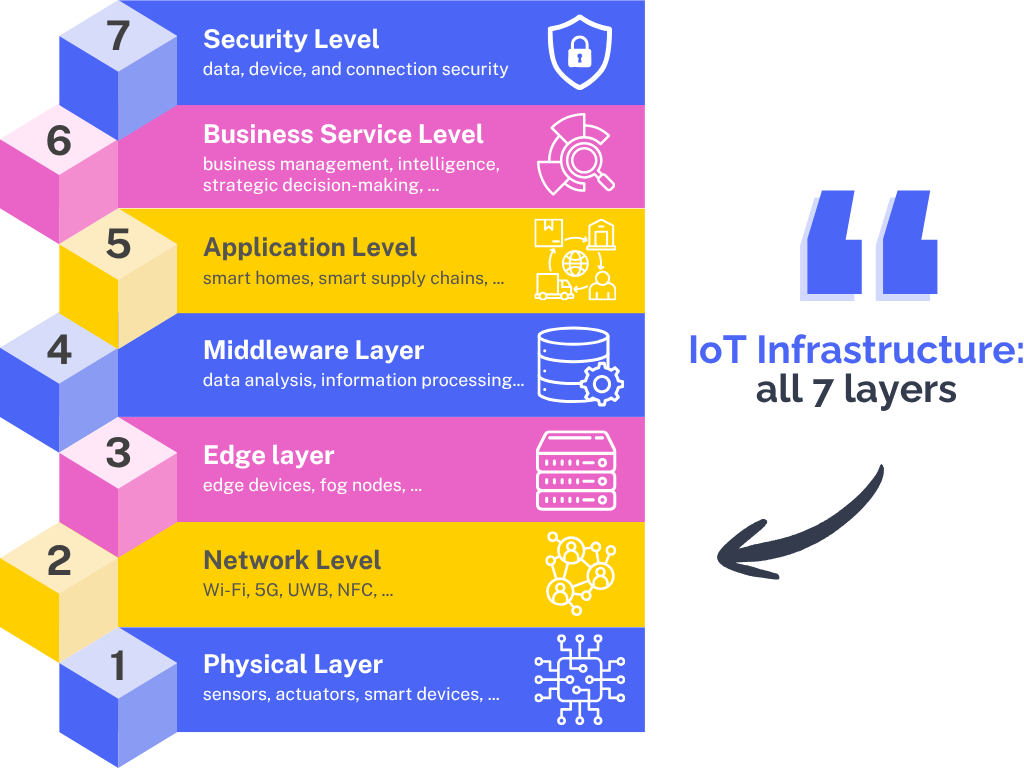 “It always starts from the Physical Layer,” explains Giovanni, “where sensors collect information from the real world (temperature, position, status of goods).” It then passes through the Network Layer which guarantees connectivity via technologies like Wi-Fi, 5G, etc. A crucial role is played by the Fog/Edge Layer, where local data processing occurs to reduce latency and traffic to the cloud. Following this, the Middleware Layer integrates and normalizes data from heterogeneous devices, making it ready for use.
But it is in the upper levels that data transforms into business value: the Application Layer enables actual services (such as asset tracking or flow optimization in warehouse logistics), while the Business Service Layer supports strategic decisions thanks to analytics and business intelligence tools. Finally, there is Security which, cross-cutting all levels, guarantees the protection of the infrastructure.
IoT in logistics: all the benefits
The integration of the Internet of Things (IoT) is ushering in a transformative era in supply chain management. It is completely changing how companies monitor, analyze, and optimize their operations through unprecedented visibility and control. As highlighted in the study by Sallam, Mohamed, and Wagdy (2023) titled “Internet of Things (IoT) in Supply Chain Management: Challenges, Opportunities, and Best Practices“, the use of sensor-equipped devices and the analysis of the data flows they collect allows for the enhancement of critical domains such as inventory management, asset tracking, cold chain monitoring, and route optimization. These applications do not just improve operational efficiency, they offer tangible benefits in cost reduction and progress toward long-term environmental sustainability. Below are all the applications of IoT in logistics and supply chain management.

1. Inventory management with IoT
The integration of IoT technologies in stock management has inaugurated an entirely new method of real-time control over stock levels. IoT-based inventory management systems leverage specific sensors called RFID (Radio-Frequency Identification) tags and various devices to monitor the status, location, and movement of goods throughout the entire supply chain.
“It is worth emphasizing that one of the main advantages of IoT in inventory management is the elimination of the black box effect,” points out Giovanni Gallo. “What often happened traditionally was that inventory entered a sort of ‘blind spot’ making tracking partial or totally absent.” With IoT, however, every item is either tagged with an RFID tag or equipped with IoT sensors. As goods move (from production plants to the store), data from these sensors provide valuable information on their location, conditions, and even the speed at which they are sold. This real-time visibility allows for:
- responding to changes in demand thanks to more accurate forecasts derived from historical data analysis;
- maintaining an optimal stock level, avoiding stockouts or surpluses;
- optimizing inventory levels;
- improving order fulfillment by promptly ensuring availability;
- reducing management costs.
“Furthermore,” continues our software developer, “IoT sensors can monitor environmental conditions (such as temperature and humidity) for sensitive goods like pharmaceuticals or perishable items.” In case of deviations, automatic alerts can be triggered, allowing for immediate corrective actions and thus preventing the spoilage of goods.

2. Asset management and tracking
With the advent of IoT, it can be said without hesitation that resource management (vehicles, equipment, goods, people, shipping containers, high-value goods) has undergone a true revolution. While previously their monitoring occurred through manual processes highly prone to error, now IoT technologies such as GPS and RFID allow for real-time visibility into the position, status, and condition of all assets.
“One of the main applications of IoT in asset tracking is in the field of fleet management,” explains Giovanni. “Companies that rely on transport as a fundamental part of their supply chain operations can now use IoT-connected devices to monitor the precise location of vehicles, their speed, and even fuel consumption.” The benefits of data collected by GPS trackers are roughly as follows:
- route optimization;
- fuel cost reduction;
- reduction in delivery times and customer satisfaction;
- security improvement (e.g., theft risk).
3. Cold chain monitoring
In sectors such as Pharmaceuticals, Food, and Healthcare, maintaining the integrity and safety of temperature-sensitive products is fundamental. These are areas where cold chain control is highly critical, especially when temperature-sensitive goods (e.g., vaccines, perishable food products, medicines) must be transported and stored. During their movements, any deviation from the required temperature range can lead to product deterioration, reduced efficacy, or, in the worst cases, health risks.
“In this context, IoT sensors and data loggers play a central role in cold chain monitoring,” explains Giovanni Gallo. “Sensors are placed inside containers, refrigerated trucks, or storage facilities to continuously monitor temperature, humidity, and other environmental conditions. The collected data is transmitted to a software platform, triggering alerts when the temperature reaches a condition harmful to sensitive goods. This allows companies to intervene promptly to ensure consumer safety and demonstrate compliance with regulatory requirements.”
4. Predictive maintenance with IoT
Predictive maintenance certainly represents a revolution compared to traditional machinery maintenance practices (which were based either on fixed schedules or interventions triggered only in case of failure). Through data analysis and learning algorithms, it is possible to predict when machinery might fail. Companies can thus reduce downtime, optimize performance, and increase equipment lifespan.
At the heart of predictive maintenance are IoT sensors and devices, which collect data on asset status (e.g., temperature, vibration, pressure, and wear). These sensors transmit real-time data to an information system (typically MES software), where it is analyzed to identify any signs of imminent failure, in which case maintenance operators receive timely alerts allowing them to schedule maintenance activities during planned downtime (or at least before a breakdown occurs). The advantages of IoT devices in predictive maintenance are significant:
- reduction of downtime, as well as related costs and disruptions;
- prolonging the lifespan of machinery;
- improved allocation of maintenance resources (instead of sticking to fixed schedules, operators can focus only on equipment that truly needs attention).
5. Visibility throughout the supply chain
“As we have seen, IoT devices act as eyes and ears to track physical objects or information along the entire supply chain,” explains our software developer. “It is this new visibility that allows companies to make informed decisions and optimize processes.” GPS, RFID technologies, or sensors are strategically deployed throughout the supply chain to acquire data at various points, including production plants, distribution centers, transport vehicles, and even retail stores. Data collected from products tagged with RFID tags, for example, is transmitted to a central platform where it is aggregated, processed, and presented in an intuitive interface.
In the Food Industry, IoT-based distribution chain visibility enables lot traceability, a fundamental aspect for identifying the origin of products in case of recalls. “Let’s not forget another huge advantage: supply chain visibility improves customer satisfaction when the company provides them with information on the status of orders and deliveries, which builds trust and fosters loyalty” adds Giovanni.
6. Route optimization
Another interesting application of IoT in logistics is the optimization of road routes. By leveraging a network of sensors and GPS, it is possible to know traffic conditions, weather, vehicle performance, driver behavior, and road infrastructure. Thanks to this collected data, it is possible to dynamically adjust routes to avoid traffic congestion, adverse weather conditions, or other obstacles or difficulties. This dynamic routing via IoT technologies allows for:
- reducing travel times, distances, and idle times;
- reducing fuel consumption;
- refining deliveries;
- reducing environmental impact and facilitating compliance with regulatory requirements.

7. Consumption reduction and sustainability
IoT sensors, in their capacity to monitor the use of energy, water, and raw materials in various stages of the supply chain, contribute to waste reduction and corporate sustainability. A timely collection and analysis of these aspects allows organizations to identify areas of inefficiency and implement measures to reduce waste, allowing them to adopt transparent and responsible practices. This applies both in production departments and in the warehouse and transport.
“For example,” concludes Giovanni Gallo, “in sectors like Fashion and Electronics, IoT contributes to ensuring responsible sourcing and disposal practices by tracking the life cycle of products and materials.”
IoT in logistics: critical issues and best practices
The adoption of IoT in the supply chain faces significant hurdles. “First and foremost,” explains Giovanni Gallo, “is the lack of interoperability between closed proprietary systems.” With the presence of IoT solutions from different manufacturers, each with its own languages and communication protocols, the risk is having a fragmented technological ecosystem full of information silos that are difficult to integrate. “For this reason, it is important to ensure you choose a provider that is also a System Integrator (like Stesi) who is able to make each device communicate with the supervisory information systems,” continues our software developer. To this, add that the huge volume of information collected from different sources requires a robust and scalable data infrastructure, capable of supporting the large influx of data and the resulting generated terabytes. Furthermore, good data management practices allow companies to filter ‘noise’ and focus only on relevant information.
A critical aspect that is very often raised when talking about IoT technologies is certainly that of cybersecurity. “It represents a crucial concern since the proliferation of endpoints substantially increases vulnerability points for potential cyberattacks,” states Giovanni. Again, the best practice to avoid this risk is to rely on a partner expert in information systems, who ensures data is encrypted, conducts security audits, and implements authentication mechanisms to protect the large volume of data being transmitted continuously. In this regard, the challenge of privacy must also be mentioned: the acquisition of data of various kinds also implies the collection of sensitive information regarding employees, customers, and partners. As Giovanni Gallo well highlights, companies must ensure they anonymize and aggregate data in such a way as to guarantee the privacy of all parties involved and establish a relationship of trust and transparency with them.
“Another challenge we often face with our clients,” continues our Team Manager, “is that of internal cultural resistance. The implementation of any new technology (IoT, software, automation, etc.) is not a mere project restricted to the IT department, it represents a profound transformation of the entire corporate operating model.” For this reason, the company must ensure it adopts good change management and training practices to prevent any prejudice or resistance against the new technology. In this case too, the key is communication and transparency with operators and stakeholders, so they understand the reasons for the change and perceive the concrete benefits for everyone.
Case study: Alpla and the use of IoT devices in logistics
 A concrete case that demonstrates the value of IoT in logistics and supply chain, is the one developed by Stesi for Alpla, an international player in plastic packaging. In the Alpla plant, IoT sensors, RTLS (Real Time Location System) devices, and integrated software platforms (such as WMS and MES) were used, working together to collect and orchestrate real-time data on goods, vehicles, and processes. The company thus obtains extremely precise operational visibility: every asset is accurately located, every movement is tracked, and every logistical activity can be analyzed with precise KPIs and optimized. In the Port Sunlight plant, RFID tags were applied to pallets. RFID readers are present at production stations and loading bays, so it is always possible to know what enters or leaves.
“The most innovative aspect, however, I find to be the transition to a sustainable supply chain,” highlights Giovanni. “Thanks to IoT, Alpla is able to track the entire life cycle of materials (including recycled plastic), giving them a digital identity and making their value visible throughout the entire chain.” This approach enables new ESG management models, where environmental performance (consumption, emissions, flow efficiency) is measured and governed.
IoT in logistics: impeccable supply chain management
In conclusion, the integration of the Internet of Things in the supply chain and logistics represents an essential strategic transformation for those aiming for operational excellence. The documented benefits are both tangible (better operational efficiency, increased corporate margins, greater supply chain visibility, reduction in consumption, etc.) and intangible (greater customer trust and satisfaction, simplified work for operators, competitive advantage, improved workplace safety, better brand reputation, etc.).
But what will the future of this technology be? According to our Team Manager Giovanni Gallo: “The integration of Edge Computing and 5G/6G connectivity will slash latency offering responses in much shorter times, while the adoption of Blockchain and AI models will guarantee transparency and much more accurate demand forecasts.” The future of IoT also includes the use of Quantum Computing to solve optimization challenges that are impossible today and the creation of Digital Twins to simulate response strategies for potential crises. “I would also add in the final analysis,” concludes Giovanni, “that the success of this transformation will increasingly reside in the ability to implement an ethical and sustainable infrastructure, where technology strengthens human-machine collaboration.”
Every logistics chain has its unique challenges. If you want to understand which IoT sensors can truly reduce your operating costs and how to integrate them with management or supervisory software, let’s get to know each other. Book a first free check-up to let yourself be guided toward the solution that best fits your company’s needs.

FAQ – IoT logistics
What communication protocols are needed for IoT?
The choice of protocols in the IoT (Internet of Things) field is quite vast: lightweight solutions like MQTT and CoAP are typically ideal for low-power devices, while technologies like AMQP or HTTP/WebSocket respond to needs for reliability and real-time communication. “For connectivity,” continues our software developer Giovanni, “protocols like LoRaWAN, NB-IoT, or Zigbee allow for adaptation to different logistical scenarios, from warehouse automation to distributed fleet management.”
What are some examples of IoT devices?
Some examples of IoT technologies include: temperature sensors (e.g., for monitoring refrigerated containers); position sensors (e.g., GPS to locate resources); humidity sensors (e.g., food quality monitoring); vibration sensors (e.g., predictive maintenance for machinery); pressure sensors (e.g., for monitoring liquid levels in tanks); gas sensors (e.g., for monitoring gas leaks), and many others.