



Two years after Stesi first adopted the Agile Scrum methodology, which our Operations Director Alessio Pavan introduced in a previous article, how are things going? Has embracing a more flexible and collaborative approach to projects delivered tangible benefits, or did it quickly lose its appeal?
Introducing new ways of working is always a complex undertaking. Even when the methodology in question is well-established, like Agile, it essentially requires training the entire team and driving a genuine cultural shift, one that leads people to approach their work from a fresh perspective. To find out how Agile has evolved at Stesi, we sat down with Anna Barisan, Team Manager and Scrum Master, who works every day to support change in project and team management.
What is the Agile Scrum methodology?
The Agile Scrum methodology is a framework designed to enable a new, more flexible approach to project management. Originally developed for software product development, it has long since made its way into organisations across a wide range of industries and sizes.
“The fact is that the five core principles of this management approach appeal to companies in many different sectors“, Anna explains, because they are grounded in:
- Greater flexibility
- Collaboration
- Process efficiency
- The ability to adapt quickly to change
- Output quality
Why choose Scrum (and move away from Waterfall)?
“The decision to introduce Agile Scrum at Stesi goes back to 2022, when Operations Director Alessio Pavan realised that to support a growing organisation like ours, with an increasing number of clients and projects, the best course of action was to move away from the traditional Waterfall methodology, which had become a significant obstacle and bottleneck, and embrace a more flexible approach.”
The Waterfall model, as the name suggests, takes a sequential approach to project phases. Phase B, for example, can only begin once Phase A is fully complete, and in turn unlocks Phase C once it wraps up.
“One of the key advantages of Agile Scrum is precisely its flexibility. A flexibility that allows developers to work on multiple projects simultaneously, without generating the kind of bottlenecks that slow everything down”, Anna explains.
The name itself, borrowed from rugby, where it refers to the scrummage, underscores a defining feature of this approach: the team works together toward a shared goal, and collaboration is the real secret to success.
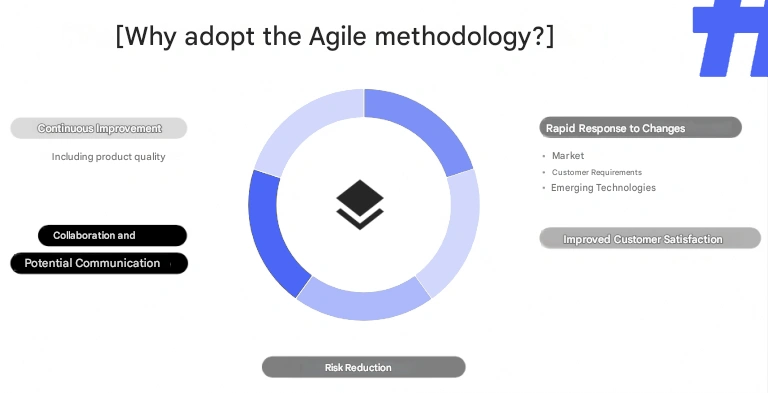
The flexibility of Agile: all down to sprints
So where does this much-talked-about flexibility actually come from?
“Agile Scrum is built around sprints“, Anna explains, “fixed time-boxes, generally ranging from one to four weeks, during which the work takes place.”
Once a sprint closes, a new one opens, creating a cyclical rhythm that carries the project from its earliest stages through to completion.
“What makes this methodology so compelling is precisely this cycle. Simply put, at the end of each sprint an incremental deliverable is released, known in the Agile Scrum framework as an increment. Unlike the traditional Waterfall approach, which only delivers a final result at the very end of the process, Agile Scrum allows the client to receive a working feature or product component to test and get familiar with. In a sense“, Anna concludes, “the client’s feedback becomes an integral part of the process. Once they have tried out the feature or product portion released at the end of a sprint, the client can share their thoughts, helping steer the project in line with their expectations.”
The key roles in Agile
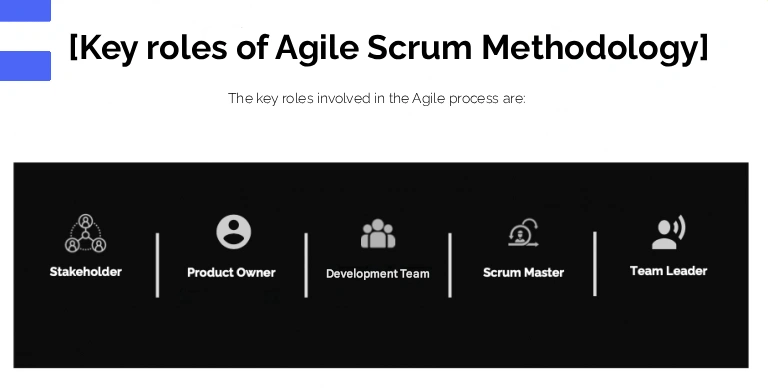
Several roles are involved within each sprint: from the Product Owner to the Team Leader, the Scrum Master, and the developers themselves.
- Product Owner: this is the figure who liaises with clients to represent their interests throughout the project. By gathering requirements and specifications, the Product Owner sets priorities and acts as a bridge between the client and the rest of the organisation, defining the individual tasks to be assigned to the development team.
- Team Leader: not officially part of the standard Agile Scrum methodology, this role was introduced by Stesi to provide a clear point of reference for both the operational team and the Product Owner. The Team Leader is a fully active member of the team, but takes on greater leadership responsibilities, working closely with the operational figures before acting as an intermediary with the Product Owner.
- Scrum Master: this is the facilitator responsible for overseeing the correct application of the Scrum methodology. The Scrum Master not only ensures that processes and practices are properly followed, but also works continuously to make them more efficient and effective, identifying areas for improvement and gathering proposals, ideas, and feedback from the operational team.
- Development team: this is the operational team. At Stesi, each team currently consists of five people.
All these roles naturally work together and maintain ongoing communication with one another.
How does sprint work?
As we have seen, sprints are at the heart of Agile Scrum, but there are several other key moments in the process.
The first is the ceremony known as Sprint Planning. “The whole team takes part in Sprint Planning, including the Product Owner, because this is the moment when tasks are estimated, prioritised, and placed into the sprint.”
At Stesi, task estimation is carried out through a card-based voting process, which allows every team member to independently estimate the effort required for a given activity, based on a unit of measurement that was recently revised to better suit internal needs. This practice enhances the value of the Agile Scrum methodology by encouraging operational team members to engage with timelines and effort forecasting, areas that have traditionally been a weak point. Not because developers lack the ability to estimate, but because this information is typically handed down from above, confronting them with a deadline over which they have had no say.
To maximise communication and collaboration within the team, Stesi has also made task completion a shared effort: one developer is assigned to complete a task and another to test it.
Review and Retrospective in Agile
Once a sprint closes, the Review begins. During this ceremony, selected team members present the results of the sprint’s work to the Product Owner, who can formally sign off on completed tasks and then coordinate with the client for the release of the newly developed features. “At Stesi, for practical reasons, we have adapted the standard Agile Review. In theory, everyone should attend this ceremony. But by encouraging collaboration between operational team members from the very start of the task, through to testing, we ensure full team alignment well before reaching this stage. So we have chosen to involve people in the Review on a rotating basis rather than all at once.”
Finally, given the central role of continuous improvement and communication in Agile, it comes as no surprise that each sprint, alongside the Review, also includes a Retrospective. “This is a moment to reflect on how the weeks of work have gone and to discuss whether there are any suggestions or improvements to bring to the project’s management. Any actionable proposal is implemented as early as the following sprint.”
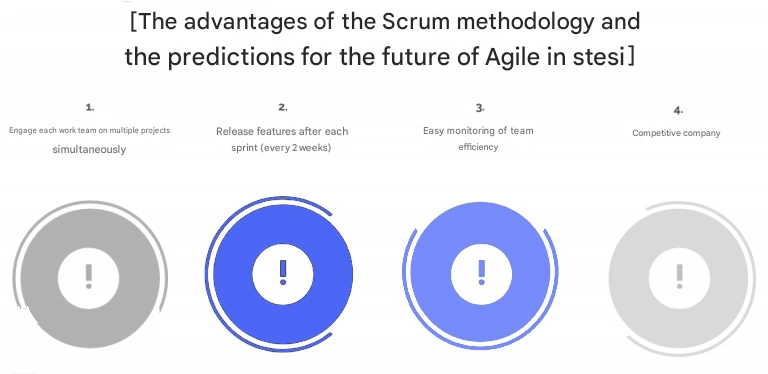
Customising the methodology
As we have seen throughout this article, Stesi has made several adjustments to the “official” Agile framework. “Part of the Scrum Master’s role is recognising that sticking rigidly to theoretical practices is not necessarily the best approach. The methodology should and can be optimised to fit the team’s specific activities and needs, and ultimately, Reviews and Retrospectives exist precisely to enable this kind of continuous improvement.”
This is also why another key moment in the methodology is the daily stand-up, the Daily Scrum, which gives the operational team members the opportunity to share what they worked on the previous day, what they plan to tackle today, and any issues or blockers they have encountered. “This way, everyone stays aligned with everyone else, and each person brings their individual experience to the whole team’s attention: some blockers may be systemic and need to be addressed at an organisational level, while others are minor and can be resolved simply by adopting a solution someone else has already tested.”
Once again, it all comes down to collaboration and communication.
And from this perspective, Agile brings with it a series of benefits that, while perhaps unexpected, turn out to be fundamental.
On one hand, it ensures that every member of the team has all the knowledge needed to support the client, being fully across every detail of the project. On the other, it actively facilitates innovation. “Any potential improvement can be rolled out in a single team first, to test its effectiveness. If it works, the other teams adopt it too. If not, it gets dropped. This allows us to innovate in a far more natural and confident way, because if only one team is trialling something new, all the others continue their normal activities according to established procedures, ensuring operational continuity.”
Want to find out more? Let’s get in touch.