


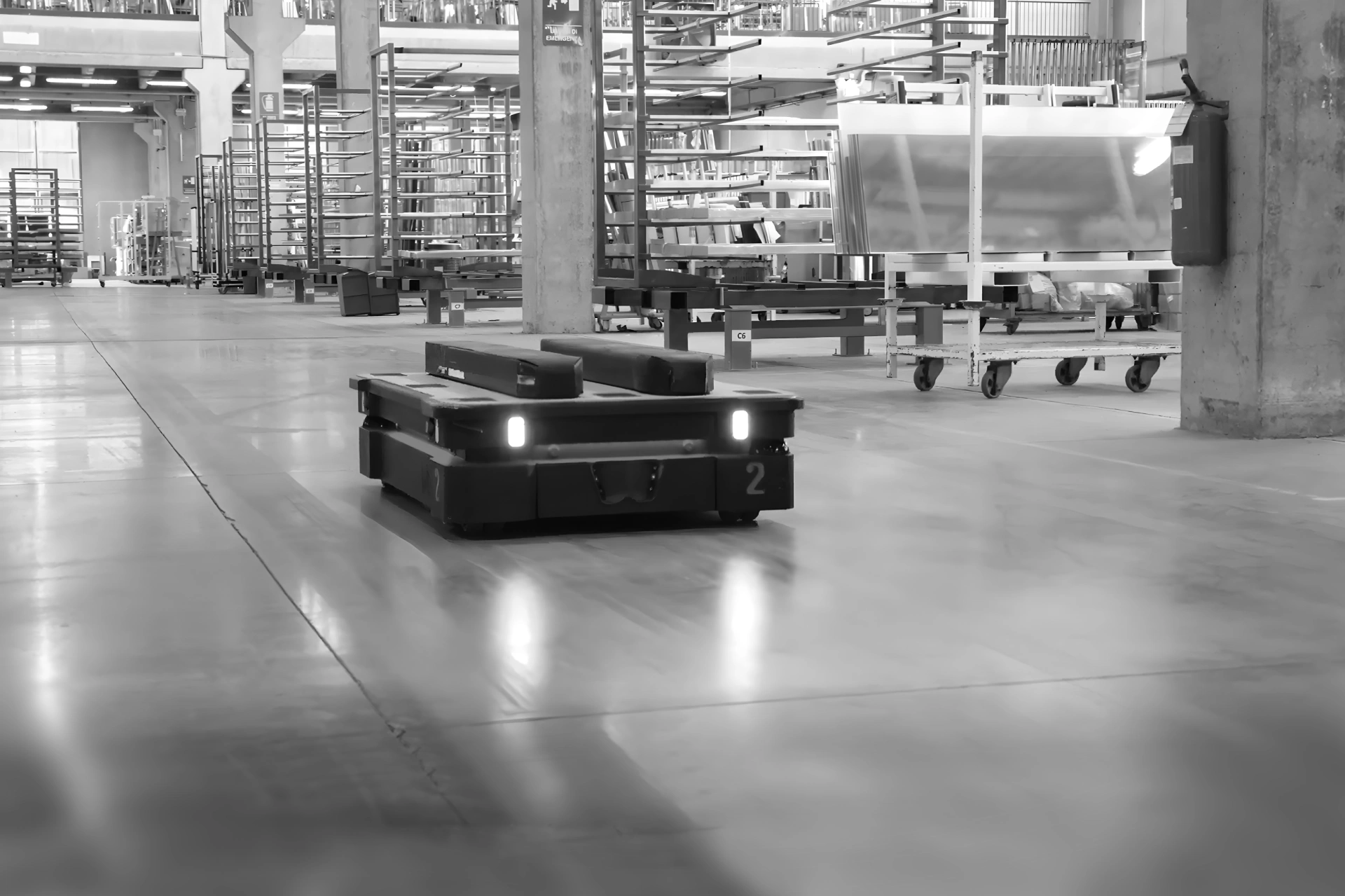
For several years now, logistics and warehouse operations have seen a remarkable increase in complexity. To meet the needs and expectations of an increasingly demanding customer base, product ranges have expanded and delivery times have been significantly compressed, partly in response to competition from major e-commerce players. Today’s warehouses hold more goods and more data than ever before, the result of introducing smart traceability systems, sensors, IoT and much more. It comes as no surprise that all of this has accelerated the drive toward automation and the widespread adoption of AGV robots, or Automated Guided Vehicles: automated robots first developed in the 1950s and widely deployed from the 1970s onwards, with the goal of increasing efficiency in warehousing, goods handling, picking, loading and unloading.
To better understand what AGV systems are, how they work, and in which situations they provide genuine value in warehouse management, we spoke with Andrea Leonarduzzi, Senior Advisor at Stesi.
What AGV systems are
AGV stands for Automated Guided Vehicle. These are essentially vehicles used in industrial and logistics settings for the movement of goods and materials within a warehouse or manufacturing facility, requiring no human operator. To navigate, AGVs rely on predefined paths or guidance technologies such as lasers and sensors.
The term AGV actually covers a broad range of vehicle types, which differ from one another in terms of their navigation method. Examples include LGVs (Laser Guided Vehicles) and IGVs (Intelligent Guided Vehicles).
Because they require no human operator, these solutions can run continuously (including 24/7) in a highly safe and efficient manner, minimising errors and damage to the surrounding environment during goods handling.
The history of Automated Guided Vehicles and the different guidance systems
AGVs are not a new concept in the industrial world. Their introduction dates back to the 1950s, when they were first used in the automotive sector to simplify the transport of heavy materials. Thanks to their wider adoption from the 1970s onwards, AGV technology has undergone significant evolution, reaching the levels of sophistication and versatility we see today.
The first AGV systems to be implemented, Leonarduzzi recalls, used a wire-guided navigation system that required the installation of fixed paths within the facility, defined by inductive lines embedded in the floor. While still valid, this approach comes with significant limitations: any need to expand or reconfigure the layout requires costly interventions to modify the predefined path.
Later, AGV systems evolved with the introduction of optically guided vehicles, in which vehicles determine their position and navigate the environment using optical sensors and reflectors placed along the routes, and laser-guided systems, in which vehicles are loaded with a map of the environment that allows them to identify their position and move by scanning their surroundings in real time.
More recent still are AGVs that navigate by combining multiple types of onboard sensors, including cameras and ultrasound, to autonomously map their environment. These latest-generation Automated Guided Vehicles are naturally the most versatile on the market, and offer the significant advantage of being deployable with minimal modifications to existing infrastructure.
Types of AGV robots
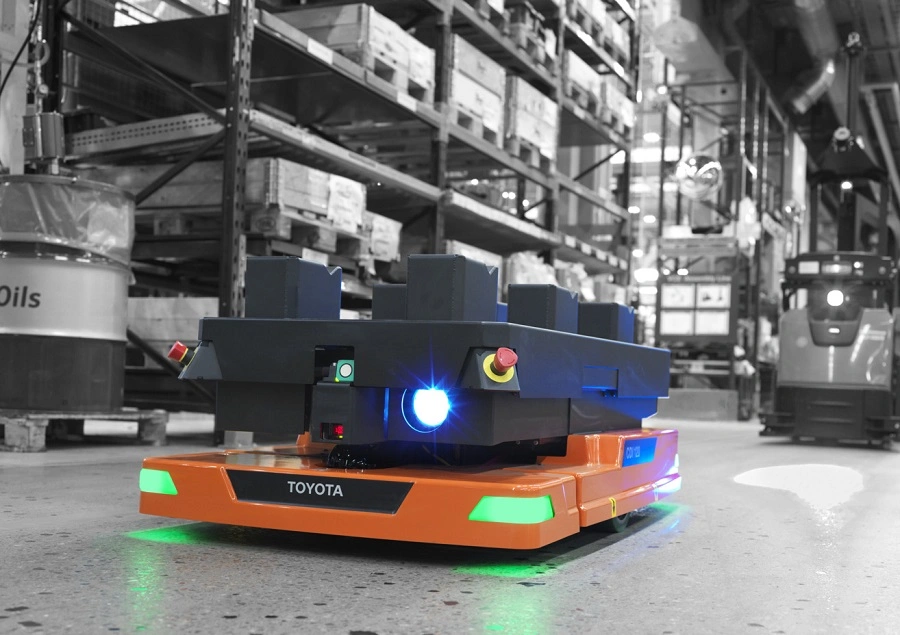
Automated guided vehicles can be classified by their guidance system, as described above, or by vehicle type:
- Fork-type: similar to trilateral reach trucks, fork AGVs can operate with any of the guidance systems described above.
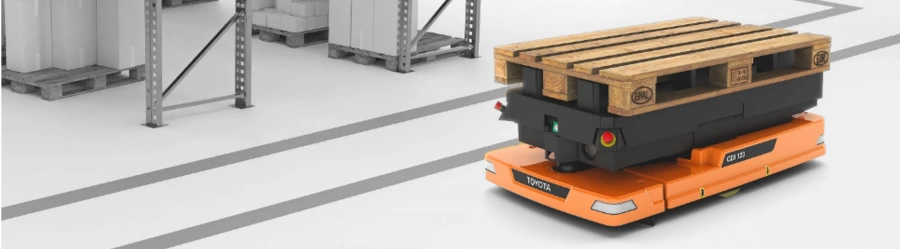
- Underride (tugger/platform type): also known as “soles” or “turtles”, these vehicles move beneath a load to lift and transport it to the required location.
- Conveyor-type (roller deck).
- Custom solutions.
Read more about the different types of AGVs.
What are AGV robots used for?
Today, AGV systems are used across a wide range of industries and can be integrated into the following goods flow types:
- Internal handling flows: for the transport of goods within a company or warehouse, reducing handling times and increasing process efficiency.
- Supply flows: for the transport of raw materials and components within the facility, ensuring a timely and continuous supply of the materials required for production.
- Distribution flows: for the transport of goods from the warehouse to loading or unloading bays, reducing waiting times and improving the accuracy and timeliness of deliveries.
- Sorting flows: for the transport of goods from one area of the warehouse to another, optimising the sorting process and reducing handling times.
- Production flows: for the transport of materials and finished products within the production area, reducing handling times and increasing the efficiency of the manufacturing process.
Advantages and limitations of Automated Guided Vehicles
Summarising what we have covered so far, the key advantages of AGVs include:
- The ability to operate continuously, including 24/7
- Reduced errors in the execution of transport missions
- Greater safety during movement in relation to the surrounding environment
- Lower maintenance requirements over the long term
But are AGV systems truly the ideal solution in every context?
According to Leonarduzzi, that is not quite the case. AGVs work best in high-repetition, high-order-volume environments. In all other situations, human operators remain the better choice, for example when it comes to handling and moving a large number of small parcels with the agility that the task requires.
What does the future hold for AGVs?
As outlined at the start of this article, the growing complexity of logistics and warehousing has pushed the sector to seek solutions capable of effectively automating all the activities that can indeed be automated.
The deployment of increasingly versatile and easily integratable AGV and LGV systems will soon make it possible to further improve the efficiency and safety of logistics processes. These automated systems will be capable of integrating with other automation equipment or transport systems, giving rise to entirely automated transport lines.
One example is Fluid-o-tech, a Stesi client since 2016, where the production supply flow involves an automated warehouse managed by trilateral reach trucks equipped with self-guidance, which lower load units and bring them to exchange bays. From there, the AGV picks up the load carriers and brings them to the line-side, and once production is complete, collects the finished product and returns it to the warehouse. In this case, all supply lines for production and finished goods storage are fully automated, with no need for human operator involvement.
silwa WMS and integration with AGV systems
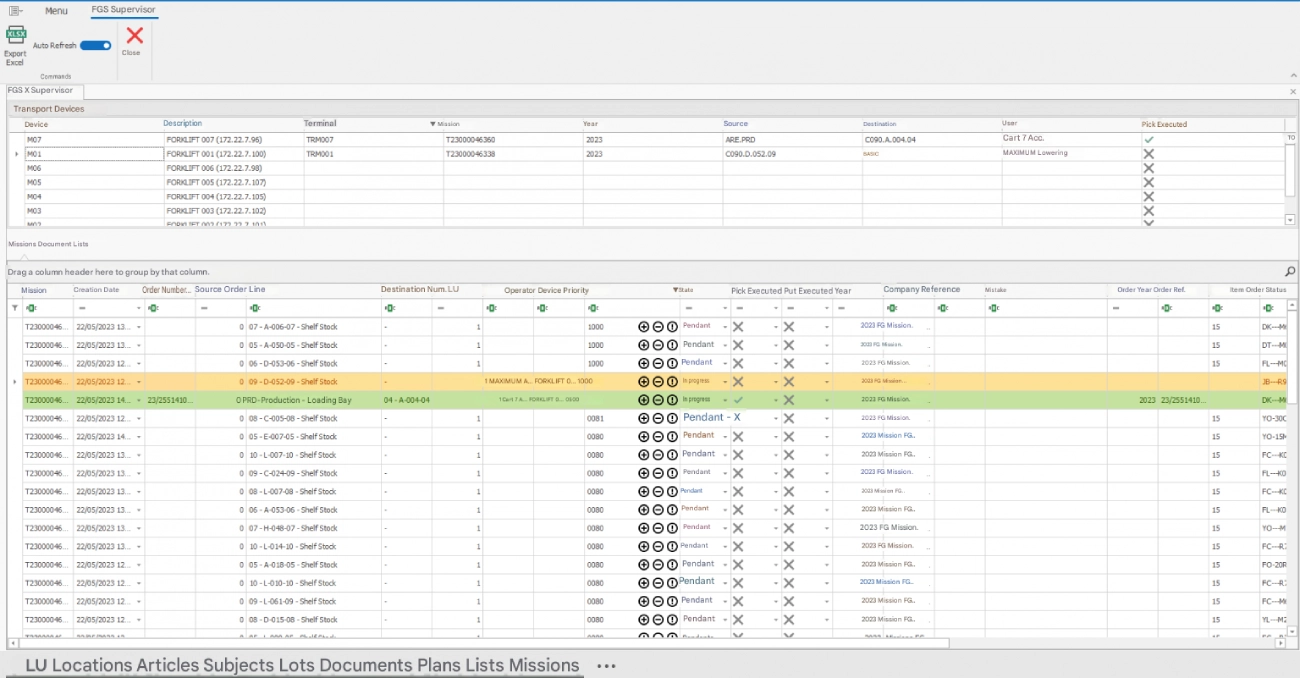
silwa, the WMS developed by Stesi, integrates with autonomous guidance systems of various types, including AGV, LGV and IGV.
The core of the solution is the Dispatcher module, which monitors the real-time status of the warehouse or production plant and organises, coordinates and assigns the transport missions that these systems are required to execute.
Each transport mission may involve multiple vehicles, and it is silwa that coordinates the vehicles and sequences the activities to maintain high operational efficiency throughout.
Want to find out more about AGVs, or are you looking for a WMS to maximise their effectiveness? Contact Stesi. To date, we have integrated AGV systems for a number of clients including Fluid-o-tech and Leocata/Tsusho, and have direct hands-on experience of what it means to coordinate the operation of vehicles and systems.
