


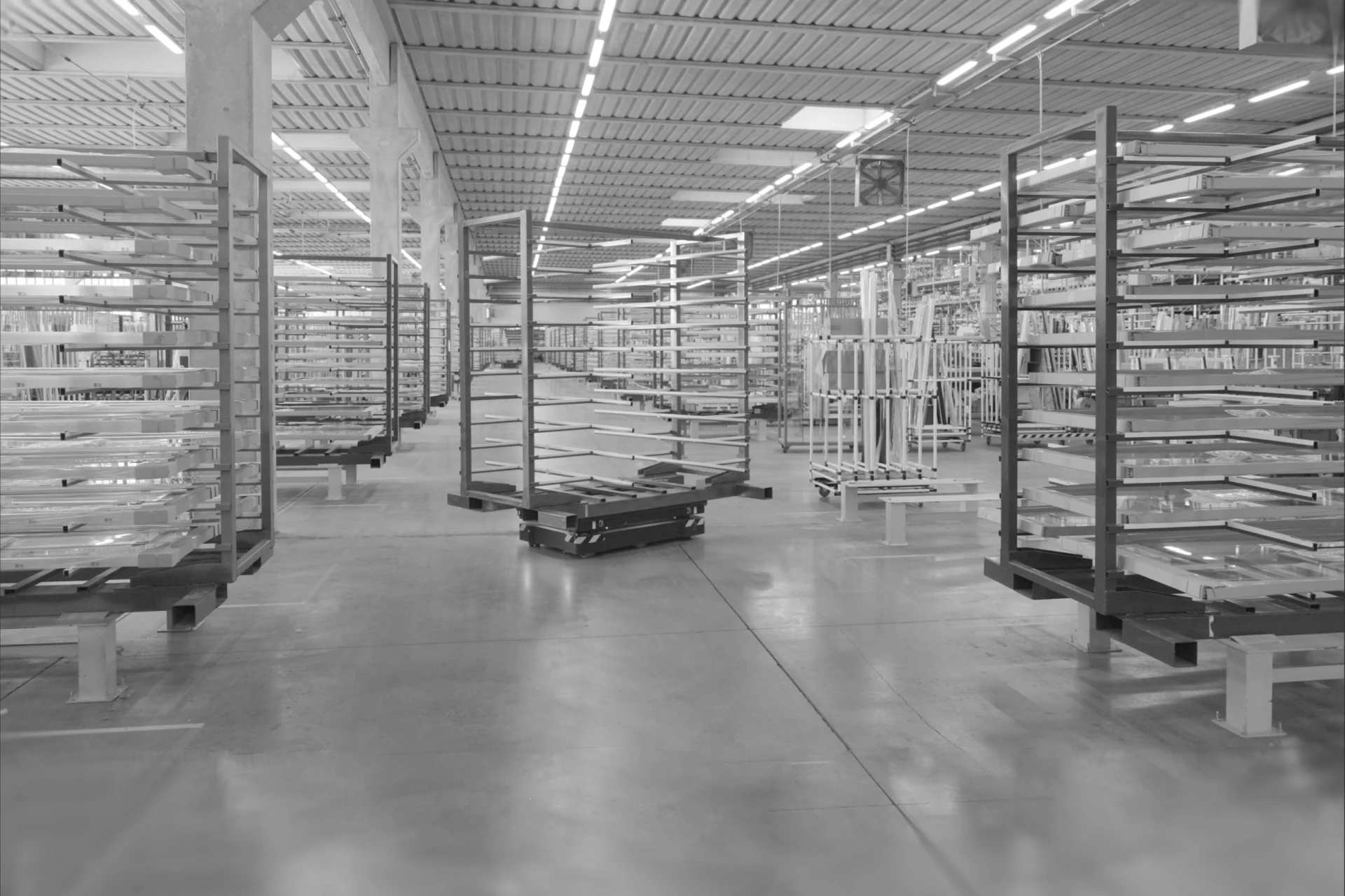
Warehouse automation today requires systems that are efficient and flexible, and that can guarantee the highest standards of safety for the people, machinery and vehicles (AGV and conventional alike) operating within the facility.
A significant example of this is the collaboration between Stesi and Fluid-O-Tech, a company based in Corsico specialising in the manufacture of precision fluid pumps. The project, carried out in partnership with Toyota Material Handling IT – Logistics Solutions, led to the implementation of an integrated semi-automation system optimised for managing material flows throughout the facility. It is now evolving further, toward the development of a new and more effective safety protocol. Here is what that involves.
Warehouse management: the Stesi and Toyota end-to-end solution
For 70 years, Fluid-o-Tech has specialised in the design and manufacture of pumps and fluid management systems for a range of sectors including foodservice, medical, industrial and automotive. In 2016, the company chose Stesi, working alongside Toyota, to reorganise and digitise its warehouse. Central to the project is the silwa WMS (Warehouse Management System), which acts as the supervisory layer for all storage and picking operations within a semi-automated system built primarily around AGVs (driverless automated robots) and VNA trucks, vehicles capable of handling pallets laterally as well as in the direction of travel.
Why Stesi? The deciding factor was the company’s approach, based on a proprietary system that is flexible and capable of adapting to the specific characteristics of each facility, enabling seamless communication between business information systems and machine protocols. Complementing this were deep functional and technical expertise, a willingness to fully customise products and interfaces, and a long-standing working relationship with Toyota, one of the leading players in materials handling globally. All of this made it possible to build a complete, end-to-end warehouse management solution perfectly integrated into the Fluid-o-Tech facility.
AGVs, trilateral reach trucks and new safety requirements
Moving beyond this first, fundamental step, Stesi‘s work is now focusing on warehouse automation and the safety challenges that come with it. Within the Fluid-o-Tech warehouse, one issue that has always required careful management is the coexistence of AGVs with everything that is not automated. Traditionally, automation tends to be confined to dedicated areas where it operates with exclusive domain, kept separate from activities that also involve human operators. Today this approach is inefficient and generates obvious waste in terms of time, space and resources: the challenge is to move beyond segregation while continuing to guarantee the highest standards of safety for both equipment and personnel working in the facility.
This is why Stesi is working on developing a protocol that operates according to a predictive and preventive logic, designed to avoid collisions. The goal is to build an intelligent supervisory module capable of orchestrating everything that happens in the warehouse, with real-time visibility of the position and movement of both machinery and operators, so that it can trigger corrective actions and activate safety mechanisms wherever and whenever needed.
The benefits of AGV warehouse automation: optimised efficiency and safety
Thanks to Stesi, Fluid-o-Tech now has access to a facility-wide supervisor in silwa, which optimises all storage, picking and goods handling operations by programming AGV routes to eliminate wasted time and movement within the warehouse. A key role in this is played by the MiM (Mission Manager) module, which acts as the interface between the company’s information system and the robots, controlling the vehicles in a fully automated way.
Also significant, as mentioned, are the implications of the system for safety: the forthcoming implementation of the dedicated safety module will make it possible to prevent damage to people and equipment, heading off incidents before they occur. A collision between an AGV and a trilateral reach truck took place just a few months ago, resulting in considerable repair costs for both vehicles.
Want to find out more? Let’s get in touch.
