


In the world of wine, quality remains a key element. But today, it is no longer enough on its own. What truly makes the difference is the ability to manage efficient, flexible and well-organised logistics. This is far from simple, considering fragmented orders, increasingly diversified sales channels, highly customised requests and ever shorter delivery times.
In a sector that moves quickly, where e-commerce is growing and omnichannel has become the standard, wine logistics has become a strategic factor. It is not only about storage and shipping: we are talking about margins, competitiveness and customer satisfaction.
To explore these topics in depth, Stesi organised a webinar together with Induvation dedicated to winery logistics. A useful opportunity to discuss tools, approaches and technologies that can truly make a difference.
Leading this analysis were two experts with extensive experience: Alessio Pavan, Operations Director at Stesi, specialised in advanced warehouse management and integrated supply chain processes, and Marco Brisotto, Management Consultant and head of the Integrated Logistics division at Induvation, with numerous projects in the wine sector.
Why wine logistics matters today
In recent years, the wine sector has undergone a profound transformation. While in the past it was enough to focus on product quality, today this is no longer the only factor for competitiveness. The market has become faster, more fragmented and multichannel. As a result, logistics management has become a daily challenge.
Wineries no longer sell only through large-scale retail. The traditional retail channel is now joined by Ho.Re.Ca, e-commerce, wine tourism and direct sales points. Each channel has its own rules, timing, volumes and delivery requirements. Orders are increasingly customised, requests more complex and service expectations significantly higher.
As Marco Brisotto, Management Consultant at Induvation, explains: “Today it is no longer enough to produce excellent wine. You need logistics capable of delivering fast, reliable and complete responses. It is a matter of processes, planning and the ability to read data in order to make more informed decisions.”
Wine logistics and multichannel distribution
“Each sales channel has its own priorities, rhythms and expectations. Logistics must be able to respond to all of them with the same level of effectiveness.”
With this statement, Alessio Pavan summarises one of the most complex challenges for wineries today: managing multiple sales channels simultaneously, each with its own logic.
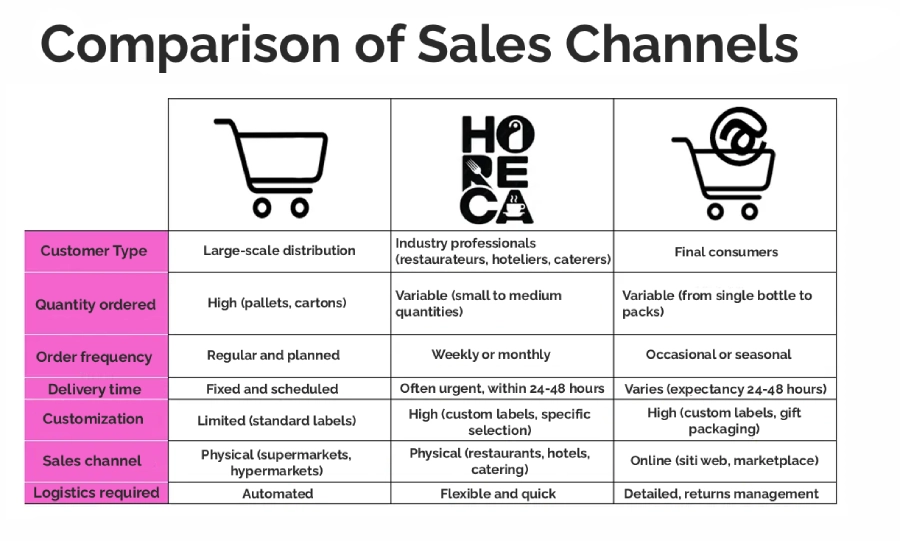
In large-scale retail, precision, standardisation and strict adherence to timing are required. Orders are planned, often at scale, and every pallet must comply with specific labelling and traceability rules.
In the Ho.Re.Ca channel the situation changes. Orders are smaller, often mixed and highly customised. Different vintages are handled, customised labels and promotional materials are common. This requires operational flexibility, customised packaging and punctual deliveries within narrow time windows.
E-commerce instead demands speed and responsiveness (as discussed in this article). Orders of one or two bottles, real-time traceability and fast, accurate returns management are essential. Here logistics becomes a critical element of the customer experience: a single delay can mean losing a sale or even a customer.
Diversification is a major opportunity, but only if supported by intelligent and integrated logistics capable of adapting without slowing down operations. This is where advanced tools such as a WMS come into play, allowing the orchestration of complex orders, parallel flows and different customer types efficiently.
WMS: the conductor of the winery
When discussing digitalisation in wine logistics, one of the most effective tools available to wineries is the WMS, Warehouse Management System. When properly configured, it coordinates all warehouse activities like a conductor: receiving, storage, picking, shipping, traceability and stock management.
It should not be confused with an ERP or a simple management system. A WMS does not only record data, it actively manages warehouse operations in real time. It knows where every label is located, in what condition, with which lot and for which customer it is intended.
“Every label tells a story,” explains Alessio Pavan. “The WMS knows it and manages it, from receiving to delivery. It enables better decision-making by providing visibility and control over processes.”
The concrete benefits are clear:
- Reduction of errors and waste
- Faster operational workflows
- Improved customer service
- More accurate inventory and stock management
- Continuous data collection for future analysis and improvement
For a winery operating across multiple channels with increasingly customised requirements, adopting a WMS means being able to grow without losing efficiency, staying agile even during peak periods or complex demand situations. Do not miss the full webinar video on wine logistics organised by Stesi in collaboration with Induvation and Portocork Italia:
Improving winery logistics efficiency with AI and motion mining
In daily winery operations, many activities are taken for granted. But what if it were possible to measure them precisely and understand where waste truly occurs? This is what advanced tools such as Motion Mining do, a technology that uses sensors and artificial intelligence algorithms to analyse operator movements and equipment usage.
During a real project conducted by Induvation in a winery, it emerged that only 28% of picking operators’ working time was actually value-added. The remaining 72% was absorbed by activities such as walking (30%), standing idle (37%) or driving equipment (3%).
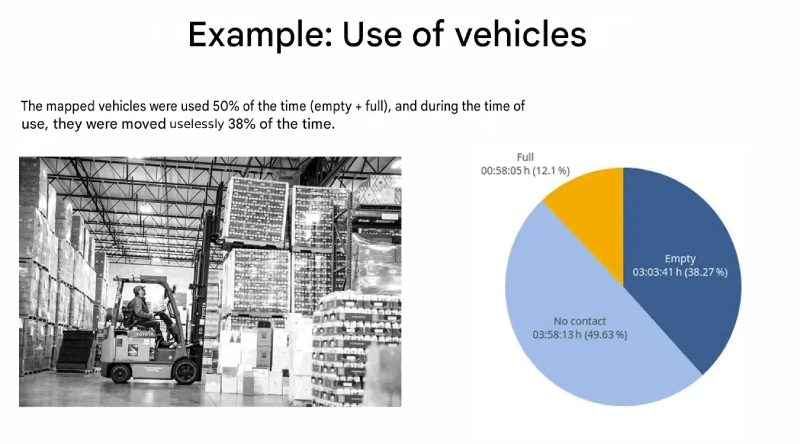
Equipment analysis also produced significant insights: during only 50% of active time, 38% was spent on empty movements, revealing optimisation opportunities in routing and load saturation.
“When we introduce Motion Mining in a warehouse,” explains Marco Brisotto, Management Consultant at Induvation, “we often discover that many operational assumptions are only hypotheses. Data tells a different story and helps identify where real improvements can be made to enhance performance and reduce costs.”
Such analyses allow companies to quantify real efficiency, redesign flows and intervene in a targeted way. The result is cost reductions of 15 to 20% and a more agile, measurable and data-driven logistics system.
Optimising wine logistics: strategy before technology
When talking about logistics innovation, there is a risk of assuming that introducing new technologies alone is enough to achieve immediate results. However, true efficiency does not come from tools. It comes from a clear strategy built on well-designed processes.
“In many cases we see wineries trying to automate immediately,” explains Marco Brisotto. “But if the underlying processes are not working, you end up automating inefficiency. And at that point you are simply making the same mistakes more expensive.”
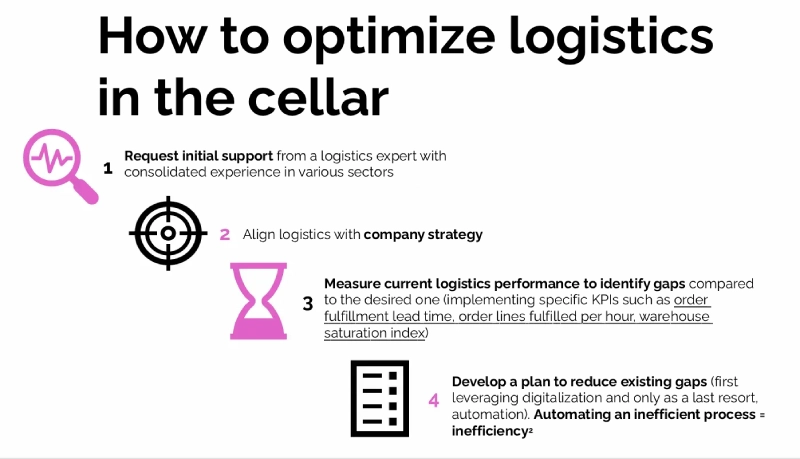
For this reason, the correct approach is: analyse first, digitise second, automate last.
This is a three-step path that starts with KPI measurement, continues with the introduction of digital tools such as WMS and tracking systems, and only then moves on to evaluating automation of selected operational phases.
For wineries, this means asking key questions:
- What are the bottlenecks in my warehouse?
- Where are waste and delays generated?
- What data am I already collecting, and how am I using it?
Technology is a powerful ally, but only when it supports a strategic vision built on awareness, method and clear objectives.
Real cases: silwa WMS in wine logistics
Many wineries have already chosen to innovate their logistics by adopting silwa, the WMS developed by Stesi. In each of these projects, the starting point has been the same: understanding processes, mapping critical issues and building tailored solutions.
The results have been extremely positive: reduced picking times, fewer shipping errors, lower stock immobilisation and full traceability control. Customer satisfaction has also improved significantly, thanks to more punctual and accurate deliveries even during peak periods.
The adoption of silwa has enabled many wine businesses to manage multichannel operations effectively, handling diversified orders in terms of volume, destination and preparation requirements.
In some cases, companies have drastically reduced returns and reallocated time and resources to higher-value activities.
Looking ahead, the direction is clear: logistics will become increasingly digital, predictive and integrated. Tools like silwa are no longer an option for a few, but a strategic lever for companies that want to remain competitive in a fast-changing sector.

Wine logistics is value, not just bottles
In the wine sector, logistics is much more than a set of behind-the-scenes operations. It is a strategic lever, a direct touchpoint with the customer and a key element in perceived product quality. Investing in processes, technology and vision does not only mean optimising costs. It means freeing up resources, increasing agility and building strong, long-lasting relationships.
Those working in wine logistics know this well: it is not just about moving bottles, but about creating, delivering and protecting value. As Alessio Pavan said: “If wine is passion, the WMS is the technology that brings it to the stage.”
Would you like to find out how to improve logistics in your winery? Tell us about your goals: get in touch and let’s work together to find the best solution.
Faq
Why is a management system not enough to manage winery logistics?
Because an ERP and a WMS have different roles. “The ERP observes. The WMS acts,” explains Alessio. While the ERP records operations after they have been executed, the WMS operates in real time to optimise warehouse activities. For example, it guides operators and machines and optimises picking routes.
What benefits can a WMS bring to a winery?
Implementing a WMS in a winery means bringing order, control and speed into logistics processes. Wineries that have adopted solutions such as silwa have achieved tangible benefits, including:
- Reduced picking times thanks to optimised routes and operator guidance
- Fewer shipping errors and a significant reduction in returns
- More accurate inventory management with reduced dead stock
- Full traceability by lot, label, customer and sales channel
- Improved customer service, even during peak periods
Is a WMS suitable for a small winery?
Yes, absolutely. A WMS like silwa is scalable and suitable even for small businesses. The goal is not only automation, but also bringing order and control to even the simplest flows: avoiding errors, optimising time and ensuring full traceability. Starting early with digital tools also helps structure processes from the beginning, supporting future growth.
How long does it take to implement a WMS in a winery?
Implementation time varies depending on complexity and customisation needs, but it typically ranges from a few weeks to a few months. The key factor is the initial process analysis: the more accurate it is, the smoother the implementation will be. With the right partner, the project is guided step by step, including training and organisational support.
Can a WMS also help with regulatory traceability?
Yes. One of the key strengths of a WMS like silwa is advanced traceability management: each bottle can be tracked by lot, customer, order and sales channel. This simplifies compliance activities, recalls, returns management and flow certification. In practice, it means more safety and less stress during audits.