



In the era of globalization and hyper-competitiveness, efficient logistics management has become a crucial factor for the success of any business. It is no longer just about the handling and transport of goods, but an increasingly complex and articulated system of processes ranging from inventory management to the distribution of finished products. In such a fast-paced era, where sustainability is increasingly central and consumer expectations are growing, logistics has transformed into integrated logistics to remain effective.
But what is integrated logistics? What are the most recent innovations and technologies changing the face of this sector? We spoke with Christian Santarossa, Software Analyst and Developer at Stesi, who told us about the evolutions of logistics management, revealing the key stages of this fundamental process for modern companies.
Integrated logistics: meaning and definition
To understand the meaning of “integrated logistics” the wisest course is naturally to start from the broader definition of logistics.
According to the Council of Logistics Management, logistics is “the process of planning, implementing, and controlling the efficient and effective flow and storage of raw materials, semi-finished goods, and finished products and related information from the point of origin to the point of consumption for the purpose of meeting customer requirements.”
“Integrated logistics, however,” Christian explains, “goes further, because it does not limit itself to the management of individual processes, but coordinates them within a global and interconnected system, where every phase is strictly linked to and dependent on the others.” Not surprisingly, an integrated logistics system can be defined as “A unique corporate management process that governs the flow of materials, information, and goods from the point of origin to the point of arrival, in which all management activities are interconnected and interdependent.”
The foundations of logistics: the key elements of a logistics system
A logistics system is composed of several interconnected elements that work together to ensure an efficient flow of goods, information, and resources, both within an organization and along the supply chain. Here are the main elements that constitute it:
Procurement management
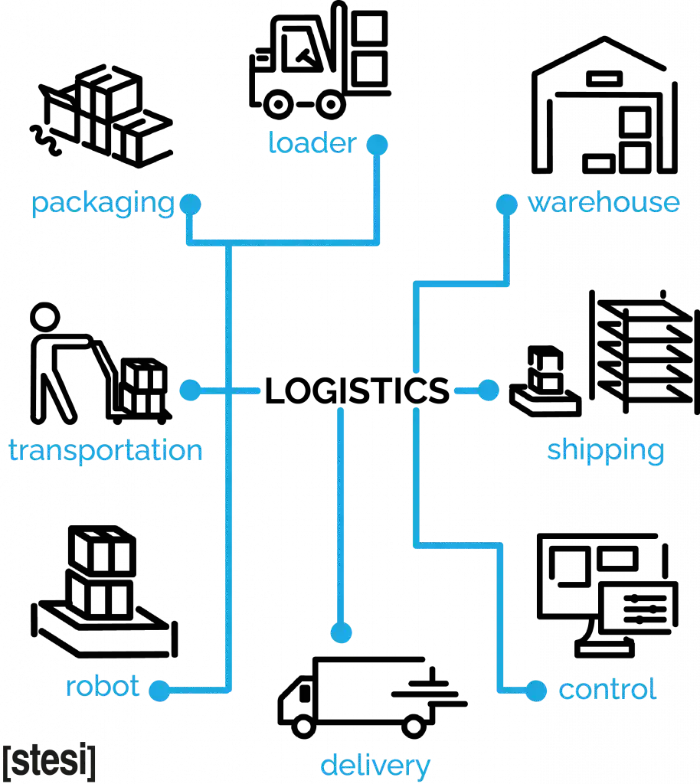
“Procurement logistics is divided into three main operational cycles,” Christian explains. The first concerns the acquisition of goods, namely the selection and purchase of the necessary raw materials. The second is storage, which involves the organization of spaces to store materials and finished products until shipment. Finally, the third phase is inventory management, which handles monitoring stock and planning orders to ensure a constant flow of resources.
Inventory management
“Warehouse stock management involves controlling the quantities of products available in the warehouse,” says Christian. “This process includes the planning and regulation of inventory levels to ensure the availability of goods needed to meet demand, while avoiding surpluses and, therefore, waste.”
Good inventory management implies forecasting demand, reordering stock, and naturally optimizing storage space to maintain high efficiency and reduce costs.
Production
The production logistics phase is synchronized with procurement needs and sales forecasts. This, in fact, reduces lead times and improves operational efficiency, ensuring that products are manufactured in a timely manner and with minimal waste.
Distribution
“Distribution management concerns the organization of the delivery process of finished products to customers or points of sale,” Christian clarifies. This includes transport route planning, carrier selection, and shipment management, with the goal of ensuring punctual and efficient deliveries. Naturally, distribution must be coordinated with inventory management and production to ensure that products are available when requested and that the flow of goods is optimized, reducing costs and improving customer satisfaction.
The foundations of integrated logistics: the key aspects of a logistics 2.0 system
An integrated logistics system is based on a series of fundamental elements, each of which plays a crucial role in ensuring that operations are smooth, efficient, and always up to date. Let’s look at the main ones:
Warehouse Management System (WMS)
One of the most important tools in an integrated logistics process is the Warehouse Management System or WMS, an advanced warehouse management system that uses technologies such as radio frequency terminals, barcodes, and RFID sensors. These tools allow for tracking and quickly identifying products within the warehouse, improving the speed and accuracy of handling operations, and optimizing space allocation, managing stock rotation and ensuring internal logistical flows are always organized to reduce errors and downtime.
Integration with ERPs
Integration with the corporate ERP allows for keeping information regarding orders, stock levels, demand forecasts, and production processes consistent and always updated. In this way, logistical operations are fully aligned with business activities, enabling more precise planning and efficient resource management, reducing errors and delays.
Connection with e-commerce CMS
Integration with CMS used for e-commerce allows for managing the growing volume of online orders. An integrated logistics system allows for automating the entire cycle, from order receipt to product preparation and shipping. This direct link between logistics and the online sales front-end ensures more efficient order management, improving fulfillment times and increasing customer satisfaction.
Integration with carriers
Thanks to a direct connection with major carriers, integrated logistics allows for automating and optimizing the collection and shipping of products, reducing waiting times and minimizing documentation errors. The integrated management of transport documents, together with real-time tracking information updates, ensures that every shipment is monitored from start to finish, improving process transparency and facilitating delivery management.
Return management in e-commerce
An integrated logistics system would not be complete without efficient returns management. Integrated reverse logistics ensures that returned products are quickly reintegrated into the logistical flow, whether to be reused or disposed of correctly.
The evolution of logistics from the 70s to today
The evolution of logistics is the result of the development of information technology and communication technologies that have guaranteed continuous improvement in inventory management, goods traceability, and delivery efficiency.
“In the last ten years, the e-commerce boom has pushed companies to further strengthen their logistical processes,” Christian explains, “to be able to compete with the giants of the sector, such as Amazon.” Among the most adopted solutions to achieve these goals are:
- The use of automated or semi-automated warehouses and robotic structures, which accelerate processes and reduce errors;
- The use of stacker cranes and vertical shelving, which optimize storage space;
- The integration of automated systems, WMS software, and connectors for interconnected and integrated management of every phase, from order reception to shipping and traceability;
- Strategies to optimize picking, reducing times and distances, thanks to more efficient space management (routing policy) and strategic arrangement of goods in the warehouse (slotting).

What to expect from the future
“The logistics sector is constantly evolving,” says Christian. “Everything suggests that in the coming years there will be major transformations driven by new technologies, new consumer habits, and the increasingly felt needs for sustainability.”
These evolutions will not only change the way companies manage their logistical operations but will also define new standards of efficiency, speed, and flexibility.
- Automation and Artificial Intelligence (AI): fully automated warehouses, equipped with advanced robots, and the use of AI to optimize operations will become increasingly common. AI will allow for forecasting demand with greater precision, improving inventory management, and automating real-time decision-making, reducing errors and downtime.
- Sustainable logistics: environmental awareness and stricter regulations will lead companies to invest in green technologies, such as electric transport vehicles and eco-compatible packaging, as well as optimizing routes to reduce carbon emissions. Furthermore, there will be a greater use of reverse logistics—namely the efficient management of returns and recycling—to minimize environmental impact.
- Omnichannel logistics: the expansion of electronic commerce and the change in consumer buying habits will force companies to integrate online and offline channels, ensuring consistent inventory management, transparent traceability, and ever-reduced delivery times.
- On-demand logistics and rapid deliveries: the demand for ever-faster deliveries will continue to grow, pushing companies to develop on-demand logistics models. Drones for last-mile deliveries, autonomous vehicles, and micro-fulfillment centers strategically positioned near urban centers will be fundamental to meeting consumer expectations in terms of speed and convenience.
- Blockchain and supply chain security: blockchain will improve transparency and security in the supply chain, allowing for complete traceability of goods, reducing fraud, and improving trust between commercial partners.
- Internet of Things (IoT) and Big Data: the integration of IoT in logistics will allow for real-time monitoring of goods’ conditions, optimization of transport routes, and more efficient fleet management. The collected data, combined with Big Data analysis, will allow for more informed and proactive decision-making, improving the resilience and efficiency of the entire supply chain.
- Personalization and tailored logistics services: with the growing demand for personalized shopping experiences, logistics will have to offer increasingly tailored services, with flexible delivery options, personalized packaging, and greater interaction with customers throughout the delivery process.
Increasingly integrated logistics thanks to silwaSUITE
The silwa software is designed to address the challenges of modern logistics. Thanks to its flexibility and the ability to integrate with different systems and platforms, silwaSUITE is able to support both the needs of classic logistics and those of integrated logistics.
- Procurement management: silwa manages the control of incoming goods from suppliers, proposing the best storage strategy based on customer requirements to optimize available warehouse space. Integration with various ERPs ensures information consistency between systems, improving bidirectional communication.
- Inventory management: silwa optimizes item positioning with customizable criteria, such as dividing the warehouse into logical or physical areas. Priority logic for storage and picking reduces operational times and maintains constant stock availability. silwa integrates with automated or semi-automated warehouse systems to automate the placement and retrieval of goods.
- Production: silwa optimizes the picking of goods thanks to advanced algorithms that reduce times and improve efficiency. Personalized picking, divided among multiple operators, reduces distances and operational costs, with an eye on sustainability.
- Distribution: silwa manages the picked goods, their packaging, and integration with machinery such as balers and packaging lines. Integration with carrier systems allows for optimal carrier selection based on delivery times, type of goods, and costs, monitoring the process until final delivery.
Case studies on silwa
Kasanova
Kasanova, one of the most well-known retailers in the household goods sector, is a long-standing Stesi client that chose silwa software to meet its specific needs.
With silwa, Kasanova manages several marketplaces in addition to its own proprietary site, receiving, processing, and prioritizing orders. Thanks to the software, shipments are entrusted to major national carriers that provide tracking information, ensuring that updates are always available and accurate.
Kasanova now offers its customers the possibility to return products purchased online at one of its physical retail stores. The return process can be initiated directly on the website, with the option to choose the most convenient store to complete the operation, thus optimizing the customer experience and generating significant savings.
Alce Nero
Stesi’s collaboration with Alce Nero was born with the aim of optimizing logistical flows and creating a perfect synergy between B2B and B2C channels, now managed by a single platform: silwa. Thanks to this integrated solution, coordinated with logistical resources and Android terminals, operational efficiency has increased, delivery times have been reduced, and space management has improved.
Alce Nero has thus been able to face growing order volumes, reach excellent service levels, and adopt a truly omnichannel approach.
Since 2019, with Stesi’s support, Alce Nero has managed to optimize processes, resource and space management, and improve the quality of service offered to customers. All starting from a profound transformation of the online sales structure, which became capable of managing multiple orders and eliminating inefficiencies, such as useless goods movements between warehouses, the separation of sales channels, and continuous batch movements.
Want to know more or discover all the capabilities of silwaSUITE? Contact us.
