


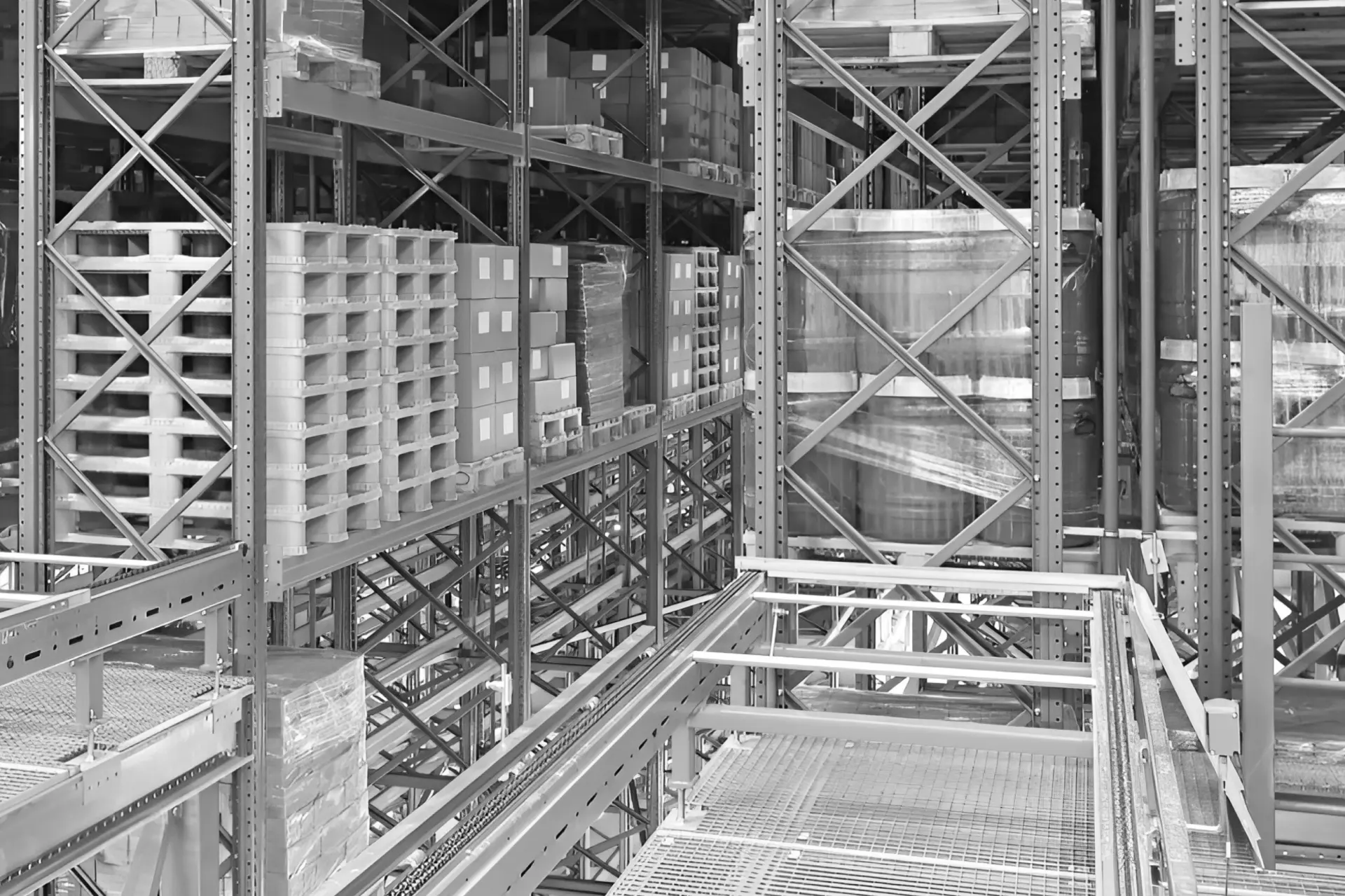
A miniload is the ideal automated storage system for lightweight loads. As a goods-to-person solution, it reduces operator travel, delivering clear benefits in terms of both operational efficiency and workplace safety.
In practice, a miniload combines racking, conveyors, a stacker crane, and a WMS into a compact automated storage system. The stacker crane performs storage and retrieval operations, while the system can handle totes, bins, containers, or trays. These trays can simultaneously hold multiple small items, creating a lightweight load unit. One of the main advantages of a miniload system is its compact footprint, making it particularly suitable for facilities where space is limited. Before investing in a miniload, however, companies should answer a key question: person-to-goods or goods-to-person?
Person-to-goods or goods-to-person?
Warehouses handling lightweight loads are not all the same, but they typically share several characteristics. They are usually defined by a high number of product references, meaning a large number of SKUs (Stock Keeping Units), and a high inventory turnover rate. These are common features of many e-commerce fulfillment centers. As a result, such facilities require highly efficient and responsive operations.
With this in mind, businesses must determine which storage and retrieval methods best fit their specific requirements. The goal is twofold: maximize productivity while minimizing picking errors.
The first decision concerns the warehouse operating logic: should operators travel to the goods, or should goods be automatically delivered to the operator’s workstation? There is no universal answer, as both approaches can be effective. However, if a goods-to-person strategy is preferred, a miniload system may prove to be the ideal solution.
Miniload: how it works
There is no such thing as a standard miniload system because every installation must be designed and engineered around the specific requirements of the warehouse. Some miniload systems operate with a single aisle, while others feature multiple aisles. Racking can be installed on both sides of the aisle or on just one side.
The stacker crane travels within the racking structure and is responsible for storing and retrieving goods. At the end of the aisle, there is typically an order preparation station where the stacker crane delivers the retrieved load. The entire process is orchestrated by the WMS, which ensures accurate picking operations and real-time inventory updates.
In general, a miniload system can handle loads of up to approximately 100 kilograms while maintaining high operating speeds. Horizontal travel speeds can reach up to 250 meters per minute, while vertical movements can reach up to 100 meters per minute.
The advantages of a miniload system
The first major advantage of a miniload system is its flexibility. Depending on operational requirements, throughput, speed, and storage capacity can be configured to meet specific needs. High-performance miniload systems can handle up to 250 containers per hour.
Another significant advantage is its compact design. This allows companies to achieve a high storage density while minimizing the floor space required. Miniload systems make effective use of vertical space, significantly increasing storage capacity within the same footprint.
In summary, a miniload system is an effective solution for warehouses that require high-intensity picking operations, optimized space utilization, and increased storage density through the efficient use of both height and length. In addition, operators remain at their workstations while the stacker crane delivers goods directly to the picking area, improving ergonomics, reducing physical strain, and enhancing workplace safety.
Want to learn more? Contact us to discover how a miniload system can improve the efficiency of your warehouse operations.
