



Warehouse storage systems are the combination of structures, technologies and processes used to store and organise goods and materials. Their ultimate purpose is to make the most of available space, facilitate access to products, and ensure efficient inventory management.
The wide variety of storage systems on the market reflects the different operational needs and layouts found across different warehouses. But what are the advantages and disadvantages worth considering? We discussed this with Andrea Leonarduzzi, Senior Advisor at Stesi, who walked us through the evolution of these storage systems over time and helped us understand when one system is a better fit than another.
The different types
To make sense of the complex world of warehouse storage systems, it helps to distinguish two broad families: high-selectivity systems and low-selectivity systems. As we will see, the choice between the two depends on the specific operational requirements of the warehouse.
High-selectivity storage systems
“One of the key characteristics of these systems”, Andrea explains, “is that they allow direct, immediate access to every storage unit, whether that is a pallet, a box, or another type of container.” In practice, every storage location in the warehouse is easily reachable without having to move other items first, which makes these systems ideal in environments handling a wide variety of products with high turnover.
High-selectivity systems include:
- Pallet racking: ranging from standard racking to double-deep configurations, these systems are designed to increase storage capacity without requiring additional floor space, by making use of vertical height and, where applicable, two levels of depth per bay.
- Mobile shelving (compactable warehouses): racking units are mounted on mobile bases that can be shifted laterally, opening only one aisle at a time to allow direct access to storage units or goods, thereby maximising the use of available space and reducing the number of aisles between shelving runs.
- Vertical storage systems: designed to enable the automated storage and retrieval of goods and materials within a self-contained vertical unit, these systems minimise floor space usage, increase operational efficiency, and also simplify correct stock rotation.
- Self-supporting structures: the racking forms part of the building’s load-bearing structure, allowing maximum use of vertical space, reduced clearance between shelves, and therefore the highest possible storage density.
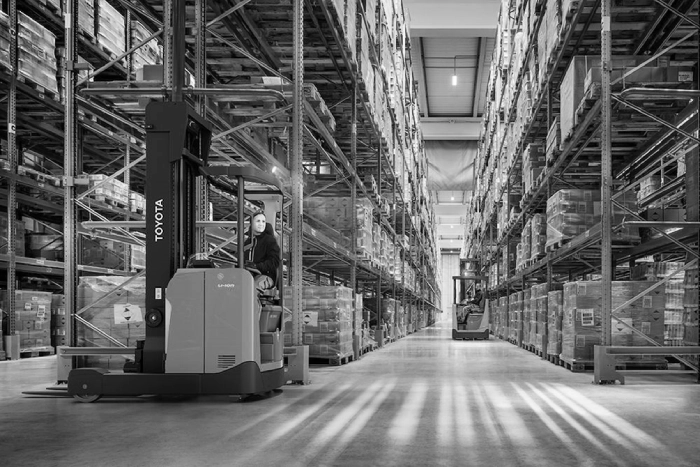
Pallet racking
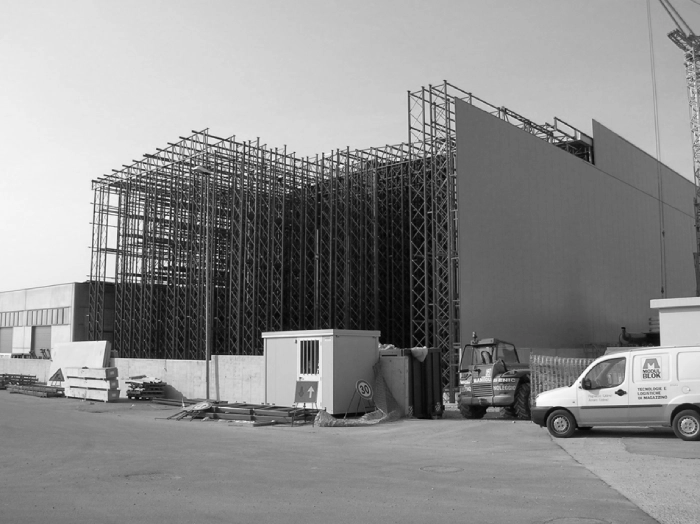
Self-supporting structure under construction
Advantages and disadvantages
As we have seen, high-selectivity storage systems provide direct product access and a high degree of flexibility, making them the natural choice for warehouses managing a wide range of SKUs with frequent movements.
Key advantages:
- They support the management of a large number of SKUs and/or high-turnover stock
- They reduce picking times
- They simplify operations that require fast, frequent picking
“That said”, Andrea continues, “it is important to keep in mind that in terms of space utilisation, these systems are less efficient than low-selectivity ones, because the aisles needed to allow access cannot be eliminated.”
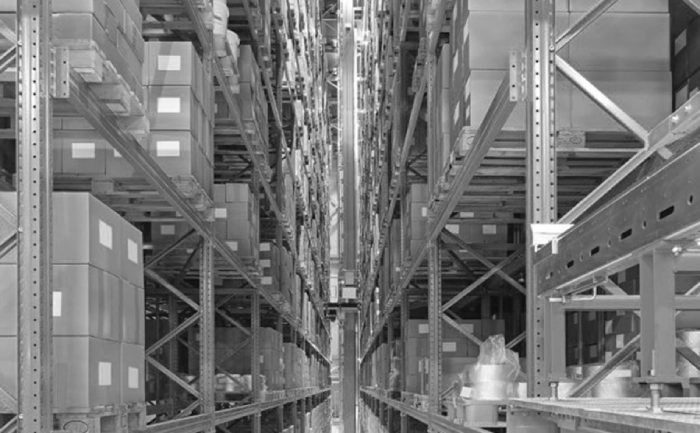
Stacker crane in operation
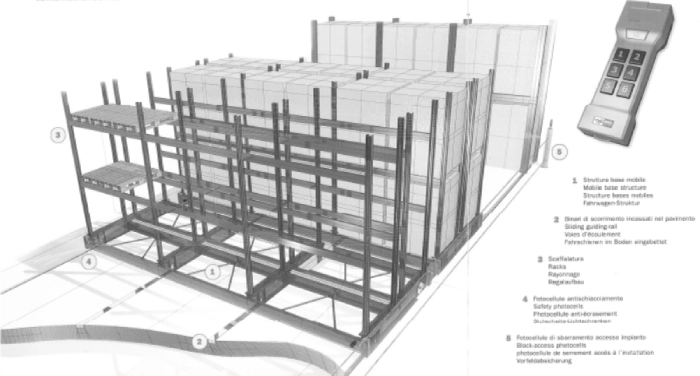
A compactable system consisting of shelving units on mobile bases
Low-selectivity storage systems
Low-selectivity systems are designed to maximise the use of storage space, at the cost of ease of access to individual load units. “This makes them particularly attractive in warehouses that need to store large quantities of a limited number of products“, Andrea clarifies, “or for slow-moving items, where space efficiency matters more than speed of access.”
Low-selectivity systems include:
- Block stacking: goods are stored directly on the floor in designated bays, sometimes managed by advanced intelligent systems. This approach requires a LIFO (last in, first out) logic and only works for stackable goods.
- Multi-deep racking/push-back racking/radioshuttle: automated solutions for managing pallets within multi-level racking. They use a motorised shuttle that moves autonomously inside the racking structure, pushing pallets deep into the storage channels.
- Drive-in and drive-through: a variant of multi-deep solutions in which movement is handled by forklifts that physically enter the racking structure to load or retrieve pallets.
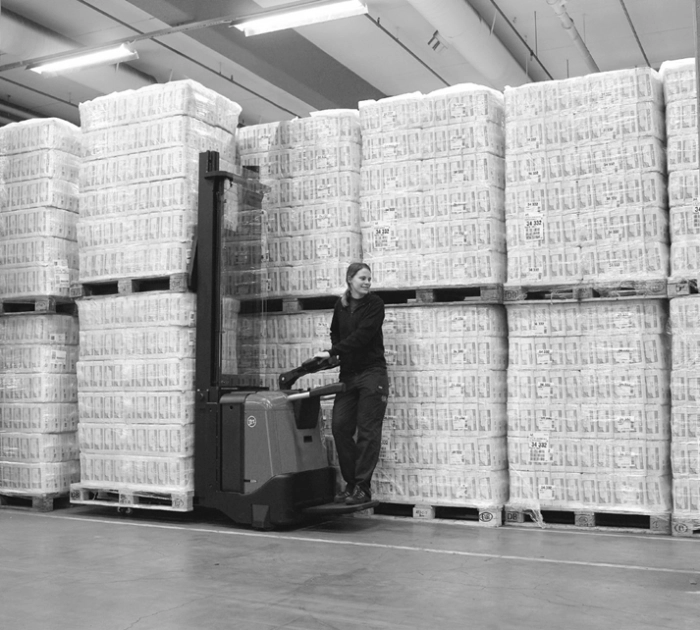
Pallet racking system
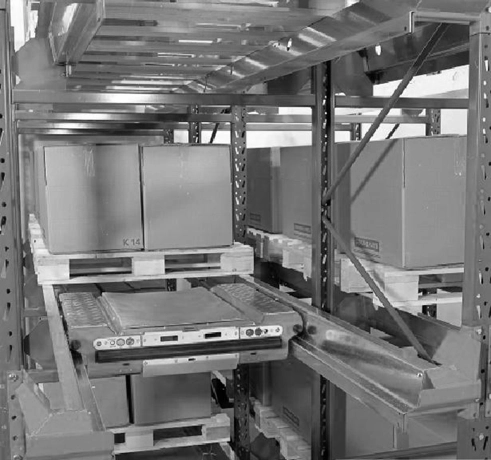
Radioshuttle
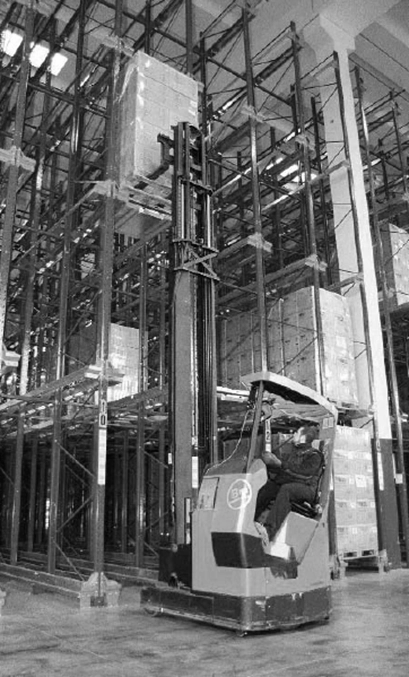
Radioshuttle
Advantages and disadvantages
Low-selectivity storage systems maximise the use of available space, enabling optimal utilisation of both vertical and horizontal dimensions and making them well suited to high-volume storage.
Key advantages:
- They optimise space usage, reducing the floor area required for storage
- They simplify the warehousing of slow-moving or high-volume products
- They reduce infrastructure and maintenance costs
Here too, however, the system has its drawbacks. Because immediate access to individual products is not guaranteed, it is often necessary to move multiple units to reach a specific item, making it a poor fit for warehouses with frequent inventory movements or a large number of distinct product lines.
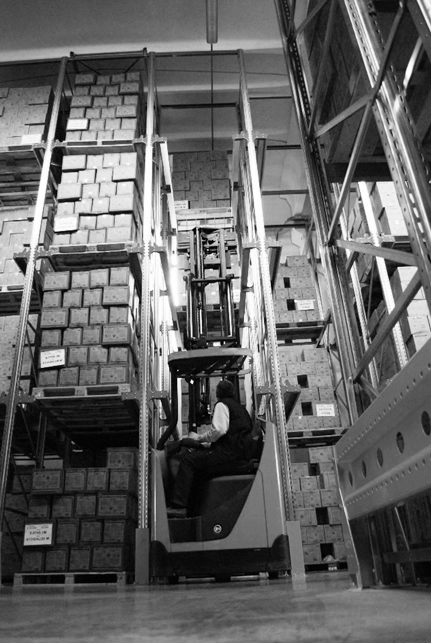
Drive through
The history of storage systems
“Given the growing demands for efficiency, speed and space optimisation in warehousing, storage systems have undergone significant evolution over time”, Andrea explains.
- Early 20th century: the first storage structures are simple, generally low shelving units, often made from basic materials such as wood, frequently disorganised and entirely non-automated. Space inside warehouses is poorly utilised, particularly in terms of height, and the loading and retrieval of goods is slow and labour-intensive.
- Mid-20th century: with industrialisation and the growth of global trade, steel shelving and other durable materials begin to appear in warehouses. These new structures allow greater use of vertical space, increasing storage capacity and improving overall warehouse organisation.
- 1980s and 1990s: warehouses begin to embrace the first forms of automation, with the introduction of automated storage systems. Automated warehouses and computerised inventory management systems, including the earliest forms of WMS, make it possible to drastically reduce handling times and improve the accuracy of warehouse operations.
- From the 2000s onwards: the advent of Industry 4.0 and the integration of advanced technologies such as sensors, artificial intelligence, the Internet of Things (IoT) and robotics enable storage systems to become increasingly intelligent and interconnected. Modern warehouses are now capable of self-management, adapting in real time to fluctuations in demand and dynamically optimising operations.
What does the future hold?
In line with current trends, the evolution of storage systems will in all likelihood be driven by technological innovation, growing demand for efficiency, and the push for space optimisation. Future scenarios are expected to include:
- Integration with IoT technologies: storage systems will be equipped with sensors that monitor the presence and characteristics of stored goods in real time, enabling more precise inventory management.
- Automation and collaborative robotics: systems and sensors will be connected to automation equipment and robots to streamline warehouse activities and increase operational throughput.
- Intelligent control: high-density storage systems will use increasingly advanced logic to optimise space utilisation and goods retrieval, with benefits in terms of both operational throughput and energy consumption.
“In short”, Andrea concludes, “high-selectivity systems will become increasingly flexible and interconnected, while low-selectivity systems will focus on spatial efficiency and the ability to handle large volumes with minimal human intervention. These developments will make the warehouses of the future more efficient, intelligent and adaptable.”
silwa WMS and its integration with different storage systems
silwa, Stesi’s advanced warehouse management software, offers a wide range of features that allow logistics operations to be optimised in relation to the storage systems in use. Among Stesi’s success stories with silwa, the following stand out:
BRN Bike Parts: integration with vertical storage systems and a mobile shelving unit
BRN, a leading distributor of bicycle components and accessories, implemented silwa to manage 14 vertical storage units and a mobile-base compactable shelving system. This integration made it possible to:
- Optimise space: automated management of the vertical storage units allowed maximum use of available height, reducing floor footprint.
- Reduce picking times: thanks to the integration with the vertical systems, silwa accelerated retrieval operations, cutting downtime and improving productivity.
- Efficiently manage the compactable shelving unit: the ability to dynamically manage heterogeneous storage systems enabled overstock to be handled while optimising the surface area occupied.
Kasanova: integration with a multi-deep system and radioshuttle
Kasanova, a specialist in homeware products, adopted silwa alongside standard high-selectivity pallet racking, a multi-deep storage system and a radioshuttle system. This configuration made it possible to:
- Increase storage capacity: the multi-deep system, managed by silwa, allowed horizontal space to be maximised by reducing aisle width and increasing storage density.
- Improve operational flexibility: the radioshuttle system, integrated with silwa, enabled fast and safe access to pallets, improving the speed of loading and unloading operations.
- Reduce errors: automated and precise management of storage and retrieval operations reduced mistakes, increasing the accuracy and reliability of warehouse activities.
Fiamma: integration with multi-deep systems, radioshuttle, compactable shelving and pallet racking
Fiamma, a manufacturer of technical accessories for luxury vehicles, chose silwa for a complex setup combining a multi-deep system, radioshuttle, compactable shelving and pallet racking. This integration delivered a wide range of benefits, making it possible to:
- Manage everything centrally and in an integrated way: silwa’s interface allowed different types of storage systems to be managed in a unified manner, simplifying operational complexity.
- Increase capacity and efficiency: combining multiple systems maximised the use of available space while also allowing direct access to fast-moving goods, with tangible benefits for picking operations.
- Achieve flexibility and scalability: the solution offered the ability to adapt quickly to changing storage requirements, supporting company growth without the need for immediate investment in additional infrastructure.
Linergy: interfacing with a self-supporting structure including stacker crane and miniload
Linergy, a specialist in lighting and emergency lamps, integrated silwa with a self-supporting structure incorporating a stacker crane and miniload system, both advanced solutions for the automated management of high-density warehouses. The integration made it possible to:
- Deliver advanced automation: the use of the stacker crane and miniload, integrated within silwa, automated the storage and retrieval process, significantly reducing manual intervention and operational lead times.
- Achieve precision and speed: the system delivered a high level of accuracy in handling operations, improving service quality and reducing errors.
- Optimise space: the integration enabled optimal use of both vertical and horizontal space, increasing warehouse capacity without compromising the speed of operations.
Want to find out more about silwa WMS? Get in touch.
