


Electronics logistics and supply chain management in the electrical and electronic equipment (EEE) sector are undergoing an unprecedented transformation. Technological progress, driven by the energy transition, home automation and electric mobility, has made electronic devices essential components of the global economy.
Yet this central role also brings considerable operational complexity. Companies must deal with global, multi-tier supply chains, increasingly short product life cycles and significant demand uncertainty. As a result, electronics logistics is no longer just about storage and material handling. It has become a strategic driver of business competitiveness.
“Managing complexity has the potential to strengthen resilience.” ⁓ Cicerelli & Ravetti (2023)
In this article, Mario Avdullaj, Software Developer specialising in supply chain solutions and R&D team member at Stesi, explores the main challenges of electronics logistics and explains how he and the development team have helped our customers address them through a structured, strategic approach.
Electronics logistics: key characteristics, challenges and requirements
Logistics in the electronics industry faces a unique set of structural challenges. These stem both from the nature of the products themselves and from the complexity of global supply networks. Unlike many traditional manufacturing sectors, electronics involves a wide variety of components, frequent updates to technical specifications and a strong reliance on international sourcing for critical raw materials and semiconductors. Together, these factors create multiple layers of complexity, both within individual businesses and across the wider supply chain. They also call for a fundamental rethink of traditional warehouse management practices.
Serial number traceability, product variants and fast-moving small components
The electronics sector must manage a diverse product catalogue with a complex component structure, alongside frequent customisations and product changes. Electronic devices rely on a wide range of circuit boards, sensors, connectors and small, fast-moving components, often purchased in relatively small batches.
This makes granular, transparent traceability essential.
Electronics companies need to link product data and specifications (unique serial numbers, item variants, production batches) to the physical storage and handling flows within their warehouses. Without accurate tracking of individual packages and components, the risk of inventory obsolescence increases significantly, particularly given the short life cycles of many electronic products. And the challenge is not just operational. Regulatory requirements also play a role.
Growing regulatory pressure around chemical substances and product safety, including REACH and RoHS regulations applicable to the European market, combined with increasing attention to environmental impacts throughout the product life cycle through life cycle assessment (LCA), makes the availability and traceability of material information across the supply chain increasingly important.
Integrating production lines, testing departments and warehouse operations
Now let’s talk about demand response and customer responsiveness, two factors connected to a company’s ability to respond quickly and effectively to market demand. At Stesi, we consistently emphasise that logistics cannot operate in isolated silos. It must be fully integrated with production, including quality control and testing. In electronics logistics, assembly, electrical and functional testing, and packaging all require a continuous flow of operational data and materials.
Integrating manufacturing management systems with logistics operations makes it possible to share production and testing data in real time. For example, when products are identified automatically as soon as testing is complete, they can enter the warehouse flow or move directly to the shipping area with their data already validated. This internal coordination improves visibility of available inventory, reduces dwell time in transfer areas and limits the need for buffer stock to compensate for process inefficiencies.

Synchronising flows across headquarters, remote sites and subcontractors
As researchers Cicerelli and Ravetti highlight in their 2023 study, (Sustainability, resilience and innovation in industrial electronics: a case study of internal, supply chain and external complexity, 2023), electronics value chains are typically geographically distributed and structured across multiple tiers of subcontractors and suppliers. Companies must coordinate physical and information flows connecting headquarters, remote manufacturing facilities, first- and second-tier suppliers, and external manufacturing partners.
This is a geographical dispersion that makes supply chains more vulnerable to bottlenecks and transport delays. To mitigate these risks and achieve genuine supply chain agility, companies need effective synchronisation across the network. Many are therefore adopting e-supply chain platforms that also connect subcontractors and remote manufacturing sites.
Cherubini S.p.A. case study: electronics logistics in practice
Cherubini S.p.A. is an Italian company founded in 1947, specialising in electric motors and systems for operating solar shading products, including shutters and awnings. Headquartered in Bedizzole, in the province of Brescia, the Cherubini Group operates in six countries and employs more than 280 people. In 2023, it reported sales revenue of €55.9 million and a value of production of €56.95 million.
“For a company like ours, with multiple sites and complex processes, traceability is essential to ensure continuity, quality and operational control” ⁓ Liviana Barbàra, Marketing Manager, Cherubini S.p.A.
These figures reflect an established industrial business with a strong international presence and complex requirements for managing manufacturing sites, warehouses and shipping operations. “Several manufacturing sites, including the location in Correzzana and the facility in China, ship goods to the Bedizzole plant, which then manages outbound operations” explains Mario Avdullaj. In 2020, Cherubini launched a logistics optimisation and digitalisation project that culminated in the implementation of silwa.
The parent-child load unit model: hierarchical management of pallets and overpacks
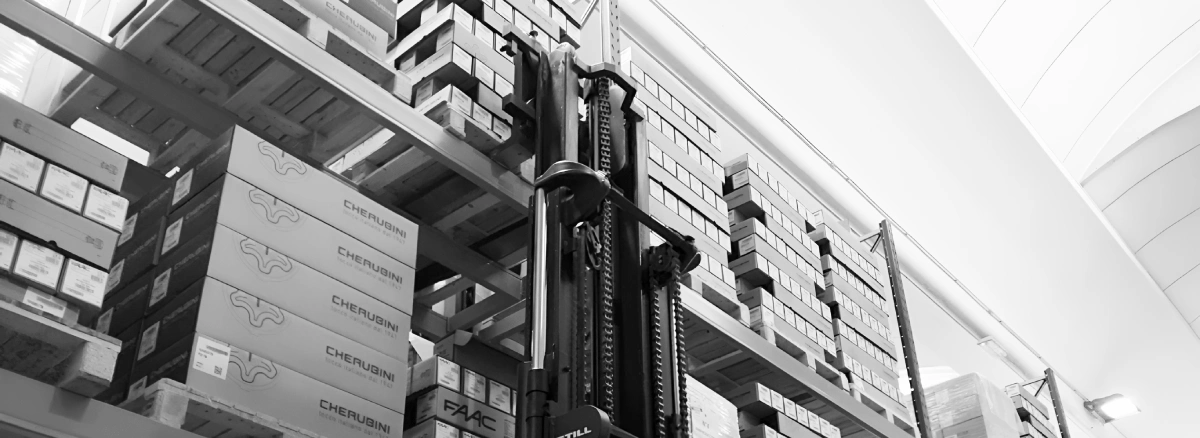
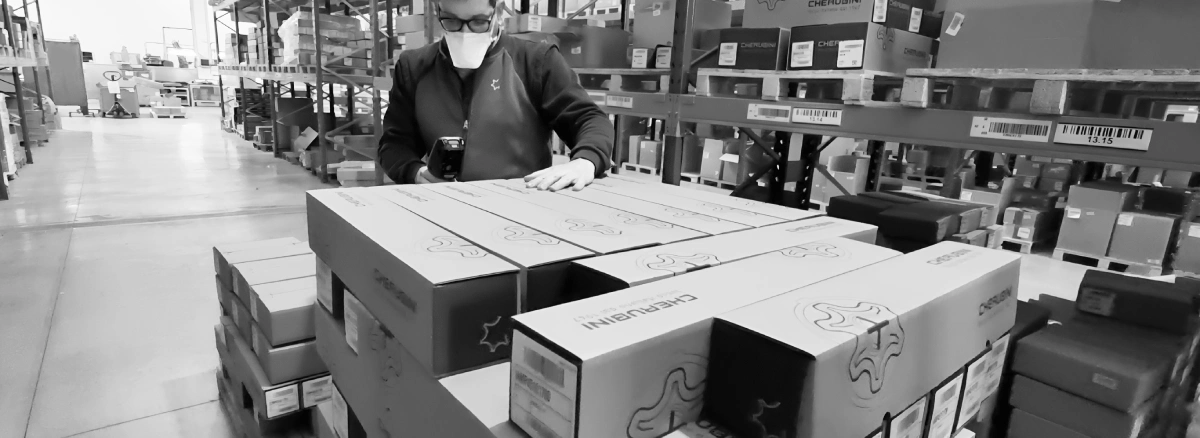
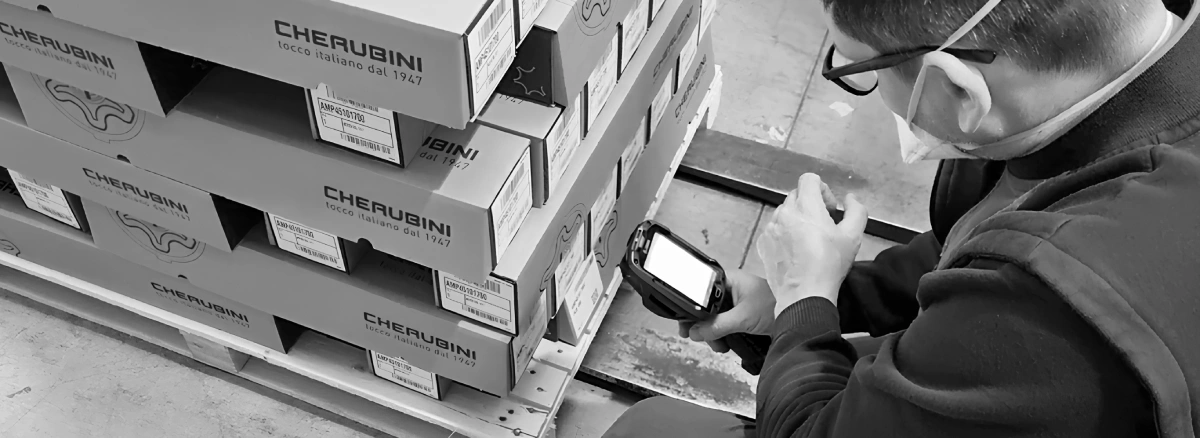
The specific characteristics of Cherubini’s products (electric motors and control devices), made it necessary to move beyond traditional warehouse management based on uniform batches. “Goods are stored on pallets made up of cardboard packages, which we call overpacks” Mario explains. “Each overpack has a unique barcode label containing several pieces of information:
- serial number
- variant
- production batch
- production order
This setup led to the development of a two-level data structure known as hierarchical load unit management, in which the parent load unit (LU), the finished pallet, contains and tracks a complex hierarchy of child LUs, the individual overpacks. This allows the Warehouse Management System to identify the exact composition of each pallet.”
Production and put-away flows: EDC testing, TCP/IP scales and batch management
Cherubini manufactures its products both at its own facilities and through subcontract manufacturers. Each motor then undergoes EDC testing, during which the following steps take place:
- generation of a unique serial number
- printing of the serial number label
- recording of the data in the production database
The software then retrieves production orders, generates ZPL labels for the overpacks (Zebra Programming Language, the language used by Zebra printers), and communicates with the silwa WMS to assign the parent LU.
When receiving and putting away purchased components or goods returned from subcontract manufacturing, operators can use a weighing-based goods receipt process. “The system connects to industrial scales via the TCP/IP socket protocol. One scale measures the individual component’s unit weight, while a second records the pallet’s gross weight. Once the tare weight has been entered, the system calculates the number of pieces” explains our Software Developer.
Goods receipt is one of the key stages at which inventory for the parent and child LUs declared during production is recorded. During guided put-away, scanning the parent LU with a warehouse terminal loads the bill of materials for its child overpacks into the WMS. The put-away algorithm then recommends the optimal final storage location, taking into account ABC inventory turnover classifications and the item’s physical and functional characteristics.
Optimising picking, packing and shipping
Cherubini uses Stesi’s warehouse management software to manage electronics logistics and assess order fulfilment feasibility. The WMS displays fulfilment status using a traffic-light colour code: green, yellow or red. The system also deducts existing allocated commitments from net stock and distributes the remaining available inventory according to order priority and FIFO (first in, first out) rules.
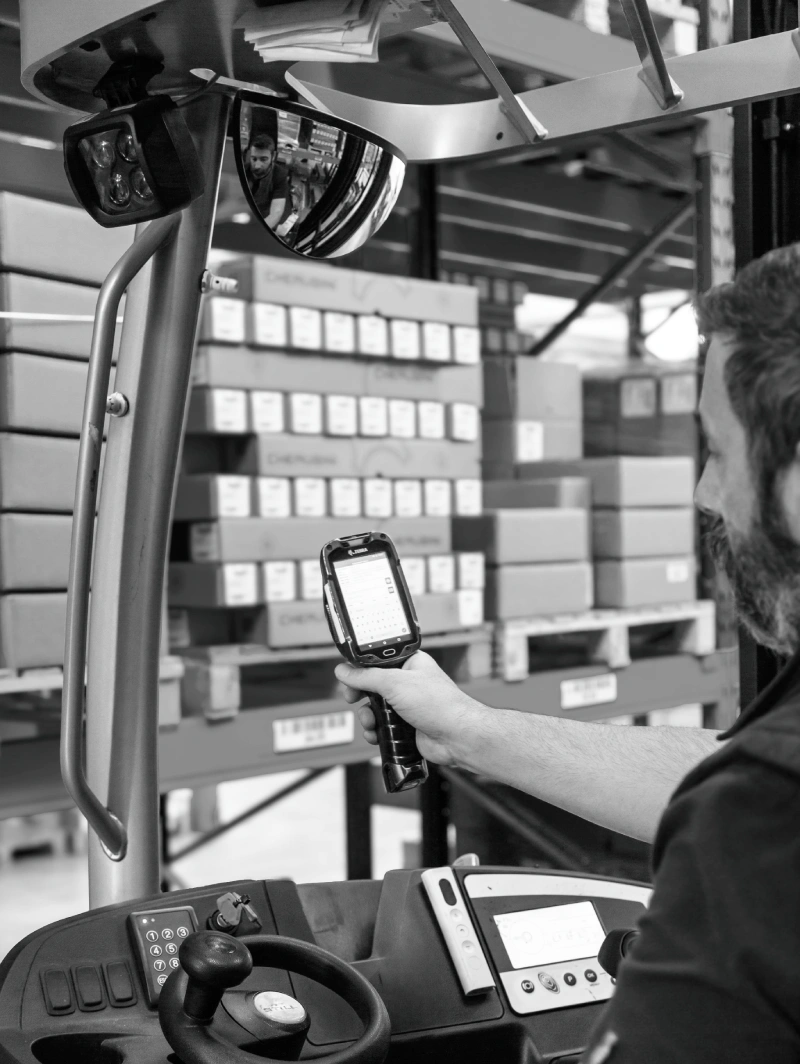
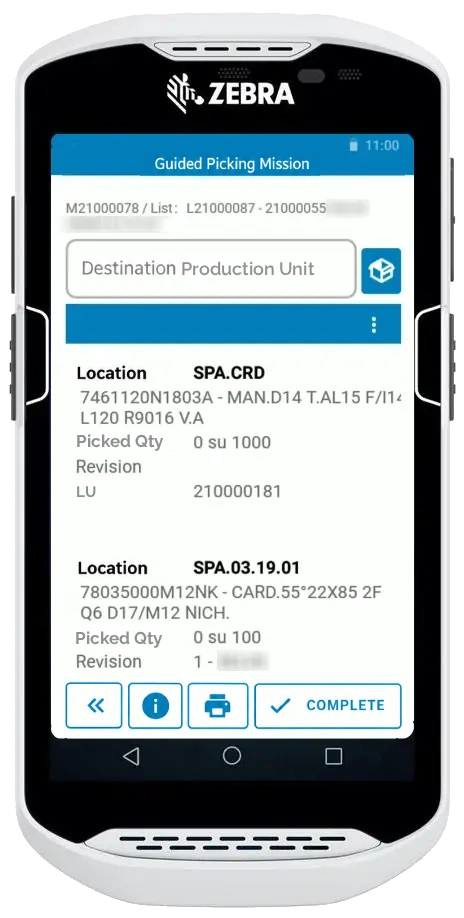
During guided picking of motors and manuals managed through the parent-child LU structure, mobile terminals allow operators to view the full list of overpacks on a parent pallet and select only the specific packages required, or pick multiple child LUs in a single operation.
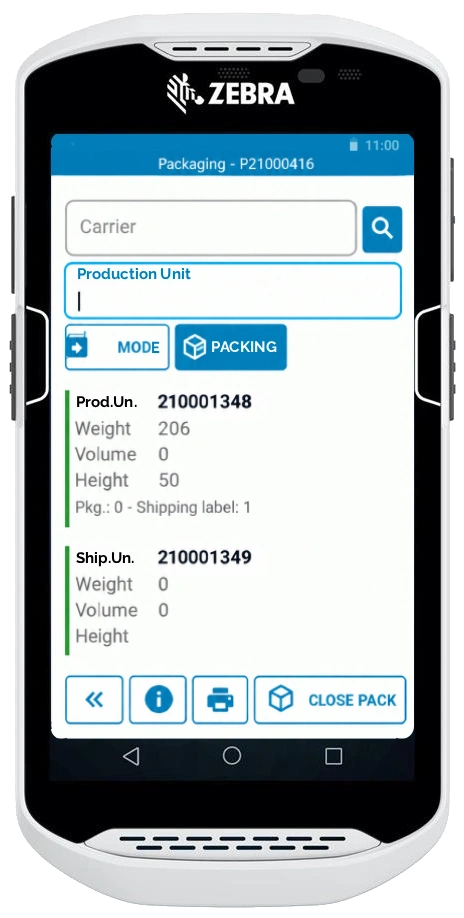
“Before closing each package” Mario continues, “the operator performs a verification check, validating every overpack. To ensure packing accuracy, the system compares the estimated weight with the actual measured weight. If the difference exceeds the permitted tolerance, an on-screen alert is generated to prevent shipping errors“.
Once the checks are complete, closing the package automatically sends the final packing list to the ERP system. The ERP then processes the information and returns the shipping document, which is imported back into the WMS to guide the operator through loading the goods onto the carrier’s vehicle.
“Working with Stesi has helped us structure our information management more effectively, contributing to a better service for our customers” ⁓ Liviana Barbàra, Marketing Manager, Cherubini S.p.A.
Software architecture: integrating the silwa WMS with Microsoft Dynamics ERP
Cherubini’s IT infrastructure evolved from its legacy AS400 system to the new Microsoft Dynamics 365 ERP. Migrating to a new ERP represented a major business change. At the same time, Cherubini needed to preserve the established warehouse processes managed by silwa, without making direct changes to the existing application codebase.
Stesi therefore designed an integration architecture based on staging databases and ETL procedures (Extract, Transform, Load). This approach preserved silwa’s application logic while introducing an integration layer between the two systems. The architecture transforms and reconciles data from Dynamics 365 so that the WMS can process it, and vice versa.
Inbound and outbound integration flows were automated, allowing silwa and Dynamics 365 to exchange information while keeping logistics data and processes synchronised. As a result, the ERP migration did not require the WMS’s operational logic to be rewritten, preserving continuity across warehouse processes.
From fragmented labelling applications to a single system
“Stesi undertook something it had never done for a customer before: rewriting an entire suite of small software applications used for labelling” explains our Software Developer.
Before the project, Cherubini relied on several in-house Java applications to manage labelling operations. “Over time, this distributed architecture had fragmented the data sources. Each application retrieved information from different databases, with no central mechanism for data inheritance and consistency” Mario continues.
Stesi addressed the issue by rewriting and consolidating the different applications into a single labelling software system. The new system centralises the information required to generate labels and guides operators through printing and subsequent warehouse handling operations.
Each motor is identified by a serial number, while the overpack containing it retains the information needed to ensure traceability. The new software was subsequently rolled out to Cherubini’s facilities in China, Spain and France.

FAQs about electronics logistics
How does partial picking of a load unit work?
Partial picking allows operators to remove only some of the packages contained in a load unit while keeping the remaining composition and inventory balance updated in the system.
What is subcontract manufacturing?
Subcontract manufacturing is a production arrangement in which a company entrusts an external provider with one or more processing or manufacturing activities. The company retains responsibility for the product and the overall production process.
What does ETL mean in business management systems?
ETL stands for Extract, Transform, Load. It describes a process that extracts data from a source, transforms it according to specific rules and loads it into a target system. In business management systems, ETL is often used to integrate applications with different data structures and keep information synchronised between ERP and WMS platforms.
How can electronic component obsolescence be managed in the warehouse?
Managing electronic component obsolescence requires accurate traceability of items, variants, batches and serial numbers, making it possible to determine how long products have been held in stock. A WMS supports this process by providing up-to-date information on inventory and stock movements. This helps companies identify components at risk of becoming obsolete and adjust inventory before those components lose value. This is particularly important in the electronics industry, where many products are subject to EOL (End of Life) decisions.
How can a WMS support the traceability required for REACH and RoHS?
A WMS does not replace the tools and procedures companies need to ensure compliance with REACH and RoHS. However, it can support product traceability. Managing batches, serial numbers and load units makes it possible to reconstruct stock movements and identify the product units associated with a particular supplier delivery or batch more quickly. This information can support compliance checks, non-conformance management and the retrieval of data required for inspections and audits.
What is the difference between a serial number and a production batch?
A serial number uniquely identifies an individual product, whereas a production batch identifies a group of products associated with the same manufacturing run or supply batch. Serial numbers make it possible to trace an individual device, while batch numbers help companies manage and track groups of products.