


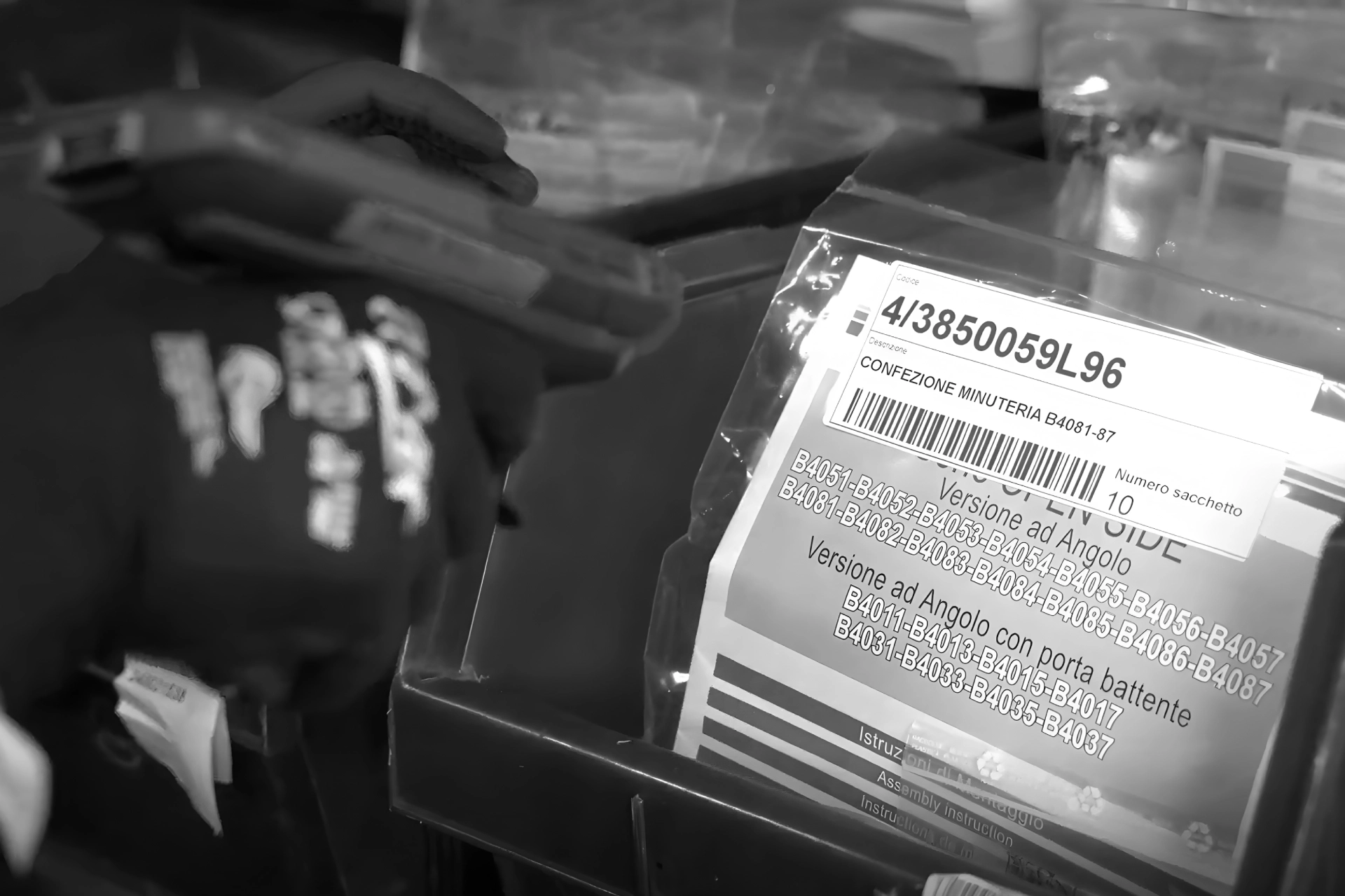
The SKU (Stock Keeping Unit) code is a unique alphanumeric identifier used to distinguish and track product variants in a warehouse.
Without properly encoded SKUs, inventory and stock management quickly becomes chaotic. Two variants of the same product, for instance a red t-shirt in size M and the same shirt in size L, remain indistinguishable in software systems. This leads to picking errors, inaccurate stock counts, and incorrect order fulfillment. Operationally, the lack of a structured SKU coding system results in wasted time searching for goods, difficulty determining real stock levels, and an inability to analyze the turnover rate of individual items.
Daniele Rosada, our Software Developer specializing in logistics workflows, explains in this article what SKU codes are, how to create them, and how to rationalize them for accurate warehouse stock management.
SKU meaning: what does Stock Keeping Unit stand for?
SKU is an acronym for Stock Keeping Unit. It is identified by means of a unique alphanumeric code created by a company to distinguish a specific product variant within its operations.
“Every SKU represents a specific item type characterized by attributes that set it apart from all others,” explains Daniele. “These attributes can include model, manufacturer, size, color, material, packaging type, or any other relevant operational characteristic.”
For instance, a pasta manufacturer manages the reference “Spaghetti No. 5” in three package sizes (500g, 1kg, 3kg) and two packaging types (single box, case of 6). Each size/packaging combination is a distinct SKU: the same pasta, but six different SKUs, each with its own stock level, location, and turnover rate (e.g., SPA5-500G-CS, SPA5-500G-C6, SPA5-1KG-CS, etc.).
In electronics, a smartphone distributor might sell the same phone model in three colors (black, white, blue) and three storage capacities (128GB, 256GB, 512GB). This setup generates nine distinct SKUs, even though the base product is identical. Confusing them means shipping the wrong color or storage size to a customer. During an inventory audit, operators do not simply count overall products in the warehouse, they count the exact available quantity of each individual SKU.
“Unlike international standard codes such as GTIN, EAN, or UPC, SKU codes are not regulated or standardized,” highlights our Software Developer. “Every company chooses its own coding methodology based on specific operational needs.”
| Code | Created by | Purpose |
| SKU | Individual company | Internal warehouse management |
| GTIN | GS1 | Global item identification |
| EAN | GS1 | Retail barcode (Global) |
| UPC | GS1 | Retail barcode (North America) |
| Serial Number | Manufacturer | Single-unit traceability |
Difference between SKU, EAN, UPC, and GTIN
SKU, EAN, UPC, and GTIN all identify products, but they serve different purposes and scope.
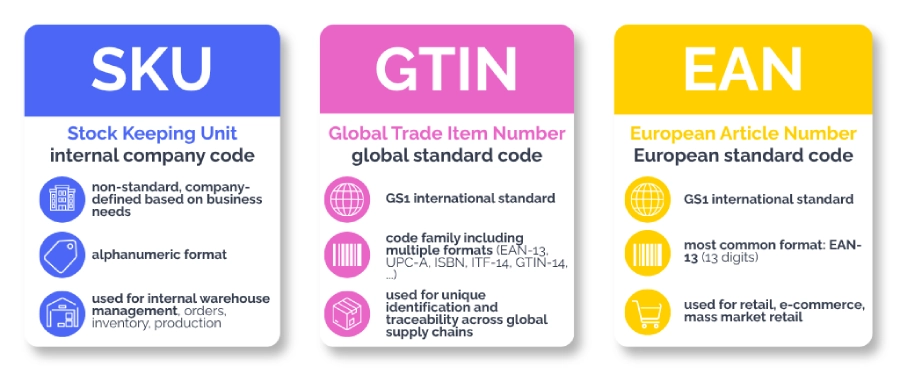
- SKU (Stock Keeping Unit): an internal code created by the company that does not follow international standards. Its purpose is to distinguish product variants within internal management systems, regardless of how the product is identified externally.
- GTIN (Global Trade Item Number): the overarching GS1 identifier that includes several code families, such as EAN-13, EAN-8, and UPC-A. It is the international benchmark system for commercial product identification.
- EAN (European Article Number): a 13-digit international standard code managed by GS1 to identify a product uniquely on a global scale. It is the standard barcode found on retail packaging and acts as the functional equivalent of the UPC (Universal Product Code) used primarily in North America.
How to generate an SKU code
Because an SKU is strictly for internal use, there is no universal standard for creating one. However, established best practices ensure that coding remains readable, scalable, and easy to maintain over time.
- Define relevant attributes in advance.
Which characteristics truly set a product apart? These may include category, supplier, color, size, format, batch, or others. Only operationally relevant attributes belong in the SKU. - Choose a logical, segmented structure.
A well-constructed SKU code consists of segments (often separated by a hyphen, underscore, or dot), each carrying a specific meaning. Example: CAT-PROD-COL-SIZE, where CAT is the product category, PROD the manufacturer, COL the color, and SIZE the garment size. - Use consistent, documented abbreviations.
Abbreviations must be standardized and recorded in an internal registry. “BLU” for blue must always mean blue across all SKUs and for all operators. - Avoid ambiguous characters.
The letter O and zero (0), or the letter I and one (1), are easily confused, especially on mobile terminals or small printed labels. It is best to exclude them entirely. - Do not include variable information.
Certain data points change frequently over time (such as price, current supplier, or destination warehouse). These should never be embedded into an SKU; a code that changes loses its identification value. - Keep scalability in mind.
If you currently manage 500 SKUs but plan to scale to 5,000, the code structure must accommodate that growth without requiring a complete re-encoding process.
Practical example: An apparel company might structure an SKU as APP-TShirt-BLU-M, where APP stands for category (apparel), TShirt for product, BLU for color, and M for size. The same item in size L becomes APP-TShirt-BLU-L, keeping the system predictable and clear.

SKU rationalization: less complexity, higher efficiency
“Over time, the number of SKUs tends to expand significantly,” explains Daniele. “New products are introduced and variants multiply, but obsolete references are rarely removed. This leads to SKU proliferation, which increases holding costs and complicates picking and inventory operations.”
SKU rationalization is the process by which a company analyzes its catalog, identifies low-turnover or duplicate items, and decides which to eliminate, consolidate, or keep. This improves operational efficiency, reduces costs, and optimizes overall business performance.
As Daniele notes: “The starting point is always an ABC analysis of stock items. Classifying SKUs based on revenue contribution and rotation frequency helps separate core items from slow-moving ones.”
The Global Inventory Management Market 2026 report by Mordor Intelligence highlights an explosive surge in SKUs for retailers and distributors, who now manage tens of thousands of items spread across physical stores, e-commerce channels, and marketplaces.
Automated SKU management with WMS software
When item volume grows, managing stock via spreadsheets or manual procedures shows immediate limitations. “With hundreds or thousands of active SKUs, simply knowing how many units you have is not enough. You need to know their exact location, batch number, expiration date, and rotation rate. Excel cannot track this dynamically, but a WMS can,” explains our Software Developer. A Warehouse Management System (WMS) allows businesses to manage SKUs in a structured, automated way. Key features include:
- complete item traceability;
- SKU-to-location mapping;
- batch and serial number tracking;
- real-time inventory control;
- barcode and RFID support;
- ABC inventory analysis;
- item turnover monitoring.
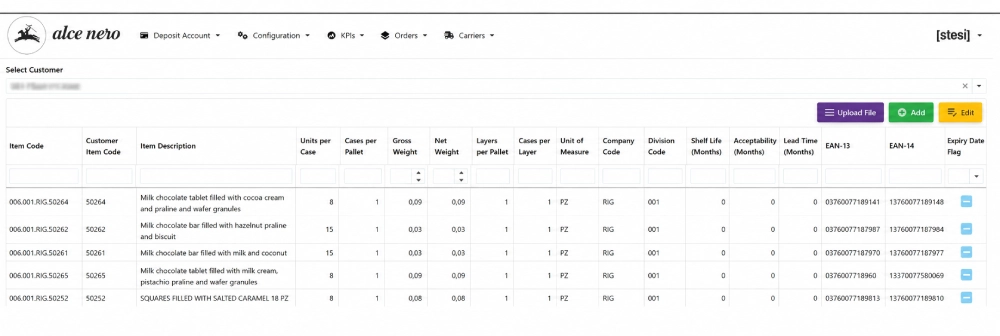
SKU-to-location mapping (managed through Load Units – LU) provides an immediate operational benefit. The WMS goes beyond tracking SKU presence; it tracks the exact pallet or container (Load Unit) holding the goods and its precise rack location, directing operators accurately. Warehouse personnel no longer waste time searching for stock, mispicking items, or confusing similar product variants. Furthermore, when an operator picks ten units of an SKU, the WMS updates inventory in real time, logs the source location, checks batch validity, and updates the associated sales order in the ERP.
“The primary advantage is that every movement is recorded as it happens, keeping inventory continuously aligned with actual physical status,” concludes Daniele Rosada. “In this way, the SKU becomes the central access point for all operational data tied to a product.”
In warehouses with thousands of active items, a WMS also automates rationalization by highlighting stagnant SKUs, flagging stockout risks, and suggesting slotting re-allocations based on real rotation data.

SKU code FAQ
Is an SKU different for every individual unit of the same product?
No. An SKU identifies a product variant, not an individual physical unit. Two identical refrigerators of the same model share the same SKU; what changes is the available inventory quantity of that SKU, not the code itself. An SKU changes only when at least one relevant attribute changes (e.g., model, color, capacity, or packaging). Two fridges of the same model with different finishes (e.g., stainless steel vs. white) will have different SKUs.
The distinction between a physical unit and a variant is handled via serial numbers versus SKU codes. A serial number is unique to each individual item and serves single-unit traceability (useful for recalls or warranties). An SKU is shared across all units of that variant to manage stock. In a WMS, both coding levels coexist: the SKU manages aggregated inventory, while the serial number tracks the specific piece.
How do you turn an SKU into a barcode?
An SKU is an internal identifier, not a barcode image. To make it scannable, it must be encoded into a barcode format. The most suitable format for internal SKUs is Code 128, a flexible standard that accepts letters, numbers, and special characters (including hyphens and underscores). It requires no registration or licensing fees and is widely supported by industrial scanners. Numerous free online tools allow you to convert SKU strings into Code 128 images instantly.
Do I need to register with GS1 to get barcodes for my SKUs?
No, registration is not required for internal use. GS1 registration is necessary only if you plan to distribute products through retail chains, major marketplaces, or global supply networks. It involves initial fees and annual dues. For internal warehouse management or 3PL operations, Code 128 barcodes generated from internal SKUs offer a valid, cost-effective solution.
Are SKU and barcode the same thing?
No. An SKU is the internal product identifier defined according to company logic. A barcode is a visual representation of that code (or an associated standard code) that allows optical scanning. A single product can have one SKU linked to multiple barcodes, such as a Code 128 label for internal tracking and an EAN barcode for external distribution. Maintaining a mapping table between SKUs and barcodes is recommended.
What characters should be avoided in an SKU to prevent barcode issues?
Certain characters cause errors during printing, scanning, or system imports. Avoid spaces, quotation marks, symbols like & or %, and the letters O and I due to visual confusion with zero and one. Avoid starting an SKU with a zero, as some database systems truncate leading zeros automatically. Using consistent uppercase letters and separating segments with hyphens or underscores ensures readability and software compatibility.
What is the difference between an SKU and a Load Unit (UdC)?
Put simply, an SKU is a commercial and management entity, while a Load Unit (UdC) is the physical handling support. The Stock Keeping Unit (SKU) defines a specific item and its variants within the software, identified by an alphanumeric string (e.g., SCA-X-42-RED). The Load Unit (UdC) is the physical support (e.g., pallet, tote, box) used to store and move goods. A single Load Unit can contain items belonging to one or multiple SKUs. The WMS tracks stock by recording exactly which SKU code is stored inside which Load Unit, and in which specific shelf location it rests.