


The Supply Chain is the set of organizations, people, activities, information, technologies, and resources involved in the passage of a product or service from the supplier to the end consumer. By definition, it covers the entire lifecycle of a good: the sourcing of raw materials, production, warehouse storage, distribution, and reverse logistics (returns). Supply chain and logistics are, in fact, anything but new concepts: from the construction of the pyramids to the fight against hunger in Africa, humanity has always had to navigate the principles of an efficient flow of materials and information in order to meet the requirements and needs of its final recipients.
“The real competition is between supply chains, not companies.”
~ Martin Christopher, Cranfield University
Yet it is only in recent times that businesses have begun to recognize the fundamental impact that supply chain management can have on the achievement of competitive advantage. While during the 1990s and 2000s the primary focus of managers was on production, the management of the overall supply chain, including logistics and shipping, was still considered marginal and secondary. According to Stefano Cudicio, President of Stesi and Contract Professor at the University of Udine, it was only with the passage of time that companies began to understand how heavily supply chain costs were actually weighing on their margins. “Add to this that the 2008 crisis was caused by a productive capacity that was far too high relative to the market’s ability to absorb it: from that moment, attention to the supply chain increased dramatically, and its importance finally became unmistakably clear,” states Cudicio.
From the moment the supply chain established itself as a strategic asset in terms of competitiveness and cost savings, a further issue emerged: it was no longer possible to rely on a warehouse supervisor to oversee the entire logistics system, because the cost of human error was beginning to weigh heavily on the bottom line. Hence the importance of “delegating” supply chain flows to information systems (that is, digitizing flows with SCES software – Supply Chain Execution Systems), in order to support human work and reduce hidden costs. But let us take it one step at a time: let us look at what the supply chain is, its different types, and the right methodology for transforming it from a cost center into a competitive advantage.

What is the Supply Chain?
According to McKinsey, the supply chain is the interconnected journey that raw materials, components, and goods take from their sourcing and assembly through to their final sale to customers. In other words, the supply chain deals with the management of upstream and downstream relationships with suppliers and customers, with the aim of delivering added value and ensuring lower costs across the entire procurement chain.
Take the purchase of a car as an example. For that transaction to be possible, a specific upstream process must first take place: starting from the extraction of iron ore from the ground, the ore is transported to a facility and transformed into steel, which is then used to manufacture the car’s chassis. To build the car, a range of components must then be assembled: engines, batteries, electrical components, rubber tires, metal bodywork, paint, and more, each of which has its own manufacturing process in turn. Once assembled, the car is sold at retail to the end consumer. Managing each phase of the supply chain with method and analytical rigor allows companies to reduce hidden costs, optimize space and material movements, save time and money, and offer customers an impeccable level of service.
“The supply chain is a fundamental element in the success of any company. You can have excellent products, strategies, and people, but without effective supply chain management, that success will be short-lived.”
~ Kevin Dooley, Arizona State University
Clearly, there are different levels of complexity within the supply chain. There can be a simple supply chain, with a direct link between supplier and company and between company and consumer; or there can be a complex supply chain, where the supplier-company and company-customer relationship involves numerous exchanges of logistics flows, both physical and informational, running from downstream to upstream and, in some cases, extending on a global scale.
Supply Chain Management (SCM) is therefore nothing more than the set of all those logistics activities whose objective is to manage these flows and improve operational efficiency. It is divided into two main phases:
- Supply Chain Planning (SCP): the forecasting phase that supports the development of procurement and manufacturing plans.
- Supply Chain Execution (SCE): the actual coordination of product flows between the warehouse and shipment.

What is the difference between Logistics and Supply Chain?
The supply chain is a broader concept than logistics management. While logistics handles the storage and transportation phases of goods, supply chain management is responsible for coordinating the entire process, from planning through replenishment, production, and storage, to transport and delivery, and for coordinating the company’s entire network of relationships, including suppliers, manufacturers, distributors, and customers. Logistics is therefore a sub-phase within the broader operational process of the supply chain.
As Martin Christopher writes in his volume Logistics and Supply Chain Management, logistics primarily represents a system for managing the flow of products and information within the company, while supply chain management extends this approach to the entire network of actors involved. The objective is to create integration and collaboration between suppliers, the company, and customers; to foster information sharing; to reduce inefficiencies such as excess inventory relative to demand; and to improve competitive advantage.
When the Supply Chain becomes a Value Chain
The supply chain focuses on the philosophy of planning and coordinating the flow of materials from source to end user as an integrated system, linking procurement, production, and distribution to reduce costs and improve service. The concept of the value chain, made famous by Michael Porter, takes a different perspective: it focuses on breaking the company down into strategically relevant activities, such as design, marketing, and logistics, in order to understand how these generate competitive advantage through differentiation or cost reduction. While the supply chain concerns operational management and flow integration, the value chain analyzes how each individual activity, whether primary (e.g. inbound logistics, operations) or support-based (e.g. human resource management, technology development), contributes to creating superior value for the end customer.
The supply chain becomes a value chain when flow management is strategically oriented toward offering the market a value that competitors cannot match. Organizations like Stesi support businesses precisely in making this transition: transforming the complexity of the supply chain into a concrete competitive advantage.
The 6 key phases of the Supply Chain
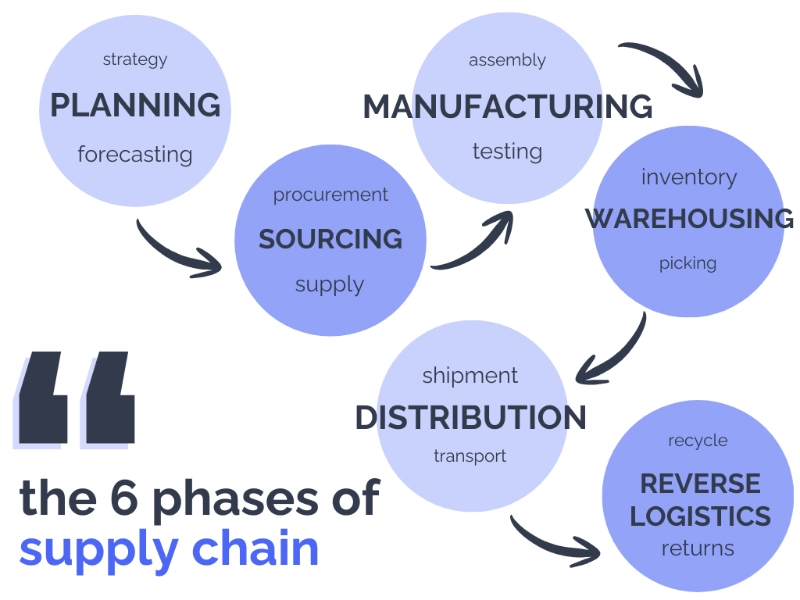
The supply chain must be an integrated process that transforms a market need into a finished product or service accessible to the consumer. Here are the six key phases that make up the supply chain:
- Planning: the phase of defining strategy and forecasting demand based on historical data, in order to align production with market needs.
- Sourcing: the selection of strategic suppliers, contract negotiation, and the procurement of raw materials required for manufacturing.
- Manufacturing: the physical transformation of materials into finished products, including assembly, quality testing, and packaging.
- Warehousing and inventory: intelligent storage of goods with space and movement optimization, along with stock reporting to remain aligned with the other phases.
- Distribution and logistics (delivery): coordination of transport and shipments from the warehouse to points of sale or directly to the end customer.
- Reverse logistics (returns): efficient management of returns and recalls of defective products, a critical step for both sustainability and customer satisfaction.
Most of these phases have a dedicated company department, which must coordinate with the others to guarantee uninterrupted flows within an integrated logistics ecosystem. What often happens in many companies, even large ones, is that these departments work instead in silos, without information integration or coordination. In the absence of a shared digital language, the company faces a whole series of waste and inefficiencies. The misalignment between production and the warehouse, for example, generates unnecessary overproduction of items that are already in stock but simply cannot be traced, or, conversely, production line stoppages caused by components that cannot be located. At the same time, the lack of shared data between procurement and logistics causes space saturation and costly emergency purchases, while the commercial department risks promising delivery dates based on inaccurate stock figures. This information short-circuit translates into inventory discrepancies, billing delays, a drastic reduction in margins, and a decline in customer confidence.
How can these common problems be solved? The answer lies in the digitalization of processes which, following an accurate phase of flow analysis, makes it possible to have real-time visibility into the status and quantities of goods and to coordinate their movements across the entire supply chain.
Supply Chain Digitalization: from passive management to proactive resilience
To overcome departmental misalignments and information silos, the solution is both organizational and technological. The digitalization of the supply chain is a process that transforms the value chain from a linear, static model into an integrated, dynamic, and real-time traceable ecosystem. This integration is achieved through an ecosystem of specialized software platforms that communicate with one another, eliminating blind spots. The key tools include:
- WMS (Warehouse Management System) software for controlling warehouse flows
- MES (Manufacturing Execution System) software for production management
- TMS (Transportation Management System) software for transport logistics
- APS (Advanced Planning and Scheduling) software for advanced production planning
- WCS (Warehouse Control System) software for integration between supervisory software and hardware (physical machinery)
Hybrid solutions also exist that combine the functionality of two or more of these systems into a single platform available on the market. These are known as SCES (Supply Chain Execution System) software, a category in which Stesi has been a specialist developer since 1996.
As highlighted by the research of Ye Tian and Lei Cui, “Supply Chain Resilience and Digital Transformation: Perspectives from a Supply Chain Network“ (2025), digital technologies are today the primary driver of resilience and enable companies to navigate crises even in contexts of geopolitical instability. The study demonstrates that the adoption of tools such as IoT, Cloud Computing, Artificial Intelligence, and Digital Twins allows companies to move from a “passive” response to crises, largely based on manual spreadsheets and fragmented communications, to a proactive construction of operational stability.
According to the researchers, modern supply chain management rests on three pillars: a superior capacity to process information in order to reduce market uncertainty; a recovery ability guaranteed by constant monitoring; and an optimization of warehouse inventory turnover. Digitalizing means perfectly aligning supply and demand, reducing the costs of capital tied up in unused stock. If in 2010 logistics management depended on phone calls and manual data entry, today integrated data platforms make it possible to recalibrate routes and suppliers within days, turning operational transparency into a concrete competitive advantage. However, as with all transformative technologies, this evolution also requires solid digital governance to protect data flows and ensure cybersecurity.
How to optimize the Supply Chain to reduce costs
Supply chain optimization is not a one-size-fits-all process. It is a journey that can be undertaken through different approaches and methodologies depending on the needs of the business. The most common method consists in automating existing processes through the introduction of new technologies, improving the efficiency of what is already being done. There is, however, a more radical approach: total reengineering. This method sets aside current flows entirely in order to reconstruct a completely new process, designed with the sole focus on the final objective the company wishes to achieve.
The choice between incremental improvement and deep transformation cannot be made arbitrarily. It must stem from a rigorous analysis of the current state of flows. The key phases of supply chain optimization are three:
- Process analysis: mapping the current state to identify waste, bottlenecks, and low-value-added activities.
- Data and logistics KPI analysis (such as average stock levels, delivery lead times, and so on) to build scenarios and support decision-making.
- Technical implementation: based on the insights derived from the previous phases, new technologies are implemented to achieve the desired results. These can be software-based (information systems and applications accessible via tablet, mobile, or workstation) or hardware-based (automation machinery, material handling systems, and so on).
Why invest in SCES (Supply Chain Execution System) software? In contexts where increasing revenue beyond a certain threshold is no longer possible, cost reduction becomes the only strategic lever available for defending and growing margins. It is estimated that logistics accounts for between 10% and 20% of the total cost of a product, depending on the sector: acting on this line item means directly impacting business competitiveness. A modern SCES system makes it possible to meet the demands of ever-faster deliveries and to improve service levels through three fundamental pillars:
- Capital optimization: reducing the financial burden associated with capital tied up in inventory, through a more scientific approach to stock management.
- Workforce efficiency: reducing the direct cost of labor. It is important to emphasize here that technology is not designed to replace operators, but to support them, eliminating the stress caused by error and making their work more fluid and higher in value.
- Elimination of hidden costs: addressing “invisible” inefficiencies, both spatial (by optimizing the infrastructure’s available space) and temporal (by eliminating downtime and costs arising from picking or shipping errors).
If you are unsure which supply chain optimization solution is right for your business, let us talk: we are here to help you convert your processes from a cost center into a competitive lever for your company.
End-to-end optimization case study: production, warehouse, and shipping
A real-world example of how technology can transform the supply chain into a competitive advantage is the project carried out by Stesi for Linergy, a manufacturer of emergency lighting systems. Operating under an Assembly to Order (ATO) model in a highly regulated sector, Linergy needed to resolve a critical misalignment between production and the automated warehouse, which had until then been managed through paper-based records and asynchronous, siloed processes.
Following a thorough consulting engagement and process analysis, Stesi’s intervention focused on optimizing and automating flows through the implementation of the silwa platform, integrating the company’s existing ERP (Microsoft Dynamics NAV), the Ferretto automated warehouse, and the assembly workstations into a single digital ecosystem. Thanks to the synergy between Stesi’s MES and WMS, Linergy achieved tangible benefits across three key areas:
- Production and traceability: the introduction of line-side operational panels eliminated paper entirely, providing real-time assembly instructions to operators. It also enabled complete batch-level traceability of critical components, a fundamental requirement for the safety standards of the sector.
- Warehouse management: the software now manages the automatic replenishment of workstations, eliminating production downtime and optimizing picking routes through bidirectional data exchange protocols with the existing automation infrastructure.
- Shipping and reverse logistics: thanks to the guided picking system, operators are accompanied step by step in selecting packaging and creating Shipping Units (SUs), eliminating dispatch errors and simplifying returns management.
“Today the silwa user interface is practically the same as any app in terms of simplicity for those who use it. This has allowed the learning curve to become extremely fast, which is an extraordinary added value.”
~ Stefano Cudicio, President of Stesi and Professor of Business Information Systems
The professions involved in Supply Chain Management
Managing a solid and effective supply chain requires cross-functional skills that span from strategic vision at the organizational level down to operational execution in the field. Here are some of the key figures who keep the logistic chain running every day:
- Production and Warehouse Operators: physically execute processes, from assembly line work to order picking and preparation.
- Operations / Plant Manager: coordinates all operational activities across the entire production site, ensuring targets for efficiency, safety, and quality are met.
- Production Manager: manages production departments and optimizes raw material transformation cycles.
- Supply Chain Manager: the architect of the overall strategy, from procurement through to customer delivery.
- Logistics and Warehouse Manager: responsible for the physical and technological efficiency of the warehouse.
- Demand Planner: analyzes data and algorithms to forecast market demand.
- Procurement Specialist: manages supplier relationships and ensures supply continuity.
- Production Planner: plans production cycles based on stock availability and order priorities.
- Supply Chain Analyst: monitors KPIs to identify bottlenecks and areas for improvement.
- Transportation Manager: organizes final distribution, optimizing routes and carriers.
FAQ
What does a Supply Chain Manager do?
The Supply Chain Manager (also known as Head of Supply Chain or Supply Chain Director) is the company figure responsible for coordinating the entire production and distribution chain, from raw material to end customer. This role encompasses the management of, often through specialized sub-functions: demand planning, supplier and procurement management, production, warehousing, logistics, and transport. Constant monitoring of logistics KPIs to optimize performance and reduce costs is another core responsibility. The Supply Chain Manager also plays a key role in guiding the company through process digitalization, leading a software selection phase aimed at implementing information systems capable of collecting real-time data and supporting the work of the teams they coordinate.
What is the difference between SCM and SCE?
SCM (Supply Chain Management) focuses on the strategic, big-picture view of the entire product cycle. It is divided into two distinct operational phases: SCP (Supply Chain Planning), which handles strategic planning based on historical data, and SCE (Supply Chain Execution), which focuses on the day-to-day operational execution of activities across production, warehousing, and shipping. In short, SCE is a strictly operational phase that falls within the broader and more strategic scope of SCM. To optimize flows across multiple supply chain departments, specific software platforms known as SCES (Supply Chain Execution System) exist, which can combine the functionality of multiple information systems into a single solution, for example WMS combined with MES.
What is Supply Chain Resilience?
Supply Chain Resilience is the ability of a logistic chain to absorb sudden shocks, such as stockouts, supplier delays, or market fluctuations, and to restore full operational capability quickly. A resilient company uses digitalization, through WMS and MES software platforms, to maintain real-time visibility over its data, instantly recalibrate production and logistics in the event of disruptions, and minimize the impact on the end customer.
