



For companies looking to stay competitive, fully satisfy their clients, and make the best use of internal resources, examining their working methodology is not optional. It was precisely by looking at the growing number of active projects and clients that Stesi decided to make the official move from the traditional Waterfall methodology to Agile Scrum.
But what exactly is the Scrum methodology? To be precise, it is an agile framework conceived in 1995 by Ken Schwaber and Jeff Sutherland for the management of software projects and products. The name itself (scrum refers to the rugby set piece in which players bind together and push in a coordinated way toward a single shared goal) signals a desire to rethink hierarchies and the organisation of work, giving greater decision-making power to individuals and, by extension, to teams. Greater freedom and accountability, in other words, which translates into higher productivity and shared knowledge.
Alessio Pavan, Stesi’s Chief Operating Officer, discusses this; in April 2022, he introduced the agile Scrum methodology at Stesi, ushering in a radical change in the management of projects and work teams.
Once upon a time: the Waterfall methodology
To fully appreciate just how transformative the introduction of Agile Scrum has been, it helps to first take a step back and look at how a Stesi project actually unfolds in practice.
The first fundamental phase of any project takes place on the client’s premises: a thorough analysis aimed at fully understanding the company’s needs, so that the best possible software product can then be built and configured. Until last year, the average time between this analysis phase and the delivery of the finished software ranged from three to four months for smaller projects, and from seven to eight months for more complex ones.
These timelines were, in practice, a direct consequence of the traditional Waterfall methodology, which organises individual activities sequentially, focusing the team’s attention on a single task that must be completed before moving on to the next phase.
Under the Waterfall model, working groups of two or three people were each guided by a Project Manager, whose role was to define the individual project activities and their sequence, set timelines, and assign tasks to the relevant team members.
Stesi: a company in continuous growth
When it comes to working methodologies, company circumstances and context can make all the difference. The Waterfall methodology, which for years had allowed us to manage our projects effectively, began to feel restrictive.
It is clear that if each team is dedicated to a single project, overall company capacity will be limited by the number of operational staff available. To keep up with growing client demand while holding on to the Waterfall model, delivery timelines would have had to stretch significantly. That was obviously not a viable option.
So how can a growing company maintain high levels of productivity in the face of an increasing number of projects and clients?

The transition to Agile Scrum
For Operations Director Alessio Pavan, the answer was straightforward: change the working methodology.
After reviewing several options, Pavan’s attention was drawn to Scrum, which appeared to have all the characteristics needed for effective adoption at Stesi. Research and extensive conversations with organisations that had already applied and tested the methodology convinced both Pavan and the Stesi board of its value, and set in motion all the activities required to make the transition to Agile Scrum official.
Changing a working methodology is never easy, of course. The risk of disrupting internal organisation and jeopardising projects already underway is always present. Yet for the Operations Director there were no valid alternatives: adopting Agile was the only real way to prepare the company for the demands of future projects, in the clear awareness that growth was not going to slow down. “What mattered most to me at that time”, Pavan emphasised, “was making sure that from the outside, no one noticed the changes. At most, they would notice the benefits.”
And indeed, the transition to Agile that began in April 2022 transformed how teams approach their work without affecting productivity in the slightest. If anything, the opposite was true.
Introducing Scrum properly: the role of training
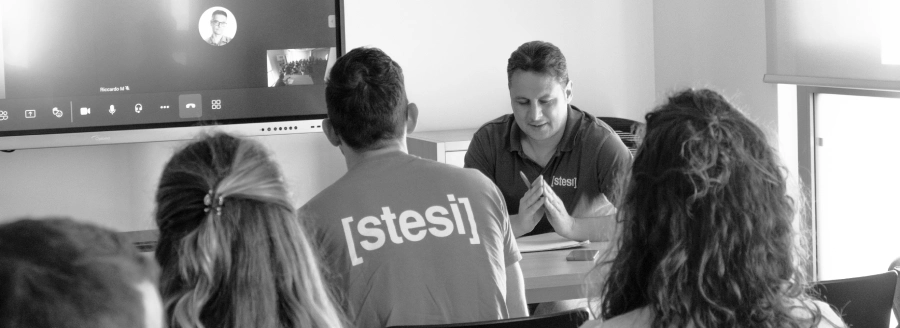
Before the change itself got underway, Stesi invested in training. Employees took part in three days of full-immersion training to develop a thorough understanding of the Agile Scrum methodology, supported by an experienced consultant. The course combined theory with hands-on simulation exercises, designed to give teams a real feel for how the Agile methodology works in practice and what project management under it would look like. It was, in essence, a prerequisite for introducing the method in the office. The goal was to help a team of around 20 people understand the reasons behind the change and get to grips with the new practices that would, in one way or another, demand a fundamentally different approach to work. A prime example was the introduction of new cloud-based software that would make information sharing simpler and task tracking easier, both at individual and team level.
Other significant changes came in the form of the various short meetings that are a defining feature of Agile Scrum, designed to keep the team aligned and encourage open dialogue. Speaking up, engaging with colleagues, communicating clearly, voicing doubts and concerns: these are all integral parts of the new methodology, and they require a genuine effort, especially from those who are naturally more reserved. For this reason, Stesi also launched a parallel programme of communication and team-building courses, designed to help even the most introverted team members strengthen their communication skills and feel more comfortable expressing their thoughts and interacting with others.
The first steps with Scrum at Stesi
Because adopting a new methodology means approaching work in a fundamentally different way, Agile at Stesi was introduced gradually and with care.
To avoid slowing down ongoing activities or negatively impacting projects already in progress, Pavan chose to roll out the new methodology with a pilot team of six people, including a number of junior profiles, working across six projects. The objective was to put the methodology to the test and, if successful, extend it to the entire office.
With the Project Manager role removed, as the Scrum methodology requires, the new roles of Product Owner and Scrum Master were introduced. In Stesi’s case, the Scrum Master was Operations Director Pavan himself, whose responsibility was to ensure the methodology was applied correctly.
One team, six projects: how does that work? One of the most interesting aspects of Scrum is precisely the ability to engage each team across multiple projects simultaneously, without any negative impact on productivity.
How the Agile Scrum method works
Agile is an extremely flexible methodology, standing in sharp contrast to the rigidity of Waterfall.
At the heart of Scrum are the sprints: fixed time-boxes that at Stesi correspond to two-week periods. Each sprint begins with sprint planning, the initial review session led by the Product Owner, the figure who, replacing the traditional Project Manager, breaks commissions down into small tasks and presents them to the team, who must complete them within the two weeks of the sprint.
This already reveals a key advantage: within each sprint, the team, working simultaneously across multiple commissions, is able to release code and features to every client it is working for, in line with the Product Owner’s priorities. In concrete terms, where the Waterfall methodology allowed teams to complete up to 10 installations per year, Scrum has pushed that figure to 25 or 30, simply by making it easier for teams to manage multiple workstreams in parallel.
To fully understand how Agile Scrum works, it is also worth pausing on the role of individual and team accountability. With the Project Manager no longer dictating timelines and tasks, the Agile methodology requires the team to self-organise the package of activities presented by the Product Owner during sprint planning. This team self-management (and here the rugby scrum analogy holds up well) is made possible by the fact that everyone knows the end goal and the deadline by which it must be reached. The team works together because everyone knows where they are heading.
From a passive role, the team takes on an active one under Scrum, autonomously organising the various project activities. This applies not only to the distribution of tasks, but also to the estimated time for each activity, which is set democratically by majority vote across the whole team.
The fixed moments of Agile Scrum: Daily Scrum, Sprint Review, and Retrospective
As mentioned, the Agile Scrum methodology is structured around a set of regular events designed to keep the team cohesive.
One of these is the Daily Scrum (or stand-up meeting): a brief session at the end of each working day in which every team member has one minute to summarise what they did during the day, what they plan to do the following day, and flag any difficulties encountered. This daily alignment is designed to ensure that everyone involved is aware of what is happening across the project. Knowledge and experience shared within the group help the whole team grow, in a spirit of continuous improvement. This is particularly valuable for junior team members, who recognise in Agile Scrum a way to accelerate their professional development.
Sprint Review and Retrospective
The Sprint Review is a meeting of roughly two hours in which the team presents a demo of everything built during the two-week sprint to the Product Owner, who can then coordinate with the end client to officially release the new features and move the project forward. This is another of Scrum’s most valuable advantages: every two weeks of work, the team has something concrete to deliver to the client. On one hand, this gives Stesi the ability to go live with logistics installations in very short timeframes. On the other, it gives the end client the opportunity to stay continuously updated on the latest releases, provide feedback, request changes mid-project, and grow familiar with the tool. The Agile methodology effectively turns delivery into a collaborative effort, giving the end client an active role throughout the entire process until they receive what is, in every sense, their own software solution.
The Retrospective is also held at the end of each sprint, and gives each individual the space to reflect on their own experience: what worked, and what did not. Once again, the goal is simple: by discussing the difficulties encountered, it becomes possible to put corrective actions in place and use the next retrospective to monitor what has changed. The aim, in short, is continuous improvement, treating constructive criticism as a tool for constantly raising the bar on project management.
The benefits and future of Agile Scrum
Beyond everything covered so far, introducing Scrum has brought a further range of advantages.
One example is the simpler monitoring of team efficiency. Agile Scrum makes it considerably easier to track project progress, expenditure, completed activities, and what is still planned. This naturally means being able to take timely corrective action to ensure the right product is delivered on schedule. A benefit for Stesi, certainly, but an even greater one for clients, who can rely on solutions that are genuinely fit for purpose.
One thing is clear. The results achieved with the Scrum methodology so far have made it evident that this new approach to work holds great promise at Stesi.
This is why we are actively considering a further reorganisation of our teams, with the goal of creating a larger number of smaller teams. Currently there are two teams, each with its own Product Owner and ten operational members. Smaller teams would require identifying new senior leads for each group, experienced professionals who can guide and support junior team members effectively, as well as new Product Owners.
Because, in the end, there is nothing better than growing inside a company that is itself growing.
Looking for a software solution to optimise your warehouse logistics? Let’s get in touch and talk.