


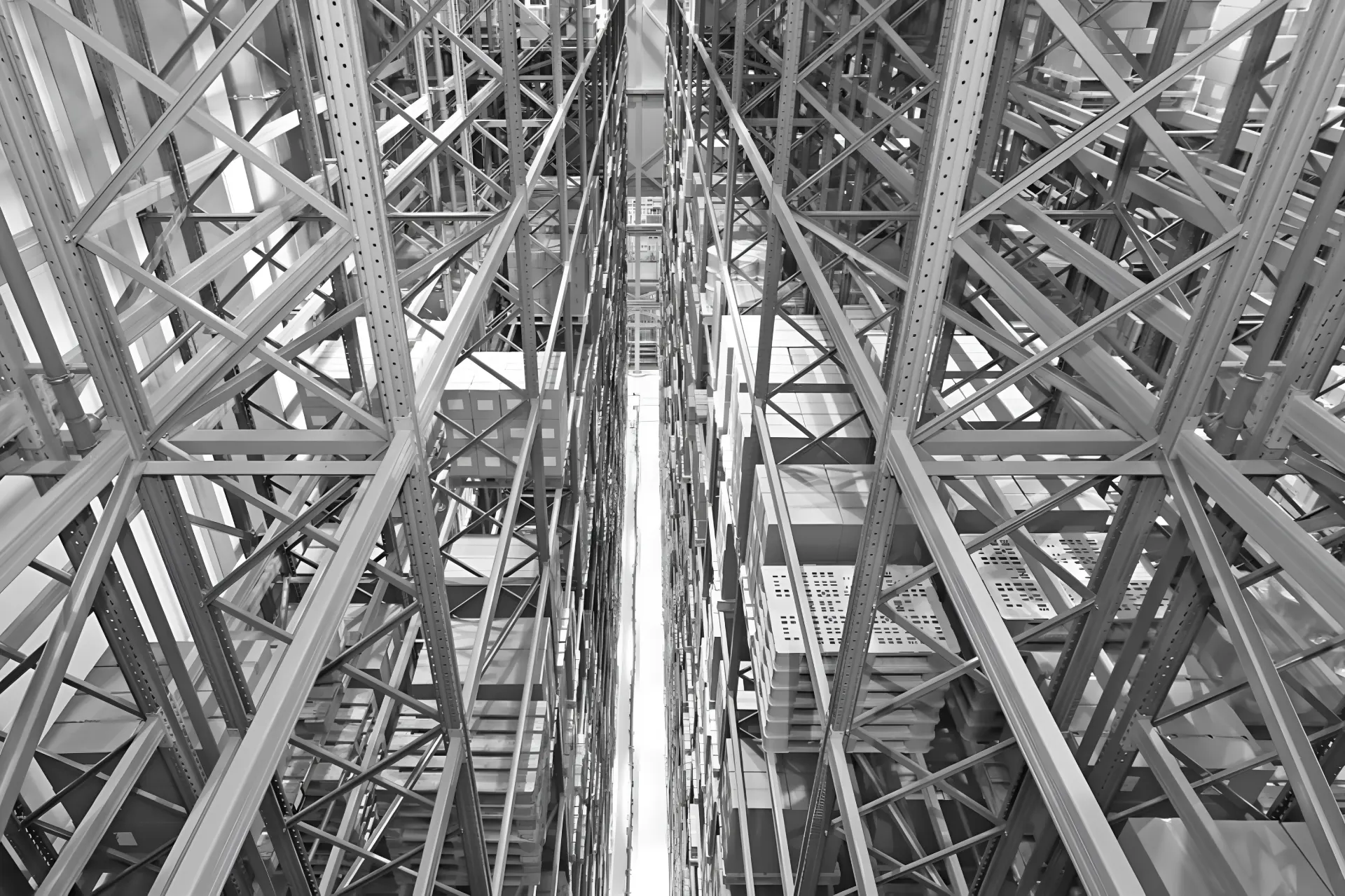
A compact, efficient automatic warehouse with stacker cranes capable of supporting continuous business growth: that is what Licar, a furniture industry company based in Friuli, now has at its disposal following the implementation of Stesi’s Warehouse Control System (WCS) at its facility in San Quirino, Pordenone.
Licar, one of Europe’s leading manufacturers of cabinet doors, had turned some years ago to systems integrator SAE to design an automated warehouse that could store finished products and coordinate their dispatch. In this context, Stesi provided an advanced WCS for the control and supervision of the five large stacker cranes on site: software capable of communicating on one side with the PLCs and on the other with the company’s ERP, with the goal of maximising storage capacity and the speed of handling operations within the warehouse.
How Licar’s automated warehouse stacker cranes work
Warehouse automation at Licar is delivered by the WCS, complete with storage logic. As each product enters the warehouse, it goes through a dimensional check procedure, where it is verified (via communication with the PLC) against its specified dimensions, rectified if necessary, compacted and weighed to confirm compliance. At this stage, the forkability of the pallet carrying the product is also tested. The item is then placed in a precise location within the warehouse’s double-deep racking, based on a range of storage logics that the operator can configure.
During goods retrieval, communication between the software, the ERP and the devices on site enables pallet and product movements to be orchestrated accurately and efficiently. The operator has access to a simple, intuitive user interface that allows them to view the current fill level of the warehouse, set their preferred retrieval logic, and also manually trigger the retrieval of specific product lines.
Why Stesi’s WCS?
The strength of the WCS implemented by Stesi lies in its ability to interface with other systems and to enable seamless communication between systems of completely different natures. Through the software, data and information are transferred in real time throughout the entire chain and beyond the facility itself, ready to guarantee product traceability along the supply chain.
As a result, Licar has a highly compact yet high-capacity automated warehouse in which storage can be configured in a customised way, following a maximum distribution logic across the racking. This ensures business continuity and the ability to retrieve any product line without delays, even in the event of machine downtime for maintenance: if one of the stacker cranes requires repair, the others are still able to retrieve pallets carrying a given reference, since those pallets are distributed across different areas of the warehouse rather than concentrated in a single zone.
Automatic warehouse with stacker cranes: the benefits
Everything described above translates operationally into greater efficiency and less waste of resources, space and time. Following the WCS implementation, Licar has significantly improved its performance and is now able to handle the movement of 60 pallets per hour.
The automated warehouse with stacker cranes can be managed by a single operator and makes it possible to minimise errors and guarantee reliable delivery times, ensuring the highest levels of customer satisfaction.
The automated warehouse also played a key role in Licar’s acquisition by the Ilcam group. Today, its considerable size and its organised, compact structure allow for the optimised storage of materials and items from three different companies controlled by the parent group, all active in the supply of furniture components.
Want to find out more? Get in touch with us.
