


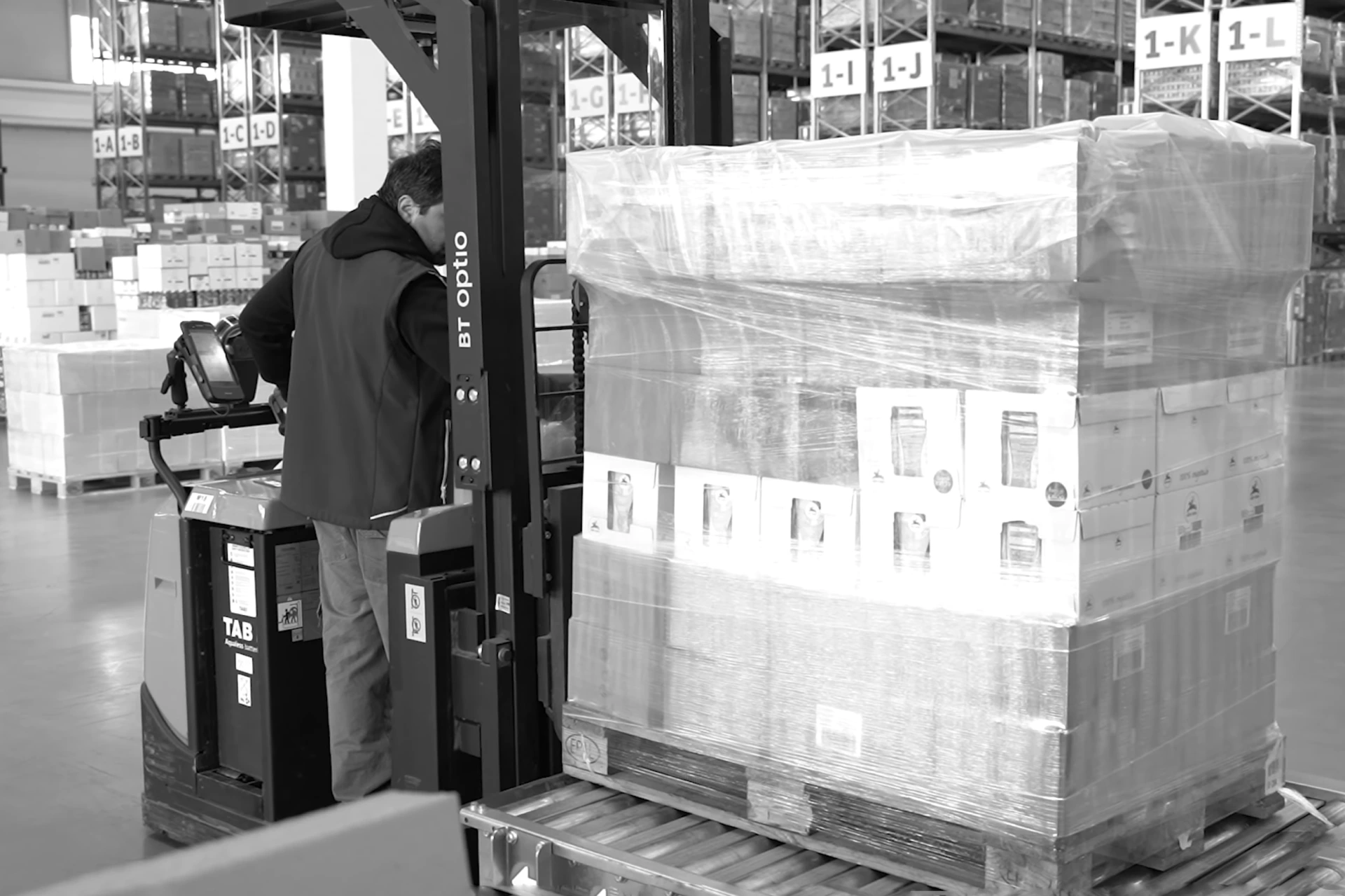
Consignment stock management, or consignment inventory management, is a commercial agreement in which a company entrusts its products to a customer’s warehouse, maintaining ownership until the moment of picking or sale. It is therefore an organizational model that brings various advantages for both parties, but which at the same time introduces complexities if not managed with the right practices. In this article, our Software Developer specialized in logistics flows, Elisa Modolo, will explain the concept of consignment stock, all its advantages and disadvantages, and will tell us in depth about a real example of managing a consignment warehouse carried out by her and her development team.
What is consignment stock and how does it work
Consignment stock (or goods on consignment) is a logistics model in which a company (owner) entrusts its goods to a buyer or third-party logistics operator (depositary), who holds them in custody and manages logistics, storage and handling. The stock owner maintains ownership of the goods until they are actually sold by the customer. In summary:
- the depositary manages receipt, storage and handling;
- the goods owner retains ownership until picking or consumption by the final buyer or sale in the case of retail.
“It is an advantageous organizational model” explains Elisa, “on one hand for all those companies that prefer to entrust the logistics of certain goods to a third-party operator; on the other hand for all those realities that have warehouse space to exploit and want to diversify their business.” Consignment stock management fits perfectly into the LaaS (Logistics as a Service) paradigm, an emerging model that is revolutionizing the global supply chain. Just as SaaS (Software as a Service) transformed IT by eliminating the need for proprietary infrastructure, LaaS applies the same principle to logistics: companies access advanced logistics services without having to invest in warehouses, personnel or technologies.
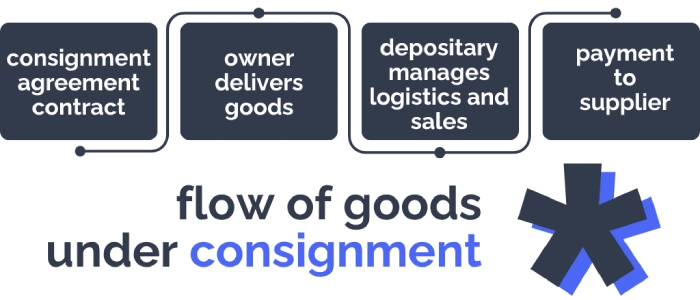
The operation is based on a contract that defines the conditions of use of the deposited goods, payment terms and the responsibilities of each party. The management of goods on consignment is very widespread in sectors such as:
- retail distribution;
- multinational supply chains;
- e-commerce;
- production with logistics outsourcing.
What are the advantages of a consignment warehouse?
Adopting a consignment stock system offers numerous strategic advantages, both for the goods owner and for the depositary.
Advantages for the owner (consignor)
- lower investments: in physical infrastructure for storage and handling, logistics personnel, forklifts and IT systems;
- greater flexibility: to better manage seasonal peaks and expand into new markets without necessarily opening new warehouses;
- focus on core business: the company can focus on production, sales and marketing, delegating logistics complexities to third parties.
Advantages for the buyer (goods depositary)
- reduction of operating costs: the buyer can receive the goods without purchasing them immediately, paying for them only after their actual consumption (in production) or sale (in retail);
- drastic reduction of replenishment lead time: having goods/components already in stock, the buyer can fulfill orders more quickly to their own customers;
- full exploitation of empty warehouse spaces: putting an asset that is already there but not fully utilized to profit;
- business diversification and increase in revenue sources.
We can say that this system simplifies supply chain management, minimizing the need to manage large volumes of inventory and streamlining logistics processes.
“With more efficient inventory management, companies can reduce stock levels by 10% to 30%, unlocking immediate liquidity and drastically reducing goods devaluations.” ⁓ McKinsey
What are the risks of a consignment warehouse and how to avoid them?
Managing goods on consignment correctly is not simple. “Consignment stock introduces complexities from an operational, accounting and contractual point of view that, depending on how they are contained, can determine the success or failure of the model,” emphasizes Elisa Modolo. Our Software Developer has listed all the aspects to keep in mind.
1. Traceability and separation of goods
It is essential to ensure both physical and logical separation of goods so that the stock of different suppliers is clearly identifiable and attributable. Elisa explains: “From a physical point of view, it is often necessary to have specific warehouse locations to assign to the stock of one owner or another. From a logical point of view, however, differentiated movements and operations must be managed. Keep in mind that the buyer ends up hosting goods that are not their own in their warehouse and stock from different suppliers, each potentially with their own constraints, priorities, expiry dates, etc.”
A certainly complex matter, therefore, which if not delegated to a specialized consignment inventory management software such as a Warehouse Management System (WMS), risks leading to errors, obsolescence and penalties. A typical error is mixing stock from different suppliers, where for each individual owner’s goods the following must be managed separately:
- visibility per individual consignor;
- lots, serial numbers, expiry dates.
How does warehouse WMS software do this? “Thanks to mapping for each location, the use of barcodes and RFID tags, a WMS can record every single goods movement in real time, thus without getting confused among all the differentiated flows and without making errors.” explains Elisa.
2. Inventory alignment
“Another important aspect is consignment inventory alignment,” Elisa continues, “that is, the correspondence between warehouse stock and the data on the logistics operator’s information system. Consequently, the stock in the owner’s software systems must also always be updated, typically through automatic integration (API/EDI) with the depositary’s WMS or view-only access to real-time stock.”
Rigorous control between physical stock and the owner’s accounting stock is needed, otherwise operational errors, errors during picking, incomplete records, integration problems between systems that do not communicate, etc. are risked. To avoid these stock misalignments, particular precautions are needed. In particular, methodical processes, such as:
- cycle counting,
- periodic reconciliations,
- shared audits.
3. Information integration
“The success of an operational model with a consignment warehouse depends heavily on the quality of communication and data exchange between the consigning owner and the logistics depositary” our Software Developer emphasizes. The goods depositary must be able to:
- consult stock in real time,
- send orders,
- receive confirmations.
Frequent problems encountered when fragile or manual integrations are made (such as with Excel sheets, paper sheets, etc.) are mostly errors and delays in managing stock and shipments. For this reason, it is essential to ensure that the management software of both parties involved is integrated in a robust manner, particularly the third-party logistics operator’s warehouse WMS, with the ERP, TMS and e-commerce platforms.
4. Contractual management and division of responsibilities
Since the goods are physically located in the buyer’s warehouse (or logistics partner’s) but ownership remains with the owner, the contract must define legal and operational boundaries surgically. Critical points to regulate include:
- risk of loss and damage: who is financially responsible in case of theft, fire, deterioration or inventory differences? It is essential to establish deductibles and methods of recovery;
- service levels (SLA): precisely define maximum acceptance times for goods, storage constraints (e.g. temperature controlled) and picking priorities;
- logistics pricing models: the complexity of third-party consignment stock requires clear agreements on billing methods. Costs can be calculated: per pallet/pallet position (occupation of floor or racking space); per order line or per operation (cost linked to picking and handling activities).
Elisa’s advice: “Managing these contractual variables on paper or Excel exposes both parties to disputes. An advanced WMS software allows storing every movement and automating the calculation of handling/storage tariffs that the depositary charges to the owner (or vice versa, in pay-per-use models).”
An often underestimated critical aspect is that the owner maintains legal ownership of the goods but loses physical control. This creates an insurance gap if not contractually managed. It is essential to define:
- insurance coverage: who takes out the warehouse policy?
- shared periodic inventories (e.g.: minimum quarterly frequency);
- dispute procedures: what happens if the depositary declares goods missing?
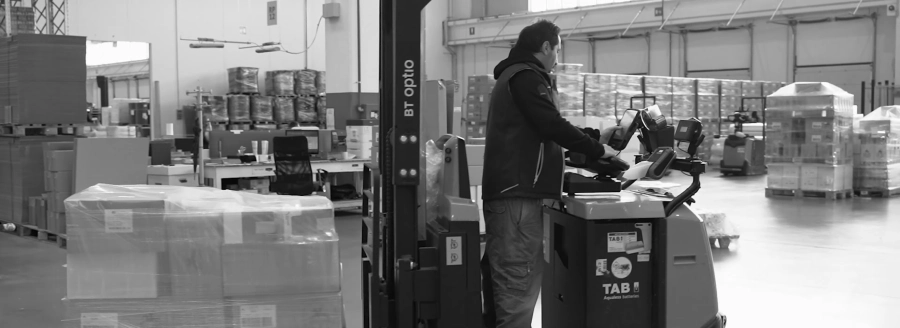
Alce Nero case study: space monetization and multi-client WMS management for consignment stock
The Alce Nero case demonstrates how consignment inventory management can transform from a pure logistics necessity to a strategic business lever. The company has exploited its unused warehouse spaces by making them available to various clients (consignors) both in B2B and B2C contexts (including logistics for points of sale).
Our Software Developer Elisa Modolo followed the project firsthand, guiding the client step by step. The success of the operation rests on the “native multi-client” functionalities of their WMS silwa, which solves the main operational challenges of the model:
- Goods segregation and total traceability
To ensure maximum reliability to consignors, Alce Nero adopts a hybrid model of physical separation (assignment of entire areas and warehouse locations dedicated to specific suppliers) and logical (rigorous proprietary master data management with customized parameters to track logistics units such as LUs (Load Units), pallets or packages, lots, governing FIFO/FEFO rotation logics). - Automatic inventory reconciliation against misalignments
Real-time stock precision is guaranteed through barcodes during inbound and outbound phases. To eliminate misalignments with clients, Alce Nero applies cycle counting and sample checks, supported by an automatic email system that periodically sends updated stock summaries to each consignor. - Cost control, business intelligence and reporting
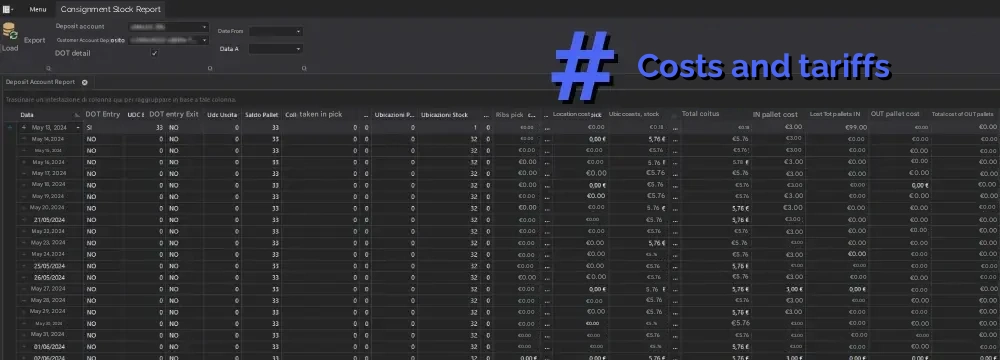
Alce Nero’s WMS offers dashboards with real-time visualization of consignment costs and KPIs, calculating tariffs based on locations occupied in a given time interval. - E-commerce integration and omnichannel
Thanks to advanced API interfaces or custom developments for legacy systems, the warehouse communicates natively with ERPs, TMSs and e-commerce platforms (Shopify, etc.), automating picking processes and e-logistics flow planning.
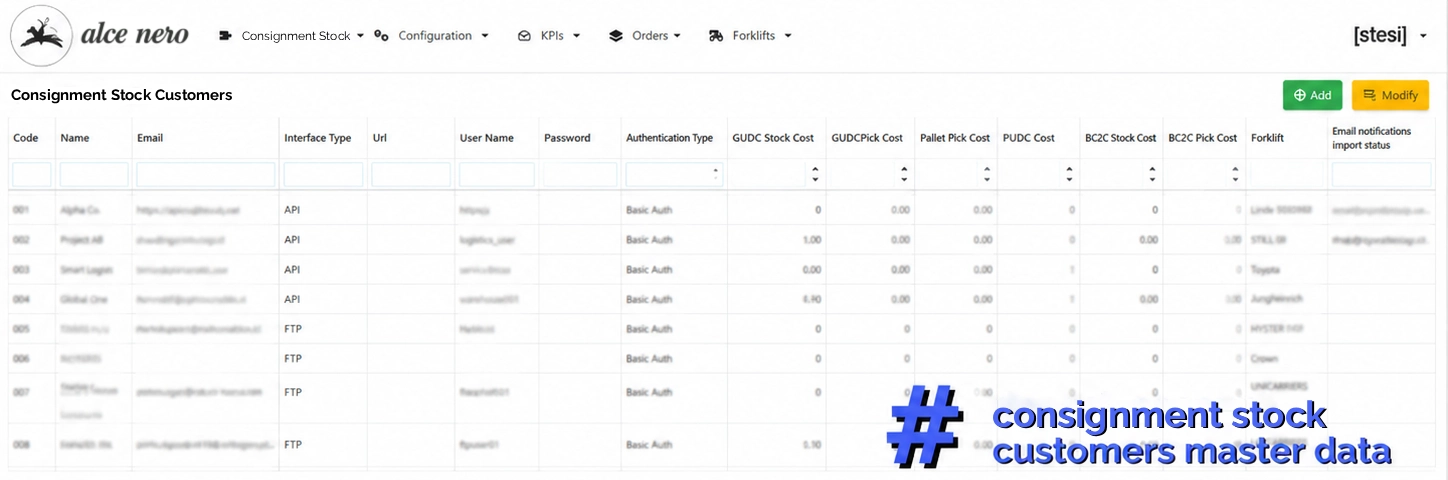
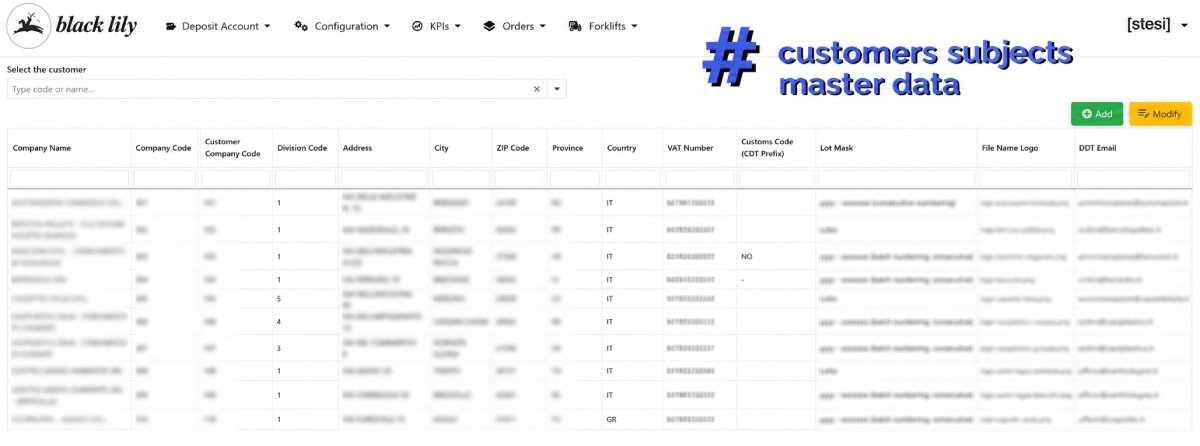
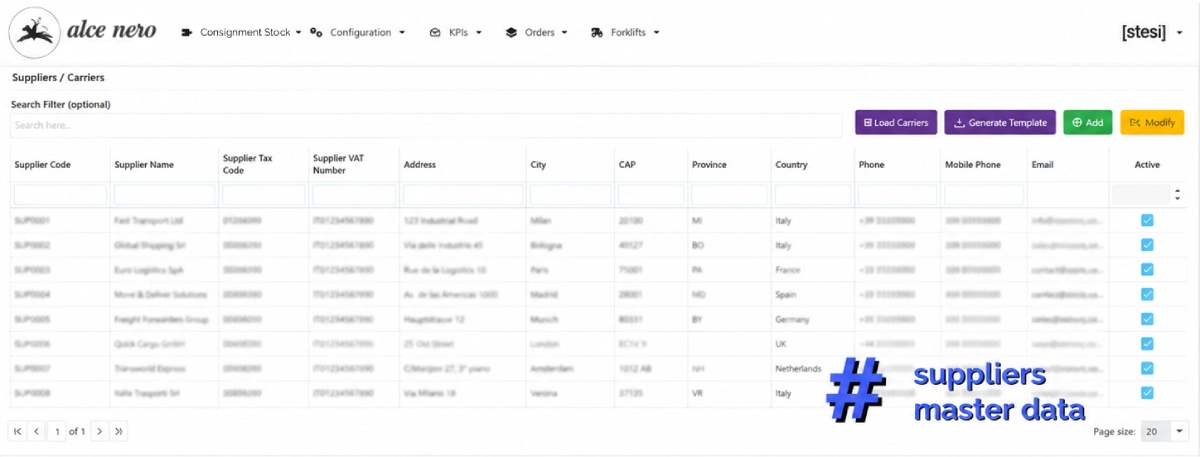
Alce Nero has a customized portal within its WMS, from which it has access to all consignment master data (items, companies, company customers/suppliers, consignment customers, bill of materials) through a drop-down menu with a simple interface.
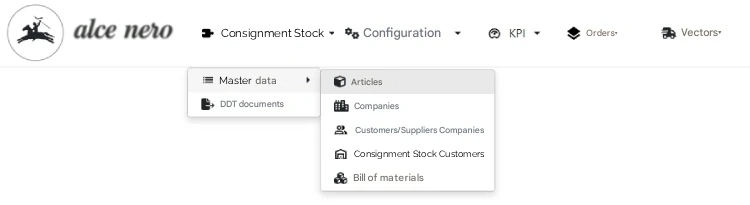
In the image below is the item master data dashboard, which allows the user to select the customer at the top and modify/add master data manually or through file import.
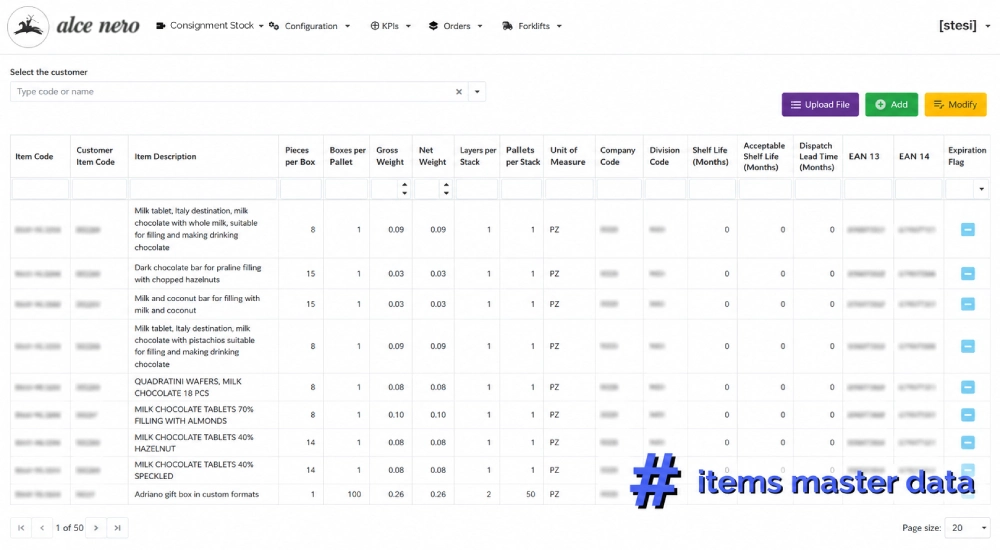
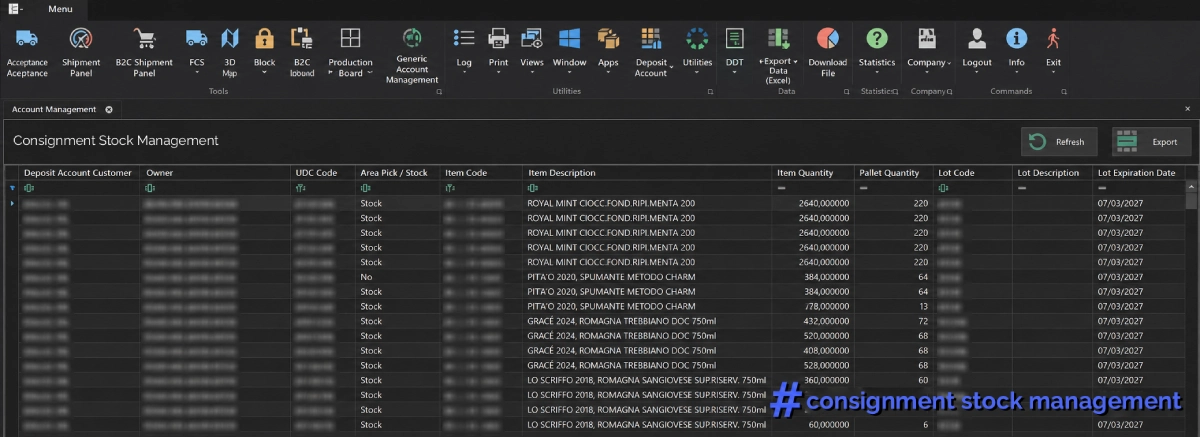
The simple silwa interface allows Alce Nero operators to have visibility of everything, including customer master data, entities managed by the various consignment customers and their suppliers.
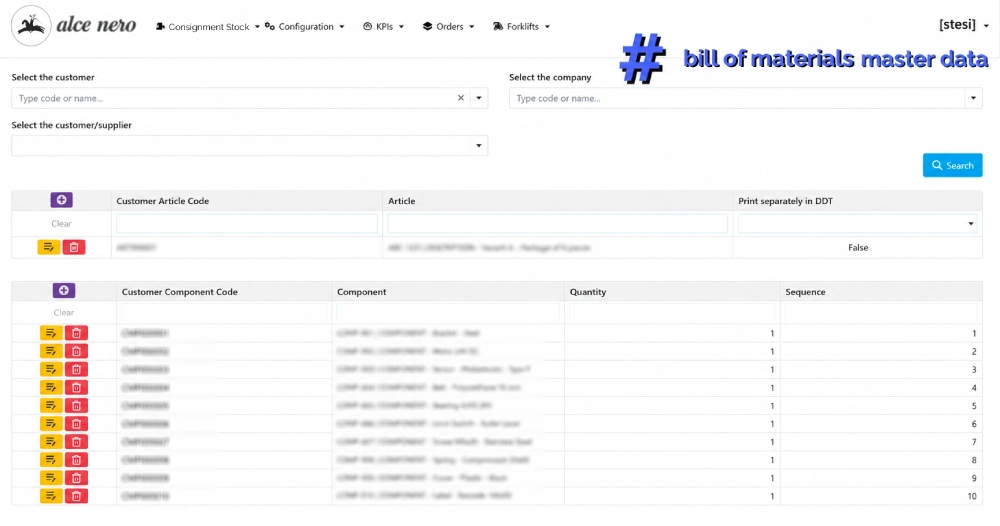
In Alce Nero’s case, the flexibility of the software provided by Stesi is also expressed in managing ad hoc production flows for consignment. In the image below, the dashboard for managing the Bill of Materials (BOM) with parent kits and related components is visible. The system also coordinates labeling and customized repackaging activities of goods before they are shipped to the final customer, optimizing throughput times.
“To conclude,” states Elisa, “at the suggestion of Alce Nero’s Supply Chain Director, we also implemented a dashboard for monitoring consignment costs and tariffs, which allows them to actively monitor the revenues from this organizational model.”
Alce Nero thus diversifies its business intelligently and strategically, increasing its revenue sources and eliminating replenishment lead time.

Consignment stock: best practices for a consignment warehouse
“To adopt a consignment warehouse model, a clear definition of location rules is therefore essential. Another necessary condition is certainly the standardization of logistics activities” explains Elisa Modolo. “To have goods on consignment you need to have coherent and standardized processes: if you do everything on paper or Excel sheets it doesn’t work, you’re left without KPIs to constantly monitor.”
An advanced and well-integrated WMS software can fluidly manage the entire life cycle of goods in a differentiated manner, from goods receipt and storage, to managing lot traceability and outbound shipping. It adapts to the different operational needs of different suppliers, also supporting value-added flows such as repackaging or labeling before shipment, without creating rigidity, ensuring:
- data separation and logical separation of different stocks;
- traceability and regulatory compliance, fluidly respecting FIFO/FEFO logics;
- possibility to insert specific and customized configurations;
- clear and simplified tariff management;
- dedicated visibility, where the consignor has access only to their own goods stock and not that of other suppliers.
A company that wants to make its warehouse space available to host others’ goods can, with a WMS, offer the consignor certain data that can be consulted at any time, as well as an always updated inventory. “On the other hand, for someone who wants to give their goods on consignment, relying on a third-party logistics operator that uses advanced digital tools has the certainty of a decidedly superior service level” explains Elisa.
As highlighted by a McKinsey analysis (How medtech companies can create value via inventory optimization, 2025), another of the biggest structural errors in consignment inventory management is the adoption of the “consign and overstock” model, that is, the tendency to overload the customer’s warehouse to eliminate the risk of missed deliveries. This obsolete strategy generates artificial inventory inflation and drastically increases the risk of goods obsolescence. The real structural breakthrough, analysts suggest, lies in creating flexible and predictive consignment models based on the customer’s actual consumption needs. An advanced WMS software like silwa becomes the indispensable tool to abandon intuition and optimize supply chain nodes.
In conclusion, the consignment warehouse, or consignment inventory management, is not so much an operational choice like any other, but rather a true structural response to supply chain complexities. It is a powerful but complex LaaS model that requires well-defined processes, rigorous control and adequate technological tools. Companies that can ensure traceability, efficiency and scalability will do so by combining organization, technology and integration, and will be those able to fully exploit the opportunities of third-party logistics in the coming years. If you have doubts about the best way to manage consignment goods, let’s get to know each other: you can book a first free check-up with our logistics consultants at Stesi.

FAQ: common questions about consignment stock
How to manage the same product if it is partly owned and partly in consignment stock?
This is one of the most common short circuits when using traditional management systems. If owned goods and those on consignment are not properly isolated, the risk is artificially inflating the inventory value on the balance sheet, including assets not yet owned by the company.
The solution lies in native logical and master data separation in the WMS. Specialized platforms like silwa allow managing this duplication intelligently with: distinction at master data level (the system distinguishes the product with dedicated item codes, isolating owned stock from consignment stock); segregation of Load Units LUs (at physical level, consignment goods and owned goods maintain their own identity and are never mixed within the same pallet or package). In this way, operators maintain maximum fluidity and visual visibility for picking, but the financial impact on the ERP is isolated. The transfer of ownership and related invoicing are triggered automatically only at the moment of actual use (e.g. when picking the Load Units or reading the barcode).
Does offering third-party goods storage risk blocking liquidity or emptying other sales channels?
Yes, shipping large volumes of goods to the buyer’s warehouse without constant monitoring means immobilizing capital in “dormant” stock. Even worse, there is a risk of channel conflict: tying up too many SKUs in a slow-moving consignment can cause stockouts on direct channels, such as one’s own B2B or B2C e-commerce, which are instead performing well. To protect margins and avoid stock cannibalization, WMS technology offers turnover rate monitoring (analyzes in real time the consumption speed of goods for each individual customer, blocking automatic replenishments if unsold is too high); and offers omnichannel allocation logics (communicating with sales platforms like Shopify or the ERP, defining untouchable safety stocks for direct channels, shipping to consignment stock only the optimized surplus).
What is the difference between consignment stock and VMI (Vendor Managed Inventory)?
Both models provide that the owner maintains ownership of goods at the customer’s location, but with key operational differences. In consignment stock the owner owns the goods but the customer decides when and how much to pick, activating invoicing. In VMI (Vendor Managed Inventory) the owner monitors customer consumption and replenishes automatically based on predefined stock levels, maintaining both ownership and reordering responsibility. So in summary: in VMI the owner also has decision-making control over replenishments, while in consignment inventory they only have ownership until picking.
What are the tax and VAT rules in a consignment warehouse?
In the case of third-party consignment stock, ownership of the goods remains with the owner until consumption. The invoice is issued only at the moment of actual picking of goods by the customer, not when it is physically delivered. Shipment requires a DDT (Transport Document) with “consignment” as cause to certify that there is not yet a transfer of ownership. After that, the customer must track the owner’s goods in a loading/unloading register separate from their own inventory. Given the complexity of international and sectoral regulations, the support of a specialized tax consultant is always necessary.