


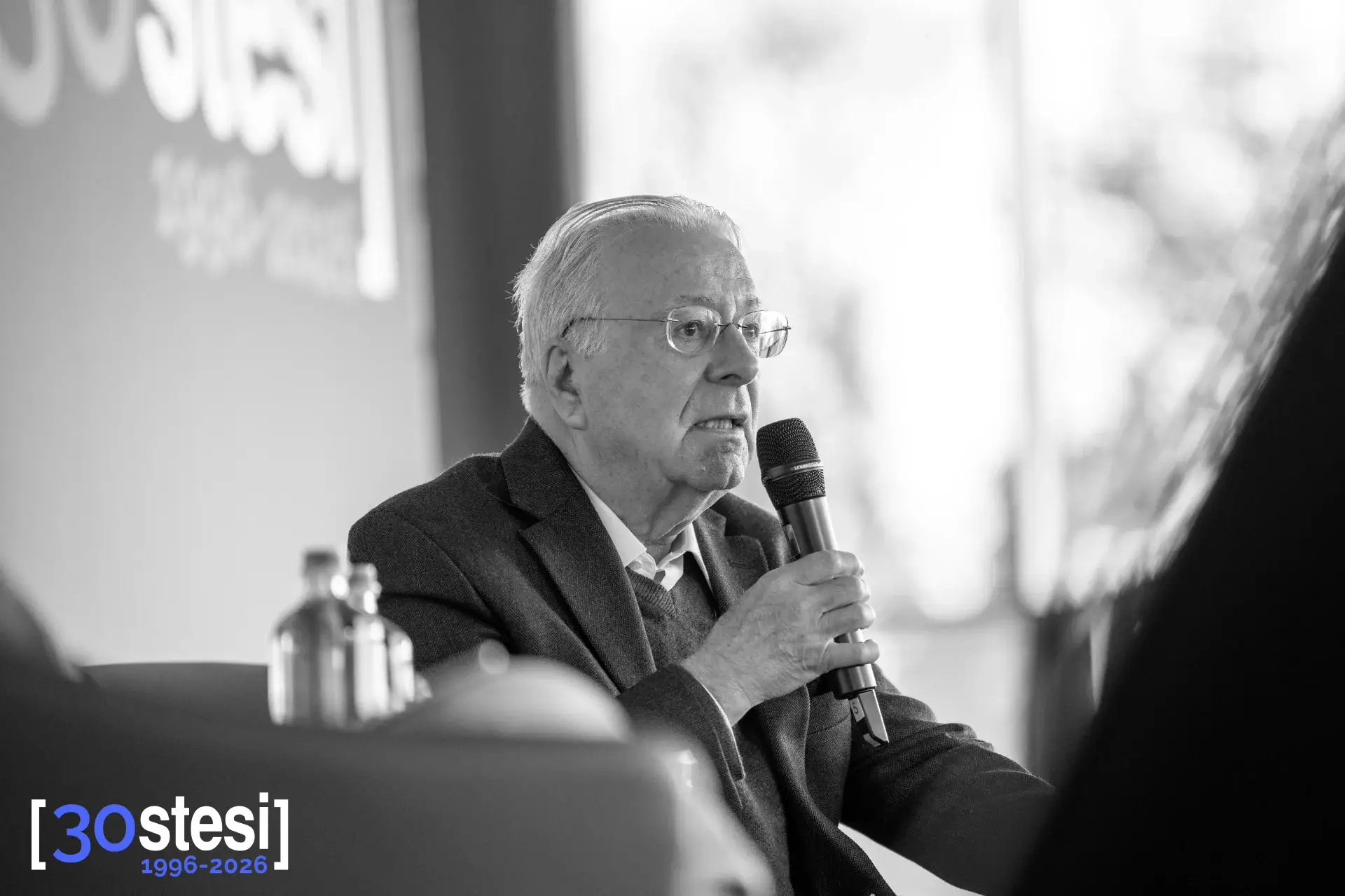
Putting technology at the service of human beings, their lives and their consciousness. This is the guiding principle with which Stesi celebrates its thirty years of activity. A commitment to humanity that we chose to honor by hosting, during our anniversary, the person who forever changed the course of modern computing: Engineer Federico Faggin, the physicist who invented the microprocessor.
His contribution has been fundamental to the digitalization of information. We are talking about the first RAM memories, the first microprocessors and even the technology behind the touchscreen. Faggin designed the essential elements we carry in our pockets every day. Yet, the very person who built the foundations of modern technology now invites us to look beyond it.
For decades, the famous Turing test has represented one of the most fascinating and controversial dilemmas of our time. If a machine is only able to imitate human behavior, can we really consider it intelligent? Or is there a deeper dimension, made of consciousness, emotions and meaning, that cannot be reduced to any form of simulation? Faggin’s talk was a moment of reflection that inspired us to question what it means to be human and what truly distinguishes us from a machine or an artificial intelligence.
Before going further, let’s take a step back to understand who Engineer Faggin is and the path he has followed.
Who is Federico Faggin
Federico Faggin is an Italian physicist, inventor and entrepreneur. Born in Vicenza in 1941 and living in the United States since 1968, he was the creator and project leader of the Intel 4004, the world’s first microprocessor.
He developed silicon gate MOS technology, which enabled the creation of the first microprocessors, EPROM memories, dynamic RAM and CCD sensors, all fundamental elements for the digitalization of information. In 1974, he founded Zilog, the first company entirely dedicated to microprocessors, where he developed the well-known Z80. In 1986, he co-founded Synaptics, the company behind the first touchpads and touchscreens.
After contributing to a radical transformation of the physical world around us, Faggin chose to go beyond the study of matter to explore the physics of the invisible. In 2011, he founded the Federico and Elvia Faggin Foundation, a non-profit organization dedicated to the scientific study of consciousness, supporting both theoretical and experimental research programs in universities and research institutes.
He later began publishing his works, Silicon (2019) and Irreducible (2022), followed in 2024 by Oltre l’invisibile: dove scienza e spiritualità si uniscono (Mondadori), a work that connects two worlds often considered incompatible. During his talk, he shared valuable insights on the relationship between science and spirit.
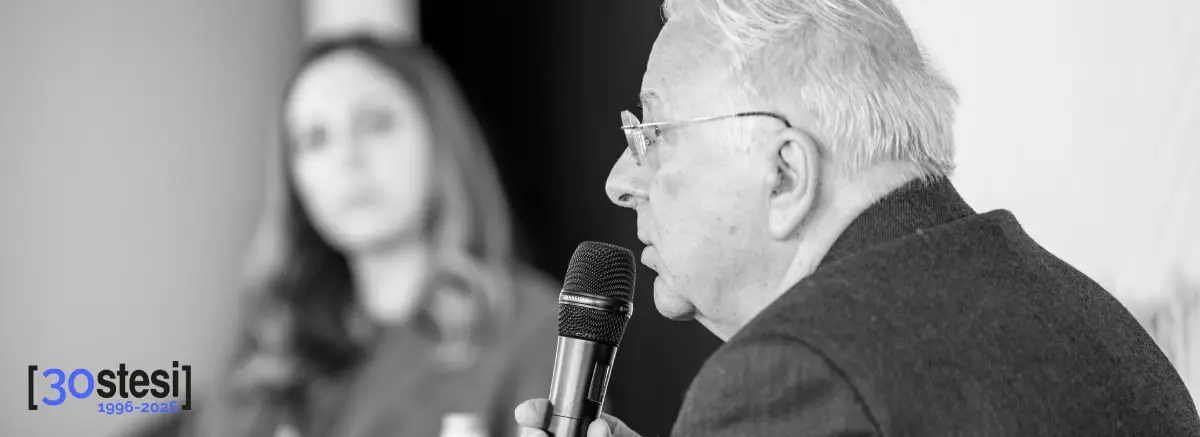
The distinction between humans and machines according to Federico Faggin
During his speech at Stesi, Faggin opened by questioning what he defines as “scientism”, the tendency to reduce human beings to mere biological machines made of molecules. Instead, he invites us to go beyond this view.
A computer can perform billions of operations and process petabytes of data per second, operating in a purely logical and deterministic domain. A logic that, moreover, has been imposed by humans themselves when creating the machine.
Humans, on the other hand, are endowed with feelings, passions and an inner dimension that logic cannot map. According to Faggin, what irreducibly distinguishes us from a computer is our ability to understand and to experience the meaning of symbols. We can program a machine to say “I love you”, meaning we can program it to imitate our behavior, but only a conscious being can actually feel the emotion that gives meaning to those words.
We are fields of consciousness, not a set of mechanisms
Through the principles of quantum mechanics, Faggin explained how physical reality is not made of separate parts but is instead an interconnected whole. We are not simply our bodies or a collection of molecules. We are “fields of consciousness” that use the body as an instrument for experience.
There is a fundamental ontological difference between bits and physical reality. Classical computer bits are separable from the physical substrate that supports them, making virtual reality a logical and abstract construction. Physical and biological reality works differently. It is tied to inseparable quantum fields, where each part, such as our cells, contains information about the whole.
“The universe is a whole that is not made of separable parts,” explains Federico Faggin. “When particles interact, they create shared states that remain connected regardless of distance. In quantum physics, these particles are not objects, they are states of fields, inseparable from each other just as a wave is not separable from the ocean.”
Until a few decades ago, we thought only in terms of particles as separate entities. Quantum mechanics has overturned this view imposed by scientism, placing connection and interaction at the center.

Artificial intelligence as a mirror and an opportunity
At Stesi, we work with innovation every day, and Faggin’s perspective on AI offers valuable insight. AI acts as a “resonator”: by imitating parts of us, it forces us to ask deeper questions that we might otherwise avoid. We are fields of consciousness with a body that have created machines, including AI, which operate according to our own logic.
We should not fear AI if we understand that it is a logical creation of our own. However, we must remain aware of our essence, which can never be replicated. As Faggin emphasizes: “we are not only logic, we are also passions and emotions“. Using a powerful metaphor, he reminds us that “love is the flavor of meaning”, what gives substance to what would otherwise be an empty container.
“Love is the force that brings resonance to our states of consciousness” – Federico Faggin
Asking ourselves what distinguishes us from artificial intelligence or a computer is essential if we want to use these technologies effectively. A machine does not constitute reality, it represents it. It is a “mathematical formula describing something that can only be truly known from within“, as Faggin points out.
Honesty, responsibility and authenticity: values for the next 30 years
The talk concluded with a deeply human reflection on Faggin’s personal journey. He shared how professional success alone was not enough to make him happy until he faced his inner life with honesty, accepting responsibility for his choices. “By choosing to do nothing when I could have acted, I caused more damage than by making mistakes,” he admitted.
“The world teaches us to be actors, and this puts enormous pressure on us because we cannot be ourselves” – Federico Faggin
With these words, he reminds us that our role is not to act a part, but to be authentic human beings who recognize their connection with the whole. “We are here to know ourselves. We are not here to live according to the idea of scientism, which describes life as the survival of the fittest. But who is the fittest? The one who survives. So scientism makes a completely absurd claim, a logical circularity: it claims that the purpose of life is the survival of those who survive” he argues. Instead, Faggin offers a perspective that goes beyond traditional physics, suggesting that the purpose of life is to know who we are and, through that knowledge, to understand the whole.
Stesi embraces this vision as the best possible wish for its future. We celebrate our thirty years with a renewed commitment to placing technology at the service of human beings, their consciousness and their ability to create meaning in the world.
