


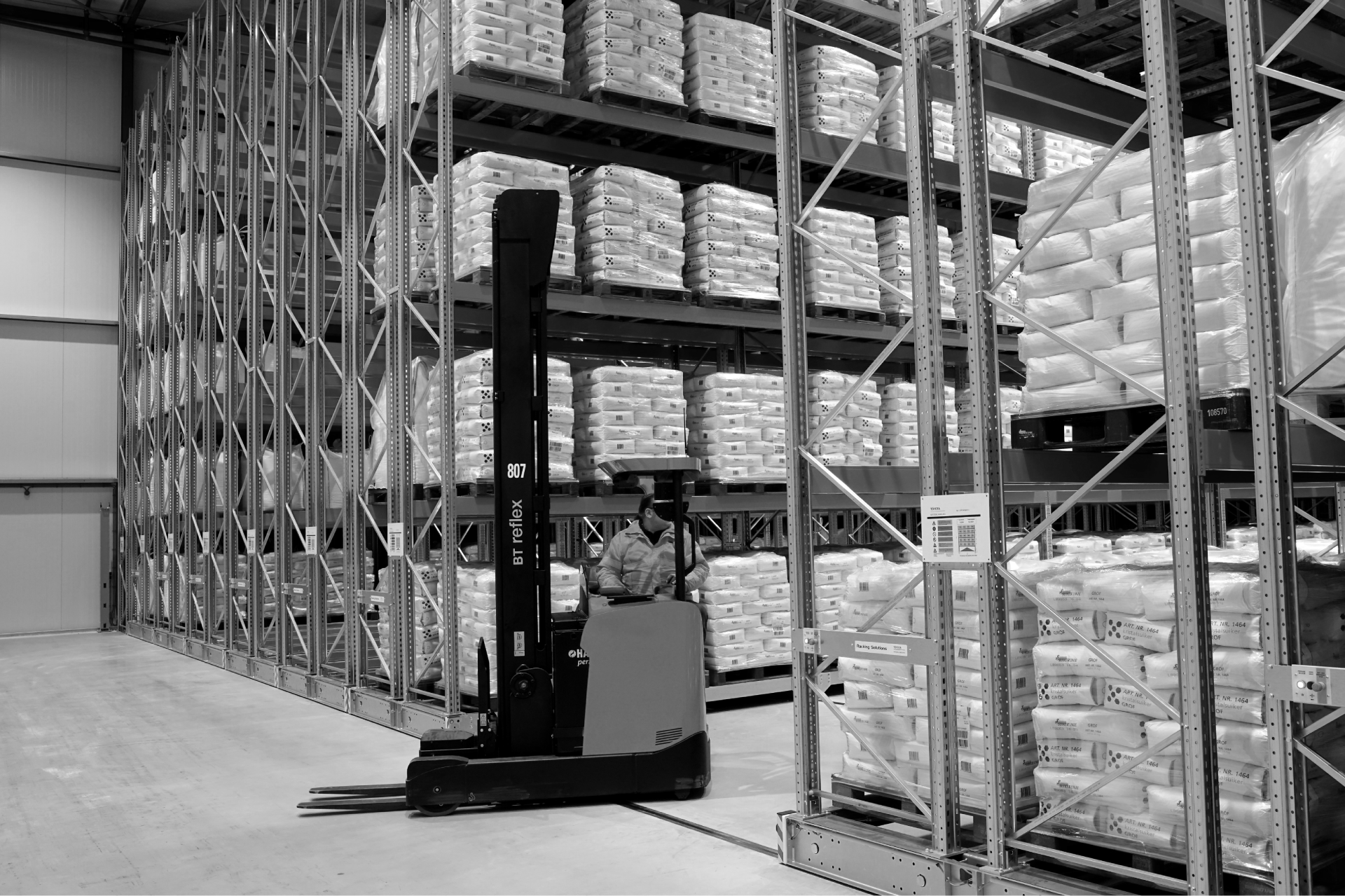
A Forklift Guidance System (FGS) is software that guides forklift drivers through warehouse missions, just as a sat nav guides someone behind the wheel. It knows the truck’s position in real time through a location system (RTLS), receives the mission to perform from the WMS, and shows the operator the route, the destination location and the operation to carry out.
The comparison with the automotive world is almost unavoidable, and it helps explain both how the system works and why it is effective. In practice, an FGS works much like the sat nav in a car: it directs the forklift driver safely, telling them when to stop, when to brake, when to turn, how to park or manoeuvre, and how to complete the mission.
The truck, however, is still driven by a person. The FGS decides where to go and how to get there; the driver operates the truck and performs the task. In silwaSUITE, Stesi’s SCES platform, the FGS is an application module that works together with the WMS, the Dispatcher and an RTLS such as silwaCAM.
To find out more, we interviewed Mario Avdullaj, our Software Developer specialising in logistics flows, who told us about his experience with the Forklift Guidance System.
What is a Forklift Guidance System?
An FGS is the software layer that connects what the management system knows (which goods to move, from where and to which location) with what happens on the warehouse floor, where the truck actually moves.
So what happens without an FGS? The WMS assigns the mission and everything else is left to the driver: they choose the forklift route, find the location by reading signs and codes, and confirm the operation by scanning a barcode. With an FGS, the system knows where the truck is, shows it the way and guides it right through to the operation at the rack.
In Italian, the term translates as “sistema di guida per carrelli elevatori”. In English, however, “Forklift Guidance System” also refers to other technologies, such as wire guidance for VNA turret trucks or fork-mounted laser pointers. We look at the differences further on.
How does a Forklift Guidance System work?
An FGS works on three layers of information: where the truck is, what it has to do and how it has to do it.
- Position
The FGS uses the position of the material handling equipment, detected in real time by an RTLS (Real-Time Location System), and tells the driver which routes to take through the warehouse. With silwaCAM, Stesi’s RTLS, localisation is based on optical technology. - Mission
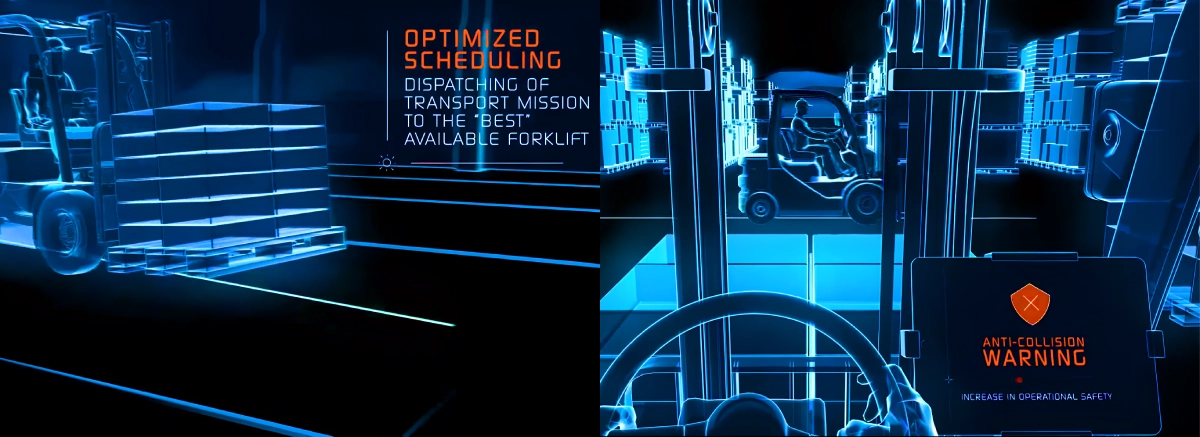
The Dispatcher calculates the optimal forklift routes to carry out missions according to the priorities set by the WMS or WCS. The FGS then uses this information to guide the driver while the mission is performed. - On-board guidance
On the truck-mounted terminal, the operator sees the route to follow just as on a sat nav, through a simple, intuitive user interface. At the destination, a graphical interface with a 3D view guides them through the pick or put-away.
As Mario explains: “The map is the prerequisite for what we call guidance. With the map alone, the operator sees on the terminal the name of the location to reach. By adding an RTLS, which provides the vehicle’s coordinates, we can guide them with the FGS, the navigation system on board the forklift.”
Because it knows the position of every truck on the floor, the FGS can calculate forklift routes based on ongoing missions and traffic, not just distance.
Another practical effect concerns confirmations. If the system knows where the truck and its forks are, it can identify the location and the load unit without the operator scanning a barcode. “Knowing the map coordinates, the real-time contents of each location and the position of the truck, we can automate the pick without the operator scanning the load unit and location barcodes” says Mario. “That’s at least two or three fewer steps before the mission is complete.”
The principle has also been studied in academia: a team at the University of Pisa showed that by reconstructing a forklift’s trajectory and orientation, pallet positions can be recorded at the moment of drop-off, in a warehouse of around 4,000 m² (Motroni, Buffi and Nepa, 2021). “In a Stesi project for a customer in the paper industry, this made it possible to pick full pallets automatically on arrival at the destination, with no operator input on the terminal” Mario concludes.
What’s the difference between FGS, wire guidance, laser guidance and AGVs?
All these technologies “guide” a vehicle, but they act at different points: an FGS guides the driver’s decisions, while the others guide the vehicle itself or part of it.
| Technology | What it guides | Who drives the vehicle | Infrastructure required |
| FGS | Forklift routes and operations, through instructions on the terminal | The forklift driver | Software, RTLS, on-board terminals |
| Wire guidance | The truck’s steering in narrow aisles | The forklift driver, for travel and lifting | Energised wire embedded in the floor |
| Fork-mounted laser pointer | Fork alignment with pallets at height | The forklift driver | Device on the fork carriage |
| AGV | The entire vehicle, with no driver | No one: the vehicle is automated | Navigation and fleet management system |
Wire guidance is typical of VNA turret trucks working in very narrow aisles. None of these technologies rules out the others: a site can use an FGS in the warehouse and Automated Guided Vehicles in other areas of the plant.
What do you need to adopt an FGS?
An FGS only works if the system has an accurate picture of the warehouse and the trucks. There are four prerequisites:
- a real-time location system (RTLS), with accuracy suited to the operations being guided. Knowing the aisle is enough to show a route; identifying a single bay on a rack takes far greater precision;
- an up-to-date digital warehouse map, with coded areas, aisles and locations. If the layout changes, the map must be updated, which is why it pays to start from good warehouse mapping;
- a WMS software that manages missions, because the FGS guides the execution of tasks planned by another system;
- terminals on board the trucks, and network coverage that keeps them connected in every area of the warehouse.
As Mario Avdullaj points out: “If we have centimetre-level accuracy on the vehicle, a very detailed map makes picking more precise. If I know there’s only one pallet in the location the driver has reached, that’s the pallet, and the operator doesn’t even need to get off the forklift to scan it.”
There is also an organisational prerequisite: involving forklift drivers from day one. A system that shows the way to people who have known it for years is accepted more readily if they understand its purpose and can flag when the instructions don’t match reality.

Forklift Guidance System: does it make forklift operations safer?
A Forklift Guidance System can contribute to warehouse safety, but it doesn’t replace training, vehicle maintenance, signage or segregated pedestrian routes. It is, however, an additional safeguard. The FGS contributes through four factors:
- assigned, predictable routes, which reduce improvised manoeuvres and visual searches for locations;
- less attention on signs and codes, because the operator receives instructions on the terminal;
- visibility of the position of all trucks, useful for whoever coordinates internal traffic;
- anti-collision alerts between forklifts and other vehicles on site.
Because it knows the position of every truck in real time, the FGS can alert drivers when two vehicles are approaching a junction or a shared aisle. It is a driving aid that adds to forklift safety devices without replacing them, and therefore one more measure for preventing forklift accidents.
Does an FGS replace the forklift driver?
An FGS doesn’t replace the driver’s judgement. It makes the truck semi-automated in its decisions, not in its driving: the vehicle is still operated by a person.
This difference matters, especially in existing warehouses. Fully automating material handling with autonomous vehicles usually requires highly standardised flows, a suitable layout and significant investment in infrastructure. Many warehouses, because of constraints on space, loads or budget, will continue to work with operator-driven trucks. For these sites, an FGS digitalises the forklift driver’s work without redesigning the building.
“Experience still matters, but it changes nature. Systems like this remove the need to memorise the logistics space. Judgement still counts” ⁓Mario Avdullaj, Software Developer, Stesi
For people on board, the change is significant: they no longer need to remember where thousands of locations are, or stop to scan codes. This matters most for new starters, who can become productive without knowing the warehouse by heart, and on high-volume shifts, where fatigue builds up through small, repeated searches.
As Mario observes: “Experience still matters, but it changes nature. Systems like this remove the need to memorise the logistics space. Judgement counts for more: the system shows where it would be ideal to put a pallet, but it’s the operator who assesses whether the pallet is stable and the location is safe. The WMS knows the warehouse, but it’s the operator who actually sees it, and their feedback is how the system improves over time.”
In which warehouses does an FGS make sense?
An FGS delivers most where handling complexity exceeds what an experienced driver can manage from memory. The signs to look for are:
- several trucks working at the same time in the same areas;
- a large number of locations, or dynamic locations that change often;
- a high number of missions per shift;
- high staff turnover or seasonal workers;
- mixed traffic between vehicles and pedestrians.
In a small warehouse, with few trucks, a stable layout and drivers who have known it for years, the benefit is smaller. There, it often makes sense to start with a well-configured WMS and good location coding, and consider an FGS later.
One point Mario highlighted is that the level of map detail also needs to be balanced. Every mapped location is data to maintain and a label to manage. In a block-stacking area holding 40 to 50 identical pallets, a coarser map gives the same performance with less maintenance.
If you’d like to understand where your warehouse fits, let’s talk, with no obligation. Tell us how your forklifts work and we’ll tell you whether an FGS makes sense for your site or whether it’s better to start somewhere else.

Forklift Guidance System: frequently asked questions
Does an FGS work without an RTLS?
No. To guide the driver, the FGS needs to know where the truck is at all times, and this information comes from the real-time location system.
What’s the difference between an FGS and a Dispatcher?
The Dispatcher decides which mission to assign to which operator and truck. The FGS guides the operator while they carry out that mission, from the route to the operation at the rack.
Do you need to replace your forklifts to adopt an FGS?
No. The terminal and the components needed for localisation are installed on board.
Is an FGS an automated guidance system?
No. The FGS guides the driver’s decisions, and the driver continues to operate the truck. Vehicles that move without a driver are AGVs.