


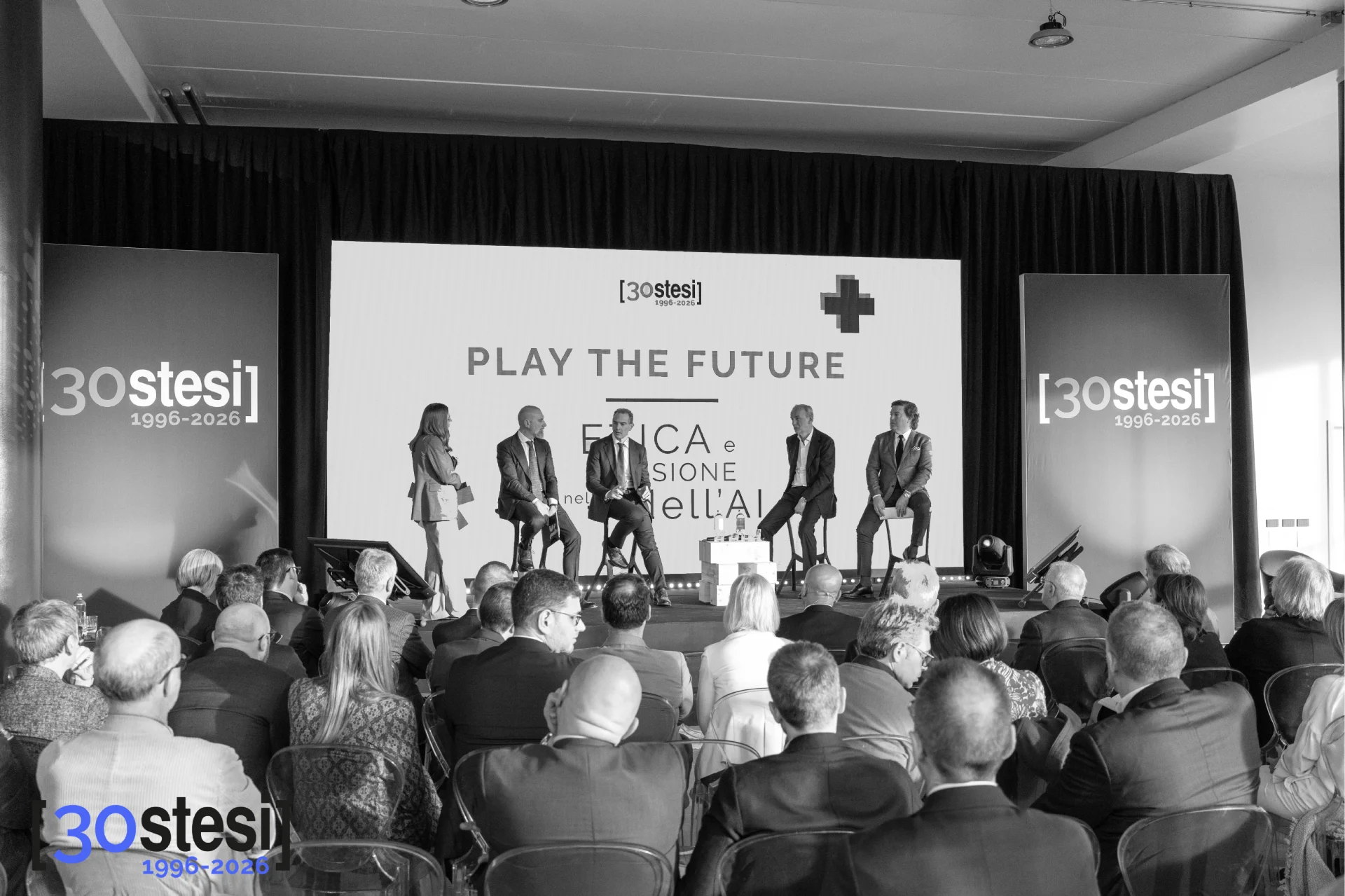
Is the future something we just wait for, or something we actively shape? Is it a flow that overwhelms us, made of instability, continuous change and exponentially evolving technologies, or is it a space of possibilities where we can choose a direction and keep control of the game?
We have been thrust into an era where new technologies and Artificial Intelligence accelerate every process, and change seems to give us no pause. In this context, asking the right questions has become an ethical responsibility for both businesses and individuals. As experts in digitalization and innovation, we chose to start from here to celebrate an important milestone: Stesi’s 30th anniversary.
We did so through an exclusive event that brought together employees, customers, partners and some of the most authoritative figures in the fields of IT and innovation. On Friday, April 10, 2026, we shared with them a journey through our memories and origins, and then reflected together on the future we want to build alongside our customers.
Our roots: the story of those who built Stesi
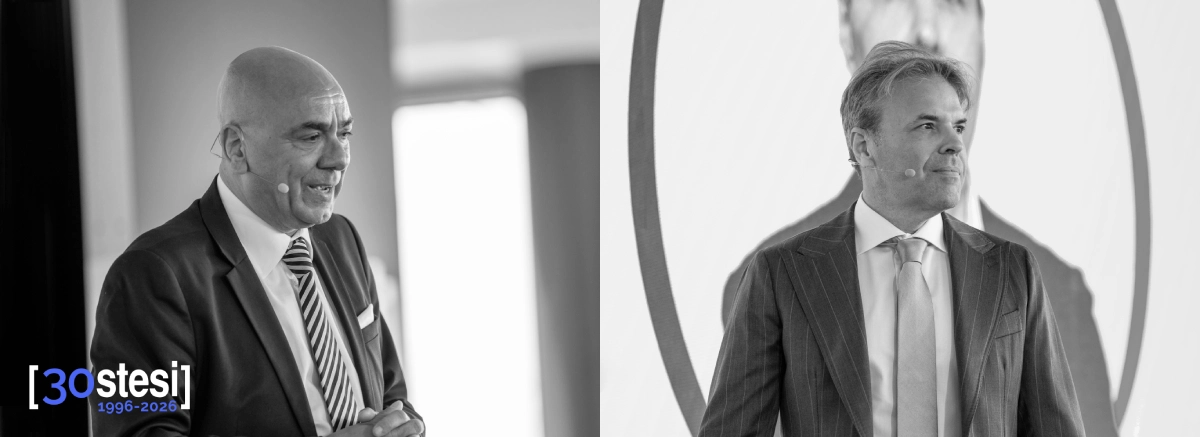
The celebrations opened with Stefano Cudicio, President of Stesi, who thanked all the customers and employees who have accompanied the company throughout this long journey. He retraced the key milestones of our history, paying tribute to the people who, through their dedication and expertise, transformed his vision into the solid company we are today.
Immediately after, CEO Enzo Cancian provided a detailed overview of the company’s technological and numerical evolution. From the first decade of Stesi, when we started with 4 customers and 4 employees, to today, where we serve over 150 customers, employ 35 people and operate in 9 countries.
Looking ahead: insights from those who shaped innovation
We turned our anniversary into a starting point, not a finish line. Thanks to the contribution of some of the leading figures in the Italian technology landscape, we explored a series of reflections on what lies ahead. Stesi’s approach is to project itself into the technological future with the right balance of ethics and methodology.
GenAI and situational awareness according to Giovanni Miragliotta
Professor Giovanni Miragliotta, Full Professor at Politecnico di Milano and Senior Director at Osservatori Digital Innovation, addressed several provocative and highly relevant questions. If ChatGPT can do it, where does my competitive advantage lie? Is Generative AI truly creating value, or is it simply commoditizing work? How should Generative AI be adopted correctly? Discover more in our dedicated article, which retraces all the key points of his speech 👉 GenAI: situational awareness and competitive advantage according to Giovanni Miragliotta
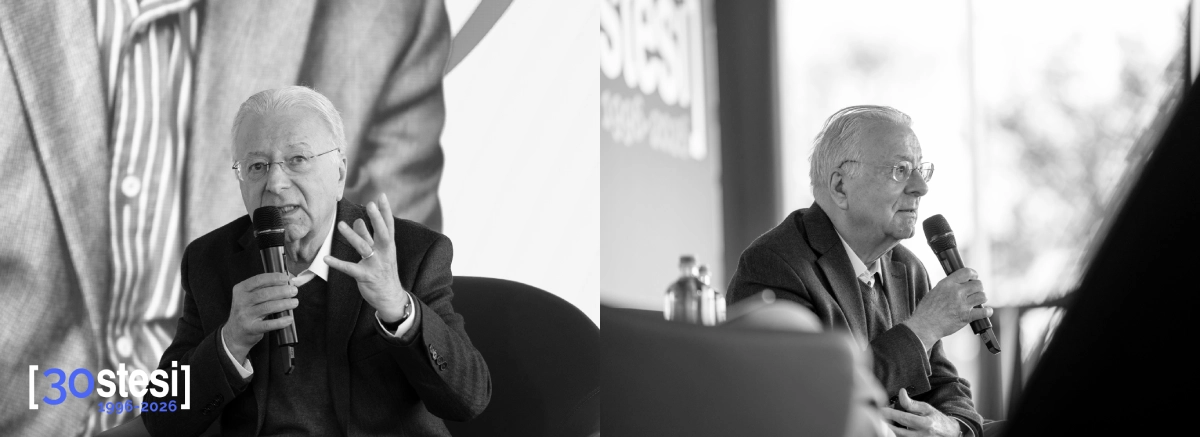
Human vs machine: the vision of Federico Faggin
A particularly intense moment was the speech by Engineer Federico Faggin, inventor of the microprocessor and pioneer of touch screen technology. Faggin engaged the audience by inviting them to reflect on the ontological distinction between machines, which operate in a purely logical and deterministic domain, and human beings, who are a field of consciousness endowed with emotions and the ability to assign meaning to symbols. Discover the difference between human consciousness and artificial intelligence in our dedicated article 👉 Federico Faggin at Stesi’s 30th anniversary: the difference between human consciousness and machines
“Play the future”: Ethics and Vision in the age of AI
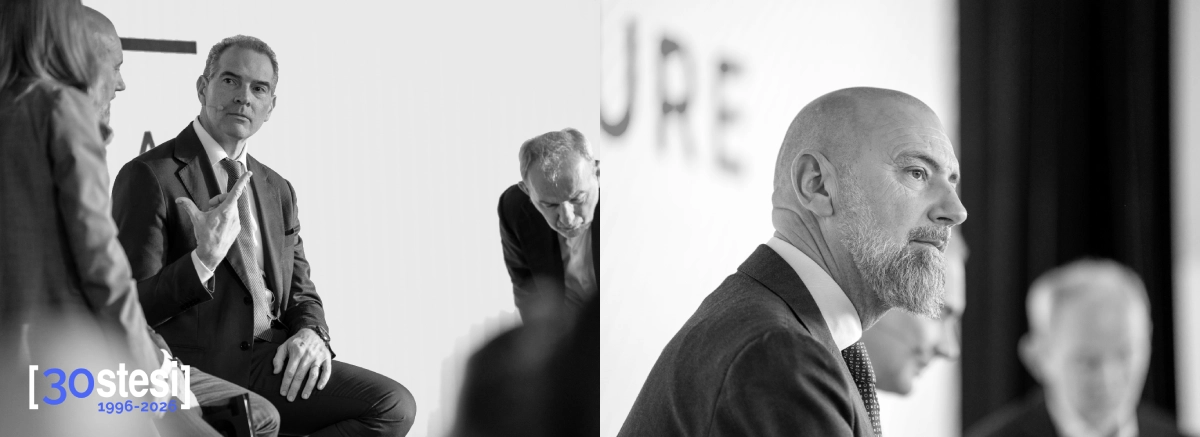
With a ’round table’ titled “Play the Future”, we created a moment of discussion featuring experts from different sectors: Professor Giovanni Miragliotta (Full Professor at Politecnico di Milano), Enrico Casiraghi (Chief Operating Financial Officer of Lega Serie A), Carlos Dos Santos (CEO of Amorim Cork Italia), and Francesco Pistorello (Sales Director of Toyota Material Handling Italia). The debate focused on the ethical dimension and future vision of Artificial Intelligence.
1. Prof. Miragliotta: should ethics be left to individuals or regulated by law?
“We all know that compliance rules and ethical rules rarely overlap,” Prof. Miragliotta stated. There are behaviors that, while unethical, are not illegal. “I believe the most important dimension is reflecting on implications, reasoning about what what is happening could unintentionally lead to. This is how I approach ethics in relation to artificial intelligence.”
Miragliotta then highlighted the issue of gender bias, explaining how AI systems trained on historical data risk amplifying inequalities rather than reducing them. If we ask a generative AI to create an image of a CEO, it will most likely generate a man, even if the request is neutral. This happens because AI reflects what we have been. Instead, we must decide the direction we want for the future. If we believe that AI usage has implications that are not ethically acceptable, it is essential to take action to mitigate or eliminate these risks.
But what other risks are involved in feeding our data into AI? Miragliotta emphasized that, as of April 2026, data is widely recognized as the primary production factor and a key driver of competitiveness. While companies have learned to protect their databases by selecting vendors that guarantee data isolation, a new and more subtle risk is emerging: the leakage of know-how through prompt engineering.
The competitive dilemma, as he defines it, is complex. Not using AI means falling behind in the short term, but using it without safeguards exposes companies to the risk that AI service providers may collect these operational logics and turn them into reusable libraries offered directly to end customers, effectively disintermediating the original company. The challenge therefore shifts to identifying where the true, non-replicable value lies.
2. Dr. Casiraghi: what experience do you have with Artificial Intelligence in your field, and how can it be regulated?
“Progress cannot be stopped,” Casiraghi emphasized. “If regulation is approached as it often is in Italy, with excessive legislation, people will simply move abroad or rules will soon become obsolete.” The correct approach, according to him, is to define the scope of control (such as traceability, transparency, …) and establish clear principles (e.g.: requiring disclosure when content is AI-generated, …).
How, then, do we translate innovation into a complex organization? For Dr. Casiraghi, the key lies in organizational coherence: the ability to correlate tools and people in a responsible manner. “A coherent organization is one that gives the right people the right tools at the right time. A hammer in the hands of a child has one purpose; in the hands of a blacksmith, it has another.”
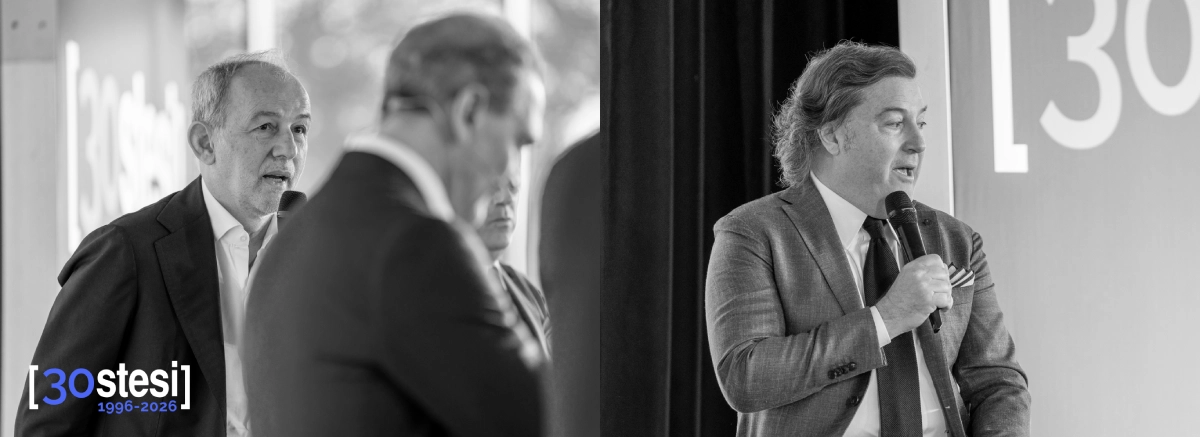
Casiraghi shared two examples of how AI has delivered tangible results within Lega Serie A:
- Accounting and RPA: The integration of AI and Robotic Process Automation (RPA) for invoice registration. A system that works overnight with absolute precision, yet keeps the human “in the loop” through an interface for final validation, ensuring the technology is not perceived as a threat.
- Knowledge Management: The use of AI to query vast archives of procedures, transforming static documents into interactive assistants that eliminate the risk of “hallucinations” by working exclusively on verified corporate data.
The heart of the challenge, however, remains human: changing habits within a company is the most grueling task. This is why a phase of cultural preparation and listening, prior to technical implementation, is fundamental to bringing a diverse audience on board, from digital natives to more senior profiles.
3. Dr. Dos Santos: How do you reconcile the use of Artificial Intelligence with your company’s “people-centric” approach?
“For us, the person is the one who creates value,” specifies Dr. Dos Santos. “I don’t manage the company; I manage the talent of my collaborators […] because that is where critical thinking is developed, and it is this critical thinking that helps create differentiation from one company to another.” If work is excessively delegated to an AI, there is a risk of losing the essence of the person and what makes them unique—and consequently, what makes the company unique. “When we talk about employer branding, we are also talking about talent retention,” states the CEO of Amorim Cork, noting that in a country facing a severe “demographic winter,” retaining talent is a social responsibility before an economic one.
Furthermore, Carlos Dos Santos strongly rejects the idea of an AI capable of profiling an individual in just a few minutes, defining the human being as an ecosystem too rich to be reduced to a simple pattern. Amorim Cork’s philosophy centers on vocation, basing recruitment on a balance where attitude accounts for 80% and technical competence for the remaining 20%. Through a rigorous aptitude test derived from Marine Corps psychometric models, the company seeks professionals who are, above all, capable of thriving in an environment oriented toward organizational happiness. This approach has transformed individual vocation into the strength of an unbeatable team, ensuring constant growth and near-zero turnover for Amorim Cork.
4. Dr. Pistorello: How is AI transforming operations in your sector?
“Thanks to these technologies, warehouses are becoming more autonomous, more predictive, more interconnected, and most importantly safer,” says Dr. Pistorello. He illustrated how, through AMR (Autonomous Mobile Robots) and robotic picking, efficiency is no longer just a matter of speed, but of quality and safety.
“The warehouse typically uses a reactive model. AI helps in making the transition toward a predictive model.” By analyzing enormous amounts of data, trends, and seasonality, it allows for inventory optimization and the elimination of stock-outs, improving company credibility. Dynamic path adaptation, automatic identification of product shapes and types, and smart stock allocation based on proximity… these are just some of the benefits Francesco Pistorello highlighted in the logistics sector. A turning point cited by Pistorello is the use of Digital Twins: advanced simulators that allow complex logistical realities to be visualized in just a few hours, breaking down mental barriers toward automation and drastically reducing design times.
In his speech, Francesco Pistorello overturned the “man vs. machine” replacement paradigm, explaining that in logistics, automation and AI do not eliminate jobs but rather compensate for a dramatic labor shortage. Technology also acts as a skills transformer: those who once drove a forklift are now becoming fleet supervisors or data analysts, leaving the most strenuous and repetitive tasks to the machines. To manage this transition, Toyota is betting everything on reskilling through dedicated academies, as the true corporate responsibility lies in guiding people past the resistance to change.
Our ‘Play The Future‘ round table confirmed that the future is not something to be endured, but something to be guided, to be actively played. We do this with the awareness that technology is an accelerator of possibilities, but the direction remains, proudly, a purely human choice, profoundly our own.
