


For some years now, logistics outsourcing, also known as third-party logistics or 3PL, has become the go-to solution for many companies that, due to limited resources or the complexity of their logistics operations, prefer to rely on external partners to maintain high levels of productivity. E-commerce businesses are a prime example: following the surge in digital commerce that began in 2020, they have been actively searching for new systems capable of streamlining supply chain processes and delivering added value to customers in a way that sets them apart in the market.
To understand why 3PL services are gaining such traction, and how third-party logistics providers manage to deliver an excellent service to their clients, we spoke again with Emilio Collot, SalesDirector at Stesi. Emilio shared the main challenges facing the sector and explained how a suite like silwa can help companies such as Guerra Graziano, active in the transport industry since 1995, transform themselves into highly effective third-party logistics providers.
3PL: who third-party logistics providers are and what they do
Third-party logistics, or 3PL, is a form of outsourcing in which a company’s logistics processes are entrusted to an external partner. This approach, as mentioned, is particularly widespread in e-commerce, where the need to manage the supply chain efficiently is proving increasingly critical to keeping pace with the major players in online retail.
3PL service providers handle activities such as warehousing, order fulfilment, goods management and more, providing essential support to companies looking to optimise their supply chain.
In recent years, Emilio points out, a growing number of companies operating in the transport sector have decided to extend their service offering by providing third-party logistics services to their clients. For these businesses, it is no longer just a matter of collecting pallets from a manufacturer and delivering them to the end customer. It is about taking full ownership of goods management from end to end.
Each third-party logistics provider stores clients’ goods in its own warehouses before shipping and delivering them to their destination as required.

The underlying drivers behind the 3PL logistics boom
In the wake of the COVID-19 pandemic, which led many companies to bring their processes entirely in-house, from production through to logistics, a reversal is now underway: a growing number of businesses are actively seeking partnerships with external providers for logistics services.
This trend is driven by several factors:
- Logistics in e-commerce has become significantly more complex than it once was. The increase in daily shipment volumes and rapid market shifts generate a level of complexity that is increasingly difficult to manage, particularly for smaller businesses.
- Partnering with a 3PL provider brings companies meaningful cost savings, even in the short term. It effectively removes from the balance sheet the costs of land, infrastructure and staffing that would otherwise be required to manage all logistics activities in-house.
- 3PL operators, typically equipped with a network of storage facilities, reduce the distance between goods and the end customer, enabling faster delivery times, an increasingly important differentiator.
But if these are the factors driving companies to choose a third-party logistics provider, what motivates established businesses to expand their own service offering in this direction?
A growing number of transport-focused companies are choosing to offer third-party logistics services to their clients because it is, in straightforward terms, a smart business decision. In the face of rising costs, offering clients services beyond basic transport (from goods management and order preparation to warehousing, packaging and labelling) represents a significant expansion of revenue streams.
In this context, Stesi brings to the table a deep understanding of the complexities of the 3PL sector and the needs of companies operating in third-party logistics, including notable names such as Di Stefano Trasporti and Guerra Graziano, also known as Autotrasporti GG.
Guerra Graziano: transport, warehousing, logistics, groupage
Guerra Graziano is a transport company with a long history and a strong track record.
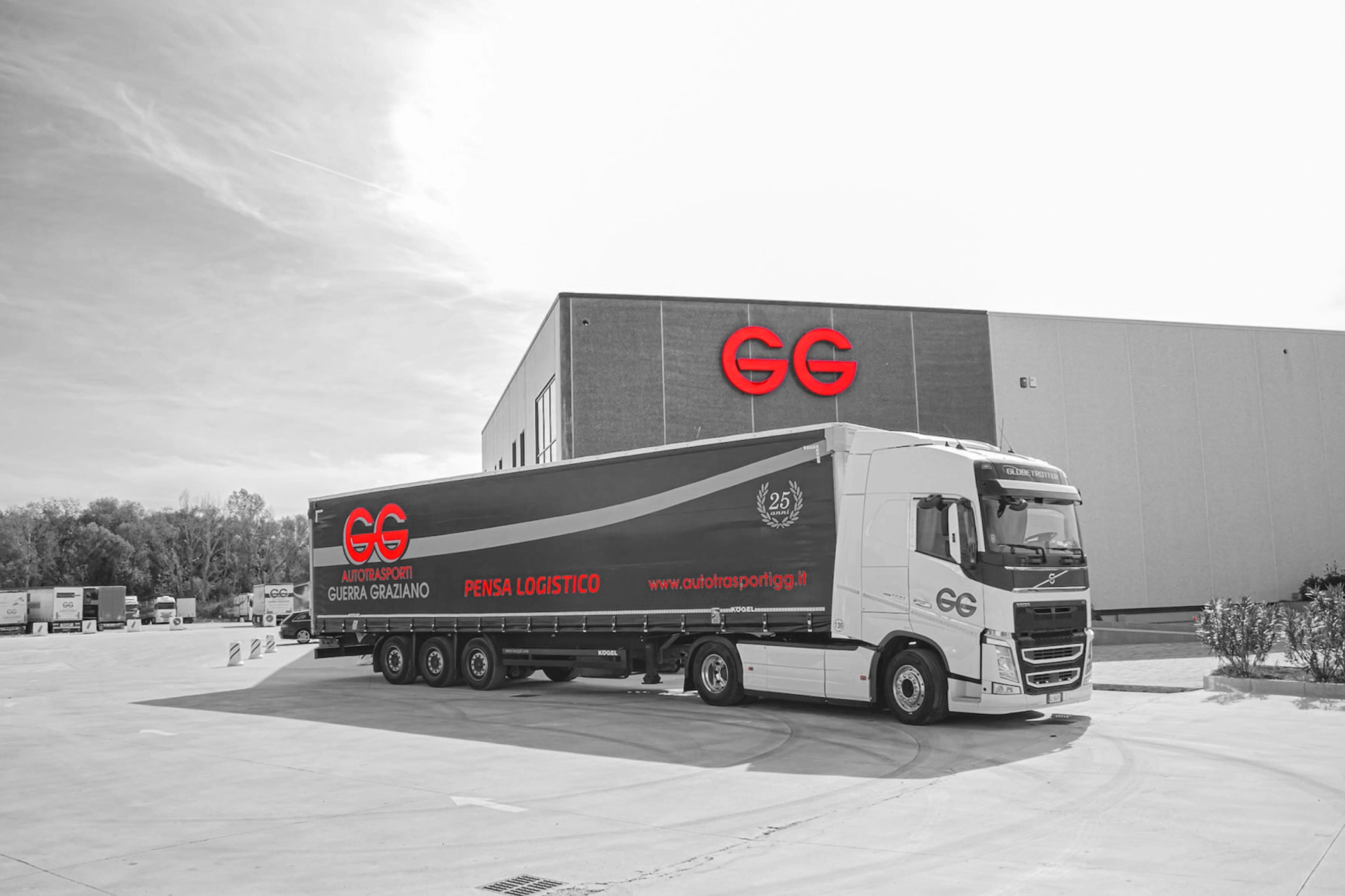
Recognised among the 31 road transport companies awarded Michelin’s sustainability stars, Guerra Graziano has been making a significant contribution to the sector since 1995, built on a commitment to on-time delivery. The collaboration with Stesi began in 2020, with the implementation of the silwa WMS alongside the TMS in its simpler configuration, suited to the company’s needs at the time.
Since then, Guerra Graziano’s expansion into full third-party logistics services has made it necessary to move to the complete silwaSUITE, which has significantly simplified all lot and serial number management operations. The most recent facility built by the company covers 6,000 square metres dedicated entirely to the storage, logistics, handling and processing of goods for its six clients.
At the heart of this facility, two trilateral reach trucks operate as semi-automatic machines interconnected with silwa, optimising storage density and enabling the management of approximately 13,200 pallet locations.
The focus on efficiency extends to multi-site management, a common requirement for 3PL operators with facilities spread across different geographic areas. With five warehouses distributed across the Marche and Emilia-Romagna regions, Guerra Graziano uses silwa to optimise goods management across all its client accounts. This naturally requires precise activity tracking, which is essential for recording movements and operations of various kinds that will ultimately be invoiced to each client. With silwa, Guerra Graziano is able to log in detail the activities carried out for individual clients, monitor inbound goods, order preparation, repackaging and labelling activities, and even quality control.

The complexities of warehouse management for a 3PL partner
“Warehouse management for 3PL partners presents unique challenges compared to traditional warehousing”, Emilio points out. While traditional operations focus on managing their own goods, 3PL operators must handle the complexity of coordinating the goods of multiple clients simultaneously.
One of the main difficulties 3PL companies face is precise activity reporting. Businesses specialising in third-party logistics must ensure the timely and accurate recording of all costs associated with each client. This means carefully tracking a wide range of data points, from goods movements within the warehouse and the number of pallets loaded, to the quantity of relabelling operations performed and pallets dispatched.
The simultaneous management of goods belonging to different clients makes it clear how important it is to have a WMS capable of attributing activities to individual clients. Without such a system, it becomes impossible to accurately calculate what to charge each client for the services provided. In response to this challenge, as we have seen, Guerra Graziano adopted the Stesi silwaSUITE, which has proven fully equal to the company’s natural growth and evolving business needs.
Another significant challenge common to 3PL operators concerns warehouse organisation. The traditional approach of physically segmenting space into dedicated areas for individual clients has often led to dissatisfaction, with clients forced to pay for underutilised storage space. Thanks to the integration of WMS software solutions, an innovative alternative has emerged, one that shifts the focus from ownership of goods to overall space optimisation. This new warehouse organisation model allows 3PL providers to offer clients a cost tied to the storage service itself, rather than to individual pallet locations. The WMS plays a key role in this shift, enabling the precise identification, localisation and tracking of goods and their owners.
The importance of the WMS
From a WMS like silwa, companies operating in third-party logistics services gain not only the benefits of core functionality such as traceability, stock management and location assignment, but also complete and precise control over logistics activities for each client, which, as we have seen, is fundamental from a billing and reporting perspective. A WMS also makes it possible to serve multiple clients across one or more warehouses, operating concurrently and flexibly on activities for different clients in order to optimise costs, goods movements and order preparation, while maintaining a consistently high standard of service.
A 3PL operation also needs to efficiently manage a large number of SKUs and coordinate shipments across multiple carrier partners. silwa integrates with TMS software, the key information systems for anyone operating in transport, enabling precise organisation of delivery runs, routes and legs.
In short, the silwaSUITE is a key enabler of success in the third-party logistics sector, providing all the essential capabilities the sector demands. A concrete example of this is evident in the case of Guerra Graziano, which successfully manages and monitors all processes across its five warehouses using the silwaSUITE. Get in touch to find out more.
