



In increasingly competitive markets and operating environments, operational efficiency has long been a top priority for manufacturing companies. It comes as no surprise, then, that businesses looking to stay competitive and meet growing customer expectations have turned to advanced solutions capable of optimising production operations. For several decades now, MES (Manufacturing Execution Systems) have become one of the essential tools for companies determined to improve the management and execution of their production and warehouse activities. But what features are non-negotiable in an effective MES system for production control, and what benefits does it deliver? We put these questions to Alessio Pavan, Operations Director at Stesi, who shared a series of practical tips to help companies navigate the MES landscape and make the right choice.
What are MES systems?
MES stands for Manufacturing Execution System: software designed to monitor, control and optimise production activities in real time.
MES systems act as a strategic interface connecting business information systems and production processes. By capturing detailed information on production activities, from order launch through to finished product, Manufacturing Execution Systems enable the use of real-time data to monitor and continuously improve production processes.
From resource availability to production progress, from maintenance activity management to quality control, MES systems help decision-makers make data-driven choices based on accurate, objective information.

The essential features of a MES system
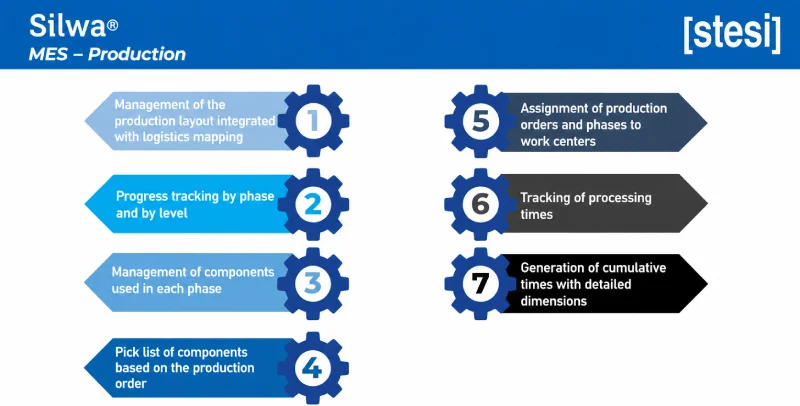
MES software for manufacturing offers a set of essential features for optimising production operations. These include real-time data collection from devices and sensors installed on machines and production equipment, enabling the monitoring and control of production parameters such as output quantities, timings, production errors and more.
Another core MES feature is real-time monitoring and control of production activities, which gives operators and managers a complete overview of performance. This capability is particularly valuable because it allows operators to identify problems, delays or anomalies promptly and take the right corrective action quickly.
Effective order execution management is another critical feature offered by MES systems. It enables the coordination of production orders by assigning them to the most appropriate operators and work centres, and by verifying the availability of the required materials. The MES ensures that operations are carried out in accordance with a specific plan and logic.
Traceability and full product history are concepts of great importance in MES software. Manufacturing Execution Systems record and track all production-related information, including the raw material batches used, the processing operations performed, and production dates and timings. This enables complete product traceability throughout the supply chain, providing a clear and detailed view of the origin and journey of each product from end to end.
Finally, MES systems offer a critical performance analysis and data reporting capability. The system records, tracks and processes production data to generate reports and analyses that allow production performance to be assessed, trends to be identified and potential areas for improvement to be pinpointed, all in support of data-driven decision-making and improved overall efficiency.
The benefits of MES Manufacturing Execution Systems
Implementing a MES software delivers a range of significant benefits for companies, providing a constant real-time picture of what is happening on the production floor. These include:
- Improved visibility and control: the system provides real-time visibility into production activities, enabling precise monitoring of work-in-progress, machine performance, resource utilisation and other key metrics. This level of control supports informed decision-making and the timely introduction of changes to improve operational efficiency.
- Production operations optimisation: the MES helps optimise production operations through activity scheduling and monitoring, reducing waiting times, optimising resource utilisation, minimising waste and improving product quality.
- Improved traceability and compliance: the MES enables the accurate tracking and recording of all production-related data and information, including materials used, processing times, quality control operations and more. This supports regulatory compliance (particularly relevant in heavily regulated sectors such as food production), product history management, defect identification and customer complaint handling.
- Data collection to support business decisions: the Manufacturing Execution System provides detailed data and reports on production performance, machine performance, resource consumption and other critical metrics. This information enables decisions based on concrete data, helps identify areas for improvement and supports the development of strategies to optimise overall efficiency and productivity.
- Process integration and coordination: MES systems facilitate the integration of different production processes, including human resource management, material supply, production planning and more. This enables activities to be coordinated and synchronised, reducing inefficiencies, overlaps and delays.
- Quality and compliance support: the MES can incorporate quality control features, enabling the definition and monitoring of product specifications, the execution of tests and inspections, the management of non-conformances and the support of continuous improvement processes.
- Improved communication and collaboration: as a centralised platform, the MES improves communication and collaboration among production teams, planning managers, operational staff and other stakeholders involved in the production process, fostering more effective information sharing and better teamwork in pursuit of production targets.
How to choose the right MES system: Stesi’s three tips
The MES system market is vast. How do you identify the solution best suited to your production environment? Drawing on hands-on experience, Alessio Pavan has identified three key pieces of advice for companies in the evaluation process:
- Define your specific requirements. Before starting your search, take the time to fully understand your company’s actual needs. What are your specific operational requirements? Are there industry regulations you need to comply with? Are there areas where you want to improve efficiency or optimise production? Answering these questions is essential for identifying the MES that best fits your situation.
- Carefully assess scalability and integration capability. Choose a MES that is scalable and capable of supporting all your business needs, including future ones. Your company may grow or change over time, so it is important to opt for a system that can adapt easily. Also verify whether the MES can integrate seamlessly with the information systems already in use at your company, such as your ERP and data collection devices. Seamless integration between systems will help you optimise data management and improve visibility and control over production processes.
- Consider usability and the support on offer. Pay close attention to the usability of the MES software you are considering. Make sure it is intuitive and equipped with a user-friendly interface, as this will support fast adoption by production operators and reduce the training time required. Also check whether the vendor offers reliable, responsive technical support: this will be essential for addressing any issues promptly and avoiding prolonged production downtime.
silwa: the complete suite integrating MES and WMS
silwa is the comprehensive suite developed by Stesi that integrates a MES and a WMS to offer companies a complete tool for the agile management of all logistics-associated activities. Already deployed across numerous application sectors, silwa is the software chosen by:
- Roberto, a company specialized in the production of excellent quality bread and bakery products. At Roberto, the MES system interfaces with the numerous machines located throughout the production area, allowing the company to leverage all the analysis and reporting tools of the silwa MES. Discover more here.
- Samo, a manufacturer of shower enclosures and bathroom products. At Samo, Stesi also introduced technologies such as pick-to-light and AGVs (Automated Guided Vehicles) that autonomously transport materials within the warehouse. Discover more here.
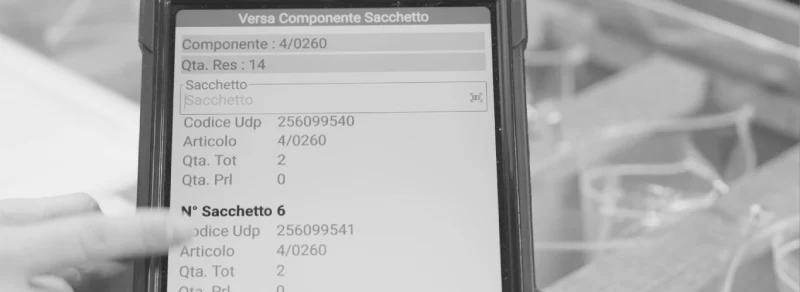
- Linergy, a manufacturer of emergency lighting systems, which chose a MES software integrated with the warehouse WMS. The solution designed for an electronics sector company like Linergy is an integrated logistical-production model built around Stesi’s Manufacturing Execution System (silwaMES). Connected to both the company ERP and Stesi’s WMS, it connects all corporate subsystems (goods inbound, automated warehouse, assembly work cells, quality control, packaging, and shipping) into a single platform. Discover more here.
Looking for MES software to increase your warehouse efficiency but concerned about making the wrong choice? Trust Stesi. With over 25 years of sector experience, the Stesi team consists of professionals who can guide you through the selection process and identify the best MES solution for your needs. Let’s get in touch.
