



The MES, or Manufacturing Execution System, plays a crucial role for today’s businesses by providing precise production management and monitoring of production activities. Having already explored the essential features of an effective MES (here, with Andrea Leonarduzzi, Product Owner) and the key considerations before choosing among the many MES solutions currently on the market (here, with Operations Director Alessio Pavan), it is now time to look at the economic benefits and return on investment.
Because a MES is not simply a tool for keeping stock under control, monitoring production status and tracking the evolution of lots and serial numbers. Its impact on the business extends well beyond this, adding tangible and strategic value to the entire operation.
But why should a business owner opt for a MES to optimise production management? To answer this question, we spoke with Emilio Collot, Commercial Director at Stesi.
A look back at production management
Over the past 30 years, the pace of industrial evolution has accelerated without precedent, bringing to light a real disconnect between production and company management. A genuinely damaging situation, created by poor communication management: always insufficiently transparent, rarely immediate and prone to errors.
Around 20 years ago, when companies began to feel the need to adopt production procedures and standards, attention naturally focused on methodologies and processes, since the right supporting technologies were not yet available.
Lean and Kaizen, both conceived for continuous process improvement, are just two of the many approaches that spread across industry and were successfully implemented without the use of technology solutions. Companies at that time soon began to rely on paper production reports, inspection records, downtime logs and manually signed timesheets to monitor the entry and exit of every individual worker from the facility.
In short, the introduction of new methodologies began to transform production management, but in doing so created a heavy dependence on paper, which proved extremely complex to manage. “In brief, we could say that 20 years ago companies began to identify the methods”, Emilio Collot concludes, “but not yet the tools to implement them effectively.”
From process to tool
Paper, as might be expected, did not prove to be the ideal medium for ensuring the smooth flow of information within the Anthony pyramid, or in other words, within the organisational hierarchy.
Despite the new methodological introductions, the disconnect between management on one side and production on the other persisted.
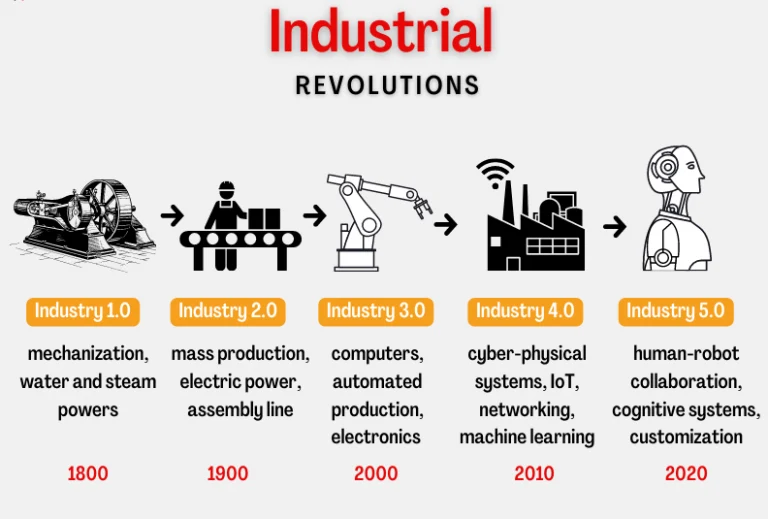
Resolving this problem required waiting for technology to advance and for the first WMS and MES solutions to emerge, followed by the spread of automation and the push toward industrial interconnection with machines driven by Industry 4.0 incentives.
This progression is not surprising. As Emilio Collot points out, we can think of the process of integrating new technologies into a company as a two-phase journey:
- Process, in which a new method is defined;
- Tool, primarily through the implementation of dedicated technologies.
Today, the market of tools available to businesses is rich with solutions designed to support and optimise processes across the entire supply chain. One thing is clear, however: for all that the business community and the media love to talk about Industry 5.0, there is still a great deal of work to be done before companies can fully benefit from 3.0 and 4.0. And that is precisely where the starting point must be.
Effective production management depends on the flow of information
The real difference, in short, only became tangible with the introduction of the right technologies, MES included, which allowed information to circulate within the organisation and be made available to the workforce, both horizontally and vertically.
Returning to the Anthony pyramid, which distinguishes from bottom to top between operational activities, planning and control, and strategic decision-making at the top, digital and strategic solutions such as a MES can make a genuine difference. They do so precisely by enabling the horizontal distribution of information within the first level of the pyramid, occupied by operators and machines. Effective production management through a MES allows operators to access all information in real time on the machines, which in turn can create valuable synergies by communicating and exchanging data with one another. “What does this mean in practical terms? That machines can flag production errors very quickly and allow operational staff to intervene just as quickly, optimising both time and costs.”
Introducing this type of production management software is capable of triggering a clear improvement in production efficiency: more units produced, fewer errors and fewer workplace incidents. All the data generated at the base of the pyramid becomes immediately available at the top, allowing the decision-making board to work from precise, transparent, real-time data.
Beyond horizontal communication, the MES also enables valuable vertical communication that reaches managers, who can now focus on accurate production scheduling, planning and programming, all the way up to the business owner or board, who can finally access production KPIs and performance reports based on accurate data available in real time, without the inevitable errors and delays that manual management would entail.

Why companies choose a MES
But why do companies today choose to implement a MES solution to optimise production?
Based on his direct experience, Emilio Collot finds that companies typically have a threefold objective:
- Machinery – improving integration with machines to automatically capture production data, downtime, cycle times and so on.
- People – simplifying the recording of operator time to get a clear picture of the number of resources involved, hours worked and other data, ultimately enabling the calculation of the actual cost of production.
- Activities – gaining the visibility to objectively compare estimates against actuals, and understanding in a clear, data-based way how performance measured up against what was originally planned.
Production management systems: the MES
To summarise what we have covered so far, production management through a MES is built to address the business’s need to measure, evaluate and correct. It is only by detecting, intervening and improving that it becomes possible to increase production output.
“Think of the classic case of a machine or line stoppage”, Collot continues. “It may seem straightforward, but with a MES the time between detecting the error and resolving it is kept to an absolute minimum.” This means that monitoring the situation in real time and immediately identifying any anomalies can deliver a production efficiency improvement of around 15 to 20%. Because the problem is not limited to machine stoppages: it also includes minor issues that often require lengthy and costly interventions. A production management system can also have a positive impact on stock management and the supply of production lines, for example by limiting line-side stock and optimising the movement of operators and goods. The same system is capable of managing maintenance requirements and, in many cases, quality control as well.
Introducing a MES is no small undertaking. But is it right to talk about a cost, or should we rather speak of an investment? For Emilio Collot, one of the great advantages of MES solutions lies in their ability to integrate with other solutions, perhaps acquired through various incentives and financing schemes. Fully implemented and integrated MES solutions give business owners access to extremely comprehensive tools that optimise production to the point of generating a return on investment within two, at most three, years.

MES solutions on the market
Today the market is saturated with MES solutions. Yet in the majority of cases, these are highly specialised tools built specifically to address the needs of particular production sectors.
The problem with these solutions, however, is that they lock companies into defined boundaries that are complex and costly to move beyond. Highly vertical solutions are monolithic by nature: too rigid to be effective in markets that must constantly adapt to changing customer demands. When every modification requires lengthy and demanding intervention, software of this kind quickly becomes extremely expensive for companies, risking a constraint on their ability to grow.
This is why, today more than ever, beyond the technology itself, the key factor for success lies in the support of the right technology partner. A technology partner must work alongside the company, understanding its dynamics, processes and potential evolution. Only in this way can the technology effectively follow the company throughout its growth, itself evolving through new features and implementations, adapting to new production models, new demand patterns and whatever else may come.
“Paying close attention to the flexibility of the tool is fundamental when choosing the right MES. If you are looking for a MES, work only with a partner who will be able to provide the necessary integrations and cover all those grey areas that sit between the WMS and the MES.”
Want to find out more? Let’s get in touch.
