


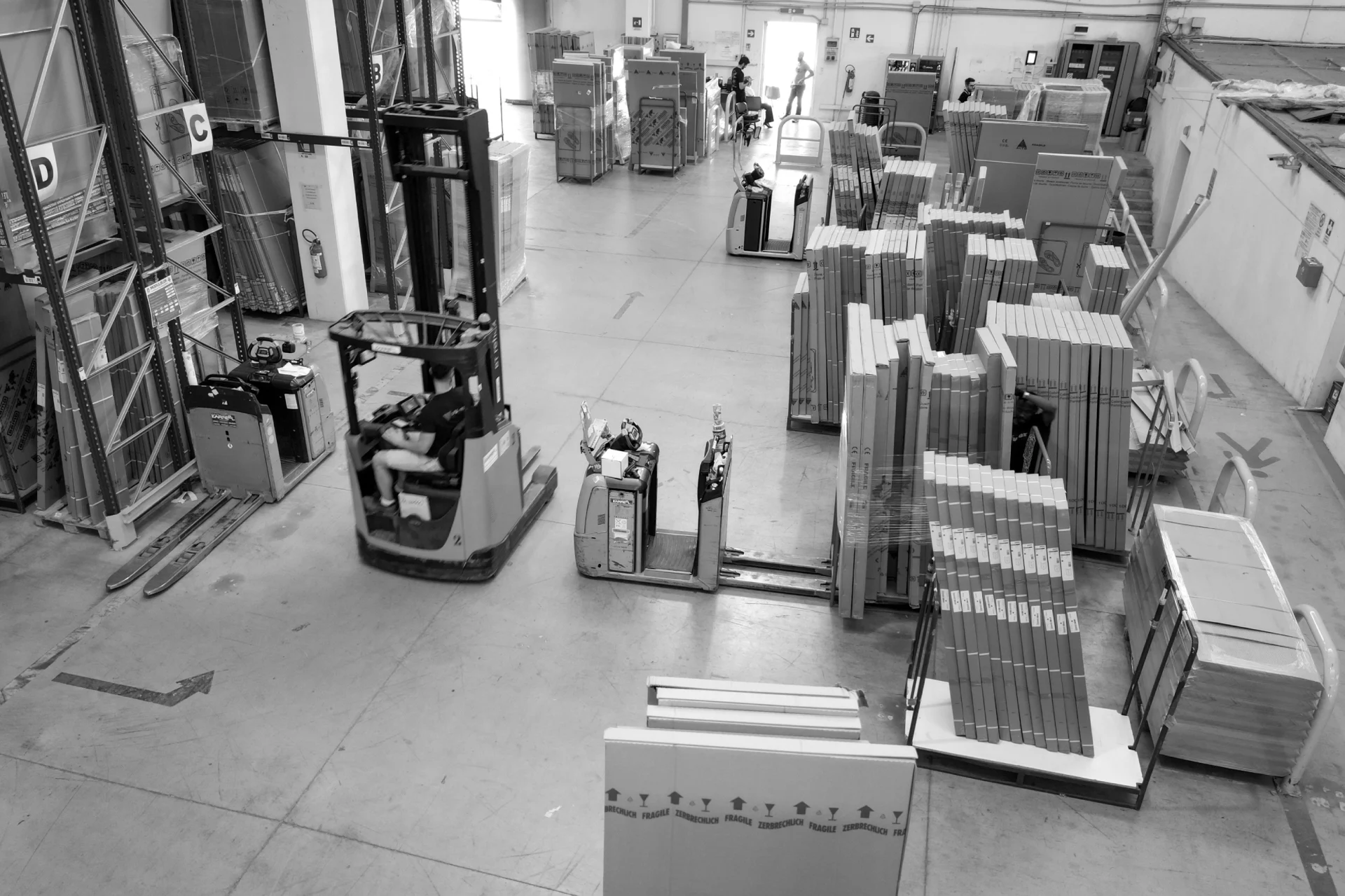
Put-away is the warehouse logistics process of placing inbound goods into their designated storage locations. When managed correctly, it allows items to be stored efficiently to facilitate future picking operations.
Efficient warehouse logistics has always had a significant impact on business results. The numbers tell a clear story of just how complex and challenging this is to achieve: studies published in the European Journal of Operational Research estimate that order picking alone can account for more than 55% of total warehouse operating costs. On top of this come the well-known productivity problems caused by poorly designed warehouse layouts, unoptimised pick routes, excess stock and inefficient procedures. These issues arise with a certain regularity because warehouse logistics optimisation depends on many factors and variables: every facility is a story in its own right, with operations shaped by the business model, its size, the structure and complexity of the supply chain, the types of goods being handled and the sector in which it operates.
What if some of these operational costs were the direct result of a non optimal putaway in warehouse management?
In the midst of the digital transformation era, technology plays an irreplaceable role in improving warehouse operations, with the same overarching goal it serves across all other business processes: maximising productivity. Simply introducing technology, from drones to robots, is not enough on its own to turn an inefficiency-ridden warehouse into a productivity benchmark. It is, however, the stable foundation on which a smart warehouse project must be built, one that can only reach its objective through the interconnection of technologies, platforms and optimised processes.
“The cost of order picking is estimated to be as much as 55% of the total warehouse operating expense.” ⁓ De Koster et al.
Putaway in warehouse logistics
Putaway sits at the heart of warehouse logistics: when it is well designed, the warehouse runs smoothly and does not waste time or money. The speed and accuracy with which orders are fulfilled depends directly on how rationally put-away is managed, and therefore, ultimately, on the competitiveness of the business. But how do you position products in the most effective way? Before choosing a storage system (manual or automated), it is worth studying the type of packaging, the dimensions and the fragility of the goods. From there, it is essential to monitor how quickly goods turn over: do they sit in the warehouse for a long time, or do they have a very short dwell time? This information about warehouse logistics flows is fundamental for space optimisation and for designing the ideal warehouse layout, because efficient warehouse logistics ultimately depends on these few but critical data points.
Goods receipt: the phase that comes before put-away
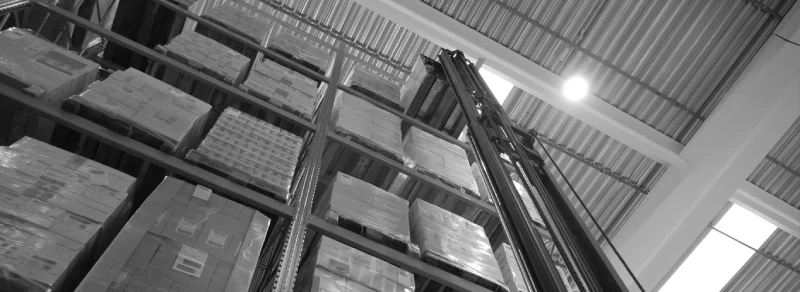
Put-away does not begin when goods touch the shelf. It begins much earlier, at the unloading bay, with goods receipt: the phase in which inbound goods are unloaded, counted, checked against the delivery note and, where necessary, labelled or subjected to quality control. Only once these operations are complete is the goods ready to be placed in its designated location.
This sequence matters because accurate goods receipt is the prerequisite for correct put-away. If goods enter the warehouse without having been properly verified or labelled, any downstream storage strategy will be compromised: incorrect locations, misaligned stock levels, untracked lots.
Put-away has a direct impact on picking
An effective put-away strategy does not just improve storage: it has a direct impact on picking as well. The more intelligently goods are positioned, the faster, smoother and more accurate picking operations become.
A concrete example: fast-moving items can be placed close to the dispatch bays or in the most easily accessible areas. This means operators travel shorter distances, reduce downtime and increase overall productivity.
The main putaway strategies in warehouse logistics
There is no single way to manage put-away: the right approach depends on the warehouse layout, the type of goods and product velocity. Everything starts with an analysis of the warehouse layout.
- Fixed-location put-away
Each item has a predefined, fixed storage location. It is a simple and orderly solution, well suited to warehouses with stable SKUs and repetitive processes. - Dynamic put-away
A WMS software, through its slotting and dispatching algorithms, automatically assigns the best available location based on availability, volumes, turnover or priority. It is more flexible and makes better use of available space. - ABC slotting
Items are distributed according to picking frequency: fast-moving products are placed in the most accessible areas, reducing travel time and distances.
Putaway and smart warehouse: Industry 4.0 solutions
If the warehouse is not performing as it should, or simply has room for improvement, the financial consequences can be significant. It is the warehouse manager‘s responsibility to embark on a modernisation journey in which the technology component will inevitably be a decisive factor. When it comes to the trends, technologies and solutions that fall under the warehouse 4.0 paradigm, certain themes cannot be overlooked. Below are four areas worth considering.
- RFID: the foundation of logistics platforms
Within the broader context of the Internet of Things, Radio-Frequency Identification (RFID) has become a fundamental step toward better inventory control, warehouse organisation and shipment management. It is capable of speeding up operations considerably compared to manual identification procedures or barcode scanning systems. For warehouses looking to upgrade and achieve a higher level of efficiency with an immediate reduction in costs, RFID may well be the right place to start.
RFID is, first and foremost, a system that integrates easily into warehouse logistics. It also has the significant advantage of being able to read data through packaging and other containers: scanning and capturing product or parcel data works without needing to remove the item from its packaging. Furthermore, unlike barcode scanners, RFID readers do not need to be precisely aligned with the tag to capture data, allowing far greater flexibility and enabling greater automation across internal warehouse operations.
- Beyond logistics platforms: Industry 4.0 hardware
You do not need robots, automated stacker cranes, AGVs or sophisticated goods-to-picker systems to enter the warehouse 4.0 world, but a capable and efficient logistics operation cannot do without a technology component. Among the many devices a warehouse 4.0 can deploy, particular mention goes to barcode scanning terminals, tablets, vehicle-mounted computers, RFID terminals, headsets for voice-directed applications, and portable or desktop label printers and RFID printers. Add to these accurate weighing systems for inbound and outbound goods with piece-counting technology, lift platforms, conveyors, roller conveyors and much more besides.
- Smart WMS (Warehouse Management System)
Optimising warehouse logistics also means relying on a software platform capable of managing and orchestrating processes, data and machinery. That software is the WMS, an essential component of any agile, fast and efficient warehouse operation. The WMS coordinates all warehouse activities, from goods receipt through to storage, from picking through to shipment management. It is the WMS that, strictly in real time, receives data from inbound RFID tags, organises cross-docking where needed based on orders coming in from the ERP, determines precisely how put-away should be handled by pre-assigning the optimal storage location for each item, defines pick routes (including batch, cluster and zone picking modes) and, where applicable, assigns those tasks to robots. Alternatively, it will push precise, step-by-step instructions to operators’ terminals, optimising their time on the floor.
- Data-driven logistics platforms and tools
Visibility, data capture, processing and, more broadly, the use of data to support both operational execution and decision-making keep pace with the evolution of technology, inside and outside the warehouse. Today, deploying a software platform that provides visibility across all processes with rigorous real-time data collection is quite simply fundamental. The more data that is available, the better the efficiency of the entire supply chain and warehouse logistics operation, and therefore the better the service delivered to the customer, whether that customer is another business or an end consumer. Developing a data-driven approach is also the cornerstone of a smart warehouse: data processed using Artificial Intelligence techniques can drive a process of continuous renewal and optimisation across all warehouse procedures, with positive downstream effects on order fulfilment times and the speed of picking and dispatch.
- Robotic solutions for warehouse automation
Technology is pushing toward the automation of as many processes and procedures as possible, enabling the concept of the fully automated warehouse that is increasingly discussed in the industry. Within this, robotics plays a leading role, representing perhaps the defining image of the fully automated warehouse. Robots are deployed primarily for picking, in both picker-to-goods and goods-to-picker configurations, and their sharpest advantages are 24/7 operability, significantly reduced error rates and high execution speed.
Cross-docking: when put-away is not needed
Not all goods entering the warehouse need to be stored. In some cases, outbound orders are already known at the time of receipt: goods can be sorted directly from the inbound bay to the outbound bay, bypassing storage entirely. This process is called cross-docking.
It is a particularly effective strategy for fast-moving products, perishable goods or urgent orders, because it eliminates the time and costs associated with intermediate storage. The WMS plays a central role: it is the WMS that identifies, at the point of receipt, which load units can be cross-docked based on open orders coming from the ERP, and directs operators or automated systems accordingly.
An efficient warehouse does not happen by chance: it is built on well-designed flows. If you want to understand where you are losing time, space or resources, book 4 hours of free logistics consultancy with Stesi. We will analyse your processes, operational flows and specific warehouse requirements together, and build a concrete optimisation strategy.

FAQ: frequently asked questions about putaway warehouse
What is putaway in warehouse logistics?
Putaway is the warehouse logistics process of placing inbound goods into their assigned storage locations within the warehouse. Well-managed put-away determines the optimal location based on product velocity, physical characteristics and the storage rules defined in the WMS, with the goal of making future picking operations faster and more efficient.
What is the difference between fixed-location and dynamic put-away?
In fixed-location put-away, each item has a predefined, invariable storage location. It is straightforward to manage but inflexible: if a location is occupied or unavailable, the operator must decide independently where to store the goods. In dynamic put-away (or floating location), the WMS assigns the best available location each time, taking into account variables such as product velocity, available space and storage rules. This approach maximises space utilisation and reduces pick travel distances.
How does put-away affect picking efficiency?
The relationship is direct: the location where goods are stored determines the route the operator will need to travel to retrieve them. Placing fast-moving products close to dispatch areas, grouping items that are frequently picked together, and applying ABC classification logic significantly reduces the distance travelled during picking, lowering order fulfilment times and operational costs.
When does it make sense to automate put-away?
Automating put-away makes sense when handling volumes are high, the number of SKUs is large, or storage times have a significant impact on overall productivity. In these contexts, systems such as stacker cranes, vertical automated storage units or AGVs reduce put-away times and eliminate location errors. For SMEs, hardware and software automation is not always necessary or economically justified. There are, however, WMS solutions designed specifically for small and medium-sized businesses, such as silwaGO by Stesi, which make it possible to implement dynamic put-away guided by a mobile terminal and achieve significant results without major infrastructure investment. The right evaluation always starts from an analysis of actual flows, not from the technology available.
