


A bill of materials (BOM) is the structure of a product’s parts and components with the quantity of each and the levels at which they are assembled. In process industries it is called a recipe or formula.
On paper then everything adds up, at least in theory. The BOM for a table says you need one top, four legs and sixteen screws. Then the department closes the week and the numbers don’t match, whether because a top was scrapped for a paint defect or because screws from another supplier were used when the planned ones ran out.
The problem is rarely the BOM itself, it’s rather more often fragmentation. The best-known BOMs are the engineering BOM (EBOM) and the manufacturing BOM (MBOM), but others emerge over a product’s life cycle, often defined separately by different functions in different systems: engineering in CAD or PLM, planning in the ERP, the shop floor on a terminal, on paper or in an Excel spreadsheet.
In this article we start with the definition of a bill of materials and a multi-level example, then look at the gap between the theoretical BOM and actual consumption: scrap, substitutions, revisions, batches and how IT systems help reduce it. Our guide is Luca Bianchi, Stesi Software Developer specialising in supply chain flows, who explains how the BOM is managed in the MES at Roberto Industria Alimentare, producer of bread and baked goods.
What is the bill of materials and what information does it contain?
The bill of materials is the established method for describing a product’s structure. Put simply, it is a list of the components and subassemblies that make up a product, showing quantities and levels. For each product, however, there is more than one BOM. Each phase of the life cycle uses its own, describing the same item with a different purpose, structure and information. A study from Jönköping University identifies six (Stolt, 2023):
| Acronym | Life cycle phase |
| EBOM | Engineering |
| MBOM | Manufacturing |
| PBOM | Process |
| TBOM | Test |
| SBOM | Spare parts and service |
| RBOM | End of life: recycling, remanufacturing, recovery (Re-x) |
The information feeding these BOMs comes from different functions such as engineering, production and marketing (each with its own systems). Keeping them all up to date is therefore not easy. This is why it is very common to use a master BOM from which all the others are generated, making it more likely they stay aligned.
For those running production in the plant, the pair that matters most is the EBOM (Engineering Bill of Materials) and the MBOM (Manufacturing Bill of Materials) and many discrepancies arise precisely in the handover from one to the other. We’ll look at this later, with a real case.
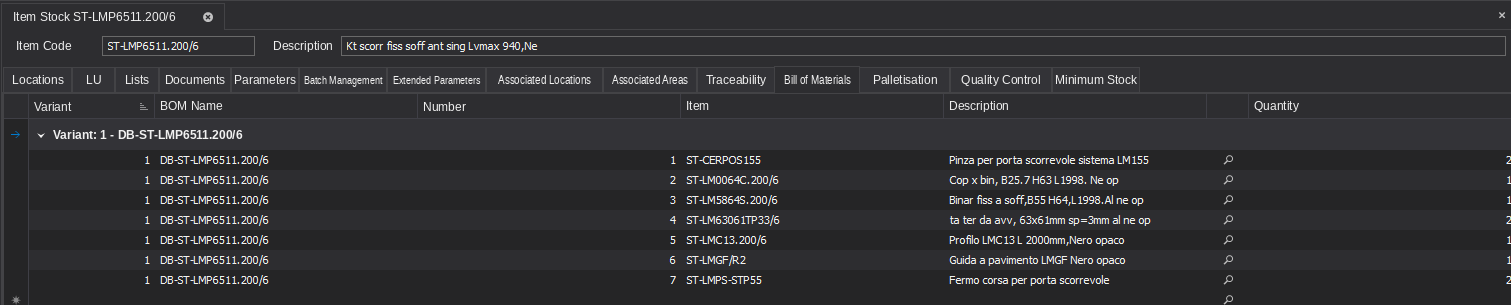
In any case, a BOM is usually represented as a tree: the finished product at the top, then subassemblies and semi-finished products and raw materials and purchased components at the bottom. Each link connects a parent to a direct child and states the quantity with its unit of measure, needed to make one unit of the parent (Cinelli et al., 2017). If the same item code appears in several branches, the total requirement is the sum of the quantities across all branches. Sometimes there are two units of measure: one for handling the material (e.g. sheet metal pieces picked) and one for controlling its cost (e.g. kilograms purchased).
“Technically, the bill of materials is simply the set of raw materials and semi-finished products that make up a finished product” explains Luca Bianchi. “Managing it, though, can become very tricky: if the tree goes very deep it becomes much harder to control”. When a finished product is declared, the components are issued in the management system, stock levels are updated and replenishment is triggered. With a production plan and the BOM you can calculate in advance how much material will be needed.
How to read a bill of materials? Multi-level example
Let’s look at a real example now. The sandwich loaf produced by Roberto Industria Alimentare (Morato Group) has a two-level BOM. “At the first level there’s the finished product” explains Luca “made of dough and packaging (wrapper, box, label, glue). At the second level there’s the dough, a semi-finished product that has its own BOM of raw materials: flour, yeast, oil and other ingredients”. Two levels may not sound like many but they are enough to complicate production, because every finished product order requires a dough order that has to be produced first.
| Level | Item | Type |
| 0 | Sandwich loaf | Finished product (FP) |
| 1 | Dough | Semi-finished product (SFP) |
| 1 | Wrapper, box, label, glue | Packaging and consumables |
| 2 | Flour, yeast, oil, … | Raw materials |
Level-by-level explosion: from finished product to purchased component
Exploding the BOM means moving down from the finished product to the purchased components, multiplying quantities level by level. With several products in the catalogue, it pays to look at all the BOMs together: a component that appears in every one is more critical than one used in a single product, because a shortage stops more production runs. And priorities change with the production plan: in the example by Cinelli et al, the component that is most critical per unit of product stops being so once planned volumes are applied.
“A component present in every BOM in a product portfolio is far more critical than one present in a single finished product” Cinelli et al. (2017)
What’s the difference between an engineering BOM and a manufacturing BOM?
The EBOM describes the product as designed, the MBOM as it is made. In the company analysed by Stolt, the structure originates in the PLM during development; it is then modified to reflect the parts and subassemblies actually produced, recreated in the ERP and enriched with planning and cost data. The transfer between systems happened partly through manual entry or exported files, which is exactly why it was hard to keep the information synchronised. The study proposes defining all BOMs together, starting from a master BOM: it takes more time at the design stage, but avoids pushing issues from the rest of the life cycle to later phases.
Why doesn’t actual consumption match the bill of materials?
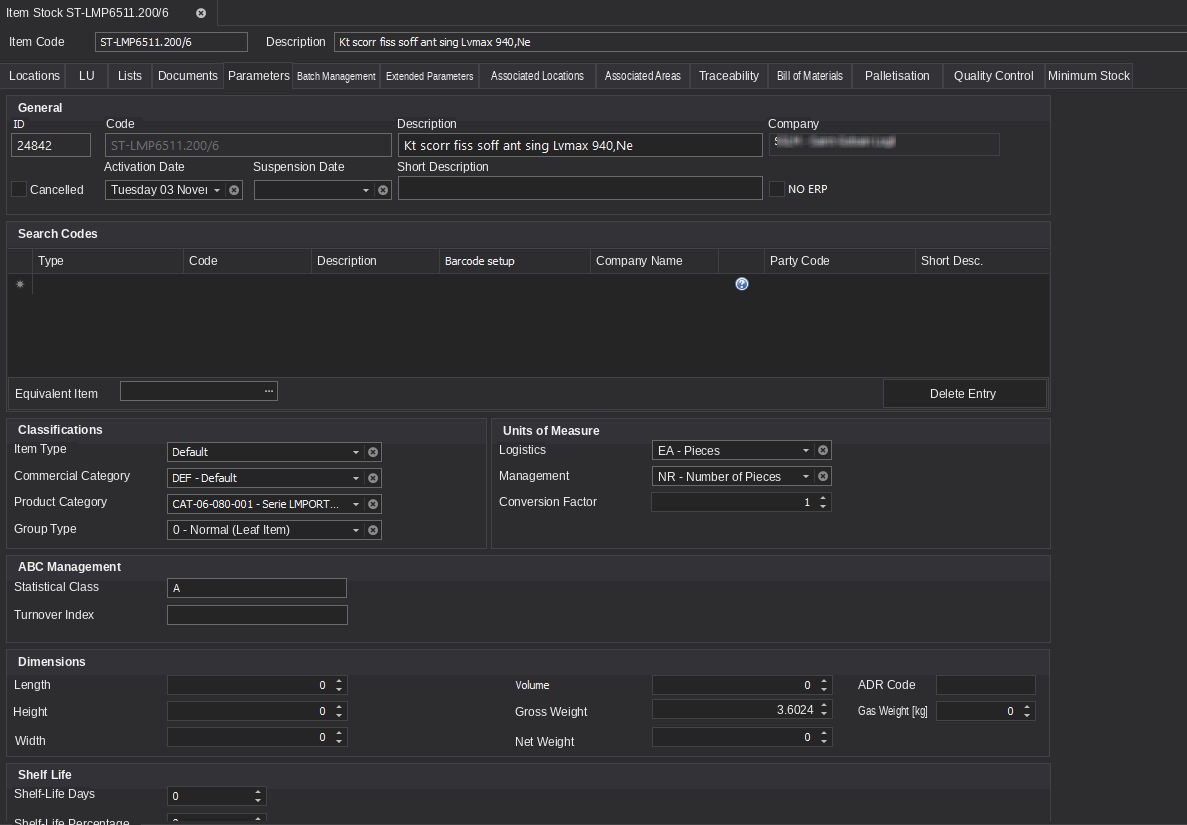 The causes vary by industry. In food, scrap is more likely because, for example, a product may be discarded because the processing temperature was too high or because it doesn’t meet quality standards. In discrete manufacturing, quantities are often exact, but not always: a picture frame maker starts from wooden mouldings measured in metres, and the offcut left after cutting becomes scrap.
“Some BOMs are precise and fixed: a bicycle for instance, always needs two wheels and that never changes” notes Luca Bianchi. “In some specific cases though, the usage coefficients of raw materials can vary. This happens in companies that have to customise the product by customer or order”. This is why in some plants the quantity of each component isn’t taken from the item master data but comes with the production order. That is the case at Roberto Industria Alimentare, where the coefficients are sent from the ERP together with the order, and the same item may require different dosages for different customers or markets.
The variance becomes visible when you compare three values: the cost estimated in the quote, the cost of the materials ordered and the actual cost calculated from production consumption, additional withdrawals from the warehouse and leftover materials returned to stock (Franco et al).
How is the bill of materials managed on the shop floor? The Roberto Industria Alimentare case
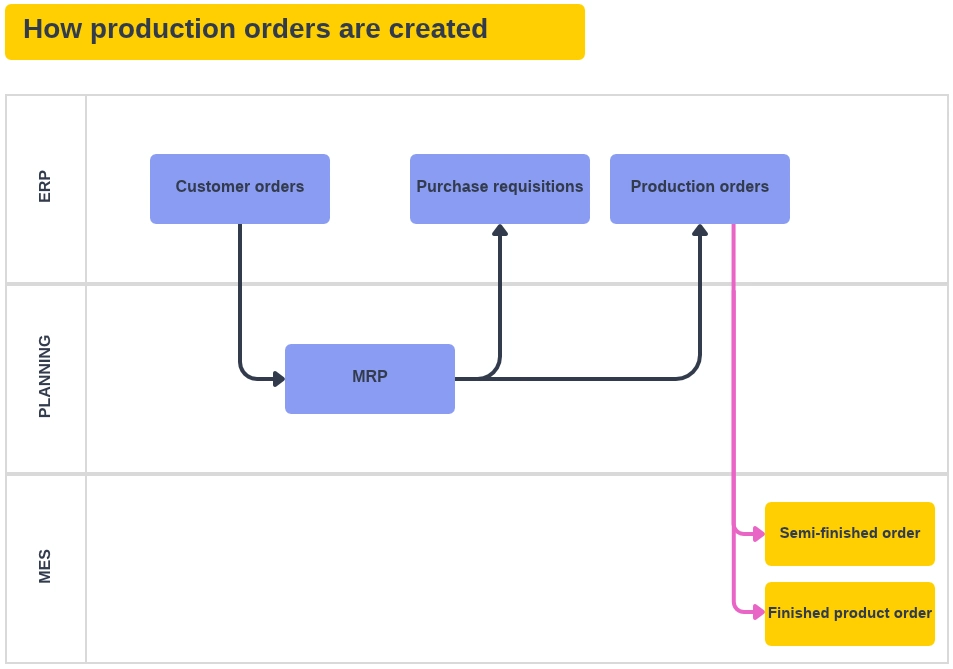 At Roberto Industria Alimentare, production orders are generated by an MRP/APS planning system, passed to the ERP and sent on to silwa, which manages the production MES and the warehouse WMS. Both finished product orders and dough orders arrive (and the system checks that no finished product order exists without its dough order). On handhelds, logistics staff see how to supply the lines: they pick components from the warehouse and take them lineside, to the feeding area of each line, prioritising those that expire first (FEFO logic). Expired materials are blocked to protect product quality. At their workstations, operators see the order with its usage coefficients.
Consumption is then recorded by backflushing. As our Software Developer explained, at the end of the line the operator declares the pallet produced and the system automatically issues the components from lineside stock according to the order’s coefficients. Previously the issue was inferred from machine run times. Backflushing keeps the ERP better aligned, because the ERP itself sends the coefficients. “It has advantages from a management standpoint” says Luca Bianchi, “but it also has a drawback, since it creates mismatches between book stock and physical consumption, which then have to be corrected”.
The correction is an inventory adjustment of lineside stock, carried out with production stopped: at the end of a run or at shift change, weekly or fortnightly. Never while production is running: subsequent declarations would issue the same material again. The timing of the declaration also matters. “The closer to real time production is declared, the more aligned the system is” Bianchi stresses. “If you declare 50 pallets after three hours, lineside stock hasn’t been issued yet”. An aligned system also helps logistics: when material runs short lineside, the handheld tells operators how much to replenish.

How does the bill of materials link to batch traceability?
In practice, each batch of finished product must be linked to the batches of the components it was made from. In heavily regulated industries this is essential, because if a batch of flour has a problem every product it went into has to be recalled. Not all components are batch-managed, however, and for those the link isn’t needed. Essentially, the BOM says which materials go into a product, while traceability has to say which batches. If different raw material batches are mixed in production, a problem with one of them means recalling every finished product that contains it: the more batches are dispersed, the wider the recall.
Reducing dispersion comes at a cost, though. In a simulation of chocolate production, not mixing raw material batches reduced the recall by 6 to 16% if a production batch was contaminated, but lowered production efficiency by 7 to 22% (Saltini and Akkerman, 2012). The authors also point out that traceability doesn’t reduce the likelihood of a problem: it limits the consequences.
Bill of materials in ERP, PLM, APS or MES: who manages what?
In many companies, development and production remain separate: the EBOM in the PLM, the MBOM in the ERP.
| System | Role in the BOM |
| PLM (Product Lifecycle Management) | The EBOM originates here during development. In a PLM-centric environment it is the single source of product data |
| ERP (Enterprise Resource Planning) | Manages the MBOM with planning and cost data; remains the reference for stock, purchasing and replenishment |
| APS (Advanced Planning & Scheduling) and MRP (Material Requirements Planning) | Explode BOMs against customer orders and stock to calculate requirements and production orders, and can reschedule them |
| MES (Manufacturing Execution System) | Receives the order with its BOM and coefficients and takes them to the shop floor; records consumption, locations and batches issued |
At Roberto Industria Alimentare the flow is as follows: the MRP planning system generates production orders from customer orders and releases them to the ERP. The ERP sends them to the MES software, along with every subsequent change (including new dates). The MES takes them to five lines from sandwich loaves to breadsticks, and collects shop floor data linking it to individual orders.
“The management system doesn’t care where the goods are” notes Luca Bianchi. “We do: we have to track where they’re located and which batches are issued.” In the Linergy case, another Stesi customer, the operator sees the item, BOM, quantities and component locations directly on the terminal during assembly. In the Cherubini case, another Stesi customer in the electronics sector, a hierarchy of load units has to be managed (“overpacks” i.e. load units made up of other load units), so scanning the parent load unit with the warehouse terminal was configured to load the BOM of the child overpacks into the WMS.

FAQ
What does BOM stand for?
It stands for bill of materials: the structured list of components and subassemblies that make up a product, across several levels and in different quantities.
What is a phantom BOM?
It is the BOM of a semi-finished product that isn’t stocked, but it’s produced and immediately consumed in the next phase. At Roberto Industria Alimentare the dough is handled this way: it appears as a phantom in the BOM and is issued at book level, but physically goes straight to the finished product line.
What’s the difference between a bill of materials and a kit?
Both list the components of an item, but for different purposes. A manufacturing BOM describes a transformation, where the components are consumed and a new item is created, with its own stock. A kit, on the other hand, groups items that stay unchanged and are sold, picked or shipped together under a single code (e.g. an oil and filter set for a service). A kit often has no stock of its own: its availability depends on that of its components. Kit BOMs are also managed in the warehouse: in Alce Nero’s consignment stock warehouse, for example, the WMS manages parent kits and their components, along with labelling and repackaging goods before shipment.
What is backflushing?
It is the automatic issue of components after the fact: when production is declared, the system issues the quantities set by the usage coefficients, without recording each individual withdrawal.
Who should update the bill of materials in a company?
It depends on the BOM: the EBOM originates in development, the MBOM is defined for production. The decisive choice is which system is the authoritative source of product data: in a PLM-centric environment, every change starts there and propagates to the other systems.
When is Excel no longer enough to manage the bill of materials?
When data is scattered across different files and nobody collects it in a standard way. In a study on make-to-order production by Franco et al. (2026), cost control relied on several non-standardised Excel files managed by project managers: monitoring and reporting on an order took an average of 20 hours, falling to 5 with a structured system.
What’s the difference between a bill of materials and a routing?
The BOM says what a product is made of; the routing says how it is made (operations, machines, times, …). They often live in different systems and a BOM, however complete, should always be integrated with the routing (Stolt, 2023).